In most instances, ‘ask’ is a verb, e.g. “Ask how long it will be before dinner is ready.” But in certain contexts, it is used as a noun, e.g. “Who’s going to make the ask at our fundraiser?”
How would your event (or appeal letter or face to face meeting) change if you thought of the ask as an invitation? Invitation in the original sense of the word: an offer to come or go somewhere.
An ask is transactional. An invitation is relational.
Where are you inviting your clients, donors and volunteers to go?
It’s no accident that infographics are all the rage these days. Our brains readily absorb info in tidy visual packages. It forces brevity and therefore helps us avoid Pitchfall #3 (“you talk too much”).
Below is great example of an infographic that blends interesting info (only 8% of venture-backed startups have women leaders…ugh) with a subtle pitch (getting an MBA can help close the gender gap).
Getting more women into tech has been an uphill battle. There are lots of different groups chipping away at it and progress is being made, but it’s tough to get a sense for how much progress. We need a shot of optimism that the gap is shrinking.
Obviously, education plays a huge role in bridging this gap. With this infographic, MBA Online, makes it easy to see how far we’ve come and, by being the creator of the graphic, plants the seed that getting an MBA could be a great move if you’re a woman interested in tech.
Sometimes, letting the words take a backseat to some visuals is a mighty fine way to make your pitch.
“The truth is that we don’t need everyone to like us, we need a few people to love us. Because what’s better than being roundly liked is being fully known—an impossibility both professionally and personally if you’re so busy being likable that you forget to be yourself.”
You can’t be all thing to all people. Better to have a smaller number of donors adore you than a whole bunch who only kinda sorta like you. Ish.
Sometimes a piece of writing is so powerful in its elegance that it stops you in your tracks.
In a recent Harvard Business Review post, Umair Haque, wrote one of those pieces. It is a powerful call to action for anyone working to make the world a better place. The piece is called, How to Fix Your Soul. I’d strongly encourage you to read it in its entirety, but wanted to share this:
“I don’t want a revolution. I want a million tiny revolutions. Awakenings to the heart-stopping commandment life gives to the living: to believe in life. Weary and directionless in the desert we may be — yet, the future, a sunlit ocean, never ceases singing. Sometimes, all we have to do is listen.”
Which he follows with this:
“Each and every one of us is a leader. Some of us just don’t know it yet.”
I recently spoke at a benefit concert for Kelly Wade–the world’s most talented acupuncturist. She’s having to take a break from her practice to duke it out with cancer.
Kelly is a doer. She has no patience for wallowing in self-pity. She is beyond annoyed that, as a society, we allow news of cancer to reduce us to living in fear.
If you live in fear, you can’t live life to its fullest. Kelly would very much like us all to knock off this living in fear business.
After we were all treated to a Brahms violin concerto by six incredible musicians from the Seattle Symphony, I gave the following remarks. I’m sharing them here in the hopes that you will join the Global Campaign to Bring It On.
_______________________
Thank you for that amazing gift of music. I played oboe from Grade 5 to Grade 12. I was okay, at best. Whenever I hear gifted musicians play such beautiful music, I am reminded of how mediocre I truly was. Thanks to each and every one of you for sharing your talent with us this evening.
I am Erica Mills, a former entirely mediocre oboe player and a current patient of Kelly’s. Kelly asked me to give a few remarks on her behalf to tie a bow on this incredible evening.
Kelly is like Bruce Lee–small in stature and big on power. She is a force to be reckoned with. Larger than life. So when she asked me to say a few words, I was humbled…and a little stumped in terms of what to say. It’s a tall order to channel your inner Kelly!
But then I realized that this was an opportunity to put into action an idea I’ve had for about twelve years.
Twelve years ago, my mum was diagnosed with Grade 4 follicular non-Hodgkin lymphoma. In non-medical terms, that’s “a bad blood cancer.”
My dad and I went to all of her chemo treatments with her. My job was to get trashy magazines. My dad’s was to get the lattes.
So we were sitting there reading about whether Brad and Jenn were going to split up (say it ain’t so!) and what Brittany Spears was wearing when my mum, out of the blue, looks up and says:
“You realize this isn’t my time, right?”
Me (with furrowed brow and a look of where is this going?) “Yep, pretty clear on that.”
Mum: “Among other reasons, it’s not my time because I don’t have any grandkids and I have every intention of having some.”
Me: Uh, okay.
Although married at the time, my husband and I weren’t quite ready for kids. So I started looking at other ways to focus my cancer-fighting energies and I decided it’d be a really good idea to launch a global campaign to Kick Cancer’s Ass. I was fairly serious about this. I really thought that was a great idea. Turns out, the idea didn’t take off in the way I’d thought it might and so it went into remission, as it were.
When I was thinking about what to say this evening, I thought, “Heck ya! It’s time to really launch this sucker!” I was psyched. The global scale was right for someone as awesome as Kelly. (Although galactic might be a little more on par with Kelly’s true influence and impact, but we’ll settle for global. Feels more actionable if we don’t include other planets at this point.)
Then I realized if we focused the campaign solely on cancer, we were missing the point. The point of beating cancer is to live life to its fullest, not just to kick its ass.
I also remembered the second law of thermodynamics.
I was first introduced to this law by my dad who, at the time, was a professor of thermodynamics. I was about 4 and was learning how to swing. My older sister was next to me going up, up, up. Meanwhile, I was going nowhere.
Seeing my frustration, my dad came over and said, “There is no free lunch, honey. Pump harder.”
At the time, I had no idea what he was talking about. Mainly I wondered if this meant we were going to get a second lunch that day.
As I grew up, my dad would say this to me periodically, “There is no free lunch”. What I didn’t realize until I was older was that he was paraphrasing the second law of thermodynamics: for every action there is an equal and opposite reaction.
As individuals and as a society, we apply this law to cancer in the following way:
Action: “I have cancer.”
Reaction: “That’s so sad.”
The depth of our sadness a mirror to the gravity of the cancer.
The flaw in our collective application of the second law of thermodynamics to cancer is that we have allowed ourselves to believe the full reaction stops with sadness or fear. It’s not that we won’t feel sad when we hear bad news about ourselves or others. But we can let that be a momentary reaction en route to the full reaction which is living life to its fullest.
We have an opportunity to make history here tonight. We have the opportunity to dismantle how we have historically applied this law and to hitherto apply it as follows:
Action: “I have cancer.”
Reaction: “Bring it on!”
Let me pause and say, I’m not advocating for all of us to actually say this when someone tells us they have cancer. That’d be weird and probably wouldn’t go over very well.
What I am advocating for is for all of us to fundamentally shift how we react to cancer and to any other piece of really bad, gnarly, yucky news. We have the choice to say: “Bring it on!”
And by ‘it’, I don’t mean cancer. I mean bring on living life to its fullest. Every day. In every way possible.
So, here, tonight, right now, I’d like to launch the Global Campaign to Bring It On!
Bring it on. Whatever ‘it’ looks like for you.
Unbeknownst to them, the Wade Family is the campaign’s first poster family. (For anyone who knows them, this is ironic, given how private they are, but they haven’t left yet so we’re going with it!)
Once Kelly is done kicking cancer’s ass, she and Bob can decide who the next poster family or person should be. But, for now, in this initial stage of the Global Campaign to Bring It On, our job is to support them in any way we can.
There are many unknowns in Kelly’s battle with cancer, but we do know a few things.
One, they will need food. Lots of it and hopefully really, really tasty.
Two, getting the amazing Wade kids to all their activities is no small undertaking. Some help getting them to and from so they can unleash their awesomeness will be a big help.
Third, we know that cancer isn’t cheap. Since Kelly and Bob are going into somewhat uncharted territory with her treatment, it’s unclear how much all this cancer fighting will cost. But it’s a safe bet that it’ll probably be expensive.
Two of Kelly’s friends, Alys and Karin, are responsible for organizing tonight’s event. They have also set up a way for us to make a donation. To the extent you are able to contribute, we invite you to do so. (Details will be emailed in a few days, so watch for those.)
Some of you might be wondering what happened with my mum and her bout with cancer. I talked to her earlier today. She is busy preparing for Thanksgiving, which she will spend with her four grandkids.
My mum is a statistical anomaly She shouldn’t be here. But she is. Because, since she’d lived with my dad for so many years, she knew that the appropriate application of the second law of thermodynamics was–Bring It On! And that’s exactly what she did. She brought it on and kicked cancer’s ass. Kelly’s going to do the same.
We all know that cancer is a powerful force. There’s no getting around it. But we know a force that is far more powerful than cancer. A force that no evil, no matter how big, can contend with. That force is humanity. As individuals, as a community and as a society, we have the opportunity to unleash the full force and goodness of humanity and channel it toward the Kelly and the whole Wade family.
Would you all please stand up and put both your hands in the air? Now make a fist. As you make a fist, I want you to visualize the enemy: cancer, living in fear, not living life to the fullest. (I personally visualize the enemy as a mashup of Donald Trump and Dr. Evil, but that’s just me.) Now open your fists and release. Release all the anger you have. The anger about cancer rudely attacking Kelly’s appendix. Release it. Because anger isn’t going to get us anywhere. Anger keeps us living in fear. If we’re going to take this campaign global, we can’t be living in fear. We’ve got to bring it on!
Now that we’ve released all that yucky fear, let’s close things out right. On the count of three, let’s say together–so loud we rattle the windows:
KELLY, WE LOVE YOU! BRING IT ON!
Thank you for being here tonight. Thank you for supporting Kelly and the Wade family. And thank you for being part of the Global Campaign to Bring It On.
UPDATE: This little gem was so popular I turned it into a mini-book! Get your copy today.
The word ‘pitch’ has such a bad rap. It’s sad, really. Because a pitch is your ticket to conversations that lead to more people engaged with you and your awesome work.
There’s a lot of similarity between people’s pitch glitches. They can, in fact, be categorized. I shared three reasons why bad pitches happen to good people a few weeks back. What I didn’t tell you was what to do about all this bad pitching.
In Pitchfalls: why bad pitches happen to good people (a FREE sneak peak), I share the top five reasons that people stumble when delivering a pitch. I explain why it happens and, most importantly, how to fix it.
I wrote the eBook knowing it would be read by busy people–people like you who want to making the world a better place, have a great pitch to help you do it, but can’t quite find the time to make it happen. You can dramatically improve your pitch in less than 10 minutes. So can your staff and board. Really, you can.
For those of you who can’t wait to know what the top five Pitchfalls are, here you go.
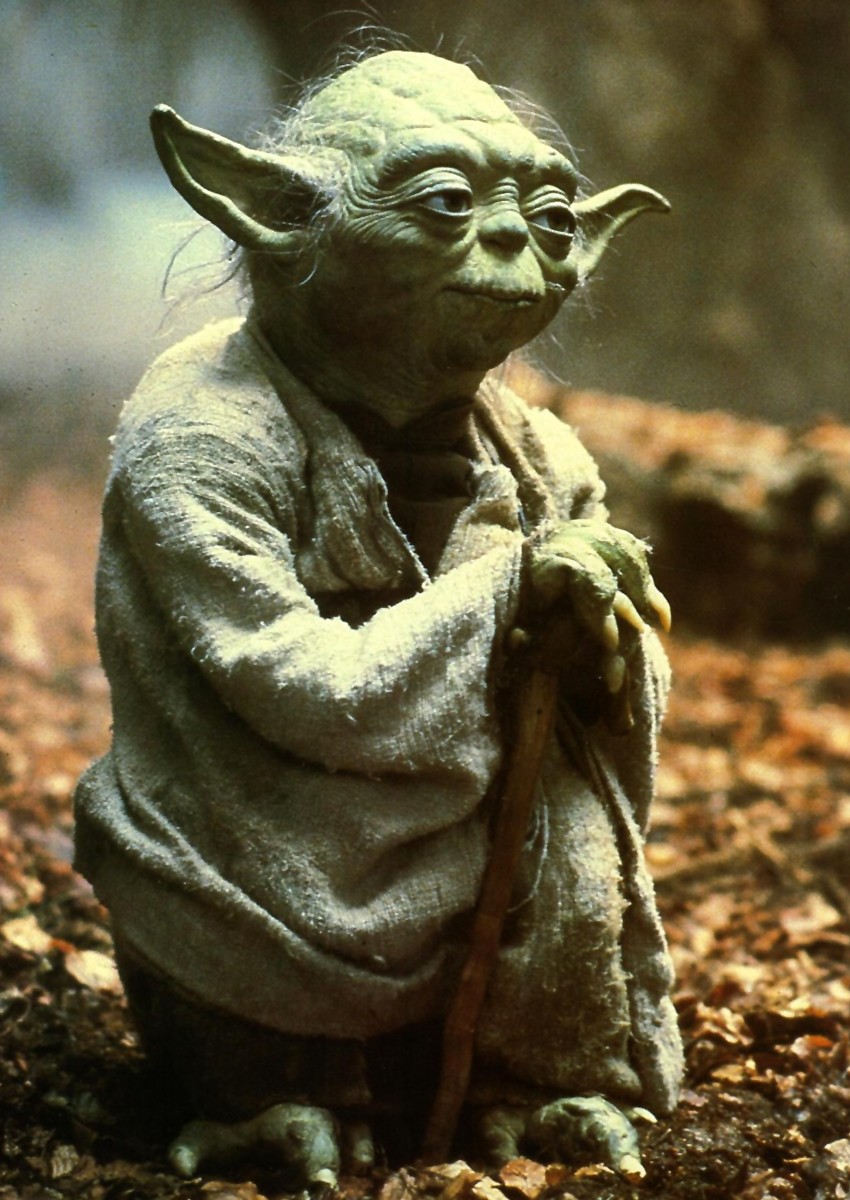
As 2012 winds down and we start thinking about 2013, here’s something to ponder: For your dreams to become reality, you need to channel your inner Yoda.
Nancy Duarte makes this point as it relates to presentations. In her TEDx talk, she points out how easy it is to think you’re the hero when you’re standing on stage delivering a presentation. The really good presenters, the ones that have the audience wrapped around their proverbial finger, take their audience on a journey in which they, the audience members, are like Luke Skywalker (or Princess Leah)–on an adventure, kicking butt, taking names and generally being and feeling awesome.
When you give people the opportunity to be awesome, they get on your side.
You have the opportunity to let people be heroes all the time: in your website copy, in your annual appeals, in your annual reports, in your newsletters, at meetings, in speeches, and every time you pitch someone on your idea.
We could add this as a fourth reason to the three already offered as to why bad pitches happen to good people: you act like Luke Skywalker instead of Yoda.
Yoda may not have youth, big biceps and good hair on his side, but he’s who you want to be like if you want your ideas to take hold, your donors to give, your clients to buy, or your kids to listen.
Let them be the hero. Show them the path and get out of their way.
Be like Dorothy: command your words (or your Winkies) to make the world a better place!
Most of us could be more effective if we paid more attention to the words we use and how we use them.
I’m not talking about big speeches here. I’m talking about day-to-day word choice. I’m talking about what you say when you open a meeting and close an email. I’m talking about which words you use in the executive summary to a new report or the intro to your annual report. I’m talking about talking to donors, customers and anyone else you come into contact with in a given day.
The average adult uses around 15,000 words per day. That means that, on any given day, you have 15,000 chances to make the world—your world, our world—a better place.
You’re a word expert–own it
Whenever someone says, “I’m not good with words,” I cringe. What they’re really saying is, “I never learned what a gerund was in English class and am therefore not ‘good with words’.”
Hogwash.
Being good with words isn’t about syntax and grammar. It’s about finding words that give voice to your vision.
In his book, Outliers, Malcolm Gladwell established the 10,000 Hour Rule—basically, that you can become expert in anything after 10,000 hours of deliberate practice.
This infographic shows how long it would take, in years, to become an expert if you did deliberate practice for a certain number of hours per day. The average is 9.6 years, assuming you practice 20 hours per week.
Here’s how this relates to you being a word expert: Let’s be generous and say you started talking, really talking (meaning stringing together cohesive sentences) when you went into Kindergarten. Even if you zoned out for big chunks of time in school, you were still probably eking out 2 hours of “deliberate practice” per day, five days a week.
That means that, on average, it took you 20 years to become a word expert. Roughly by your mid-20s when, coincidentally, your frontal lobes—the part of your brain in charge of concepts and abstract thinking—becomes fully developed.
In sum: by around the age of 25 you had practiced enough and had the brain development to be a full-fledged word expert.
If you are over the age of 25, the “I’m not good with words” excuse simply doesn’t hold up. So best to stop using it, accept your status as a word expert and start using that expertise to your advantage.
Words are like Winkies
In the Wizard of Oz, the Wicked Witch of the West calls on her Winkies to destroy Dorothy and her crew. Winkies are not brave; they are dutiful. They have to do whatever their master says.
When the Winkies’ master was the evil Wicked Witch of the West, they did bad stuff (usually related to killing things). After Dorothy successfully kills the Witch (by accidentally dumping water on her, oops), they do good things because Dorothy is nothing if not nice.
Words are like Winkies—they will do what you ask them to do. They are dutiful. They will serve you well if you use them well. The can help you be a more effective leader and make the world a better place.
1,000 chances to make the world a better place
A key piece to being an expert at something is the intentionality you bring to it, whatever ‘it’ is you are out to master. If your ‘it’ is more effectively using words to give voice to your vision, this means deciding how many of the 15,000ish words you use in a day you are going to use intentionally.
Can you be intentional with 1,000 of your words today?(As a point of reference, this post is about 700.)
This could be in a meeting with staff, or lunch with a donor, or in an email you write to a colleague at a partner organization. Heck, it might be a chat with your accountant or teenager.
Remember: Those words are like 1,000 Winkies waiting for you to give them orders. They are your 1,000 chances to make the world a better place today.
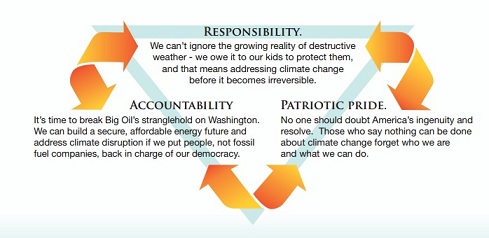
Having culled through a bunch of new research, they have found that the good ol’ America values of responsibility, accountability and patriotic pride are a winning combination for those trying to advance a pro-environment platform.
It’s voting season, so people are thinking a bit more than usual about what they believe. But, just like a little black dress, American values are always in vogue.
Look at the diagram below. If you insert your cause, e.g. education, hunger, economy, does this narrative work? If not, is there another value that strengthens the narrative as it relates to your cause?
(Thanks to SightLine and their awesome Flashcards for getting this report on our radar!)
 In most instances, ‘ask’ is a verb, e.g. “Ask how long it will be before dinner is ready.” But in certain contexts, it is used as a noun, e.g. “Who’s going to make the ask at our fundraiser?”

 Sometimes a piece of writing is so powerful in its elegance that it stops you in your tracks.