There’s nothing worse than getting a wimpy marketing email. You know the ones. You start reading, fail to identify the point and—poof!—it’s gone with one click of the delete button. Bad, boring emails are an epidemic these days.
Missing from most of these bad emails is a clear, compelling call-to-action (CTA). You know, that part where you give the reader easy ways for them to engage. Calls to action should be directive. After all, we’re talking about a “call to action”, not a “request for action”. The goal is to make it so compelling and abundantly obvious what you want them to do that, of course, they want to do it.
Mushy and obsequious are not invited to your CTA party. They don’t inspire action. Yes, it can feel funky to ask someone to do something for you. Think of it this way: people who take the time to read your stuff through to the CTA like what you’re doing. They want to help. Make it easy for them to do it.
So you’ll tell your stories to your supporters to set the stage, then simply tell them what you’d like them to do. Be clear and be bold! In your emails, on your website and in your conversations.
Here are few resources to help you create a kick-ass CTA:
The brain is a mysterious organ. Case in point: someone’s brain decided that huge hair bows and rubber neon bracelets would be in style… and that is how the 80s happened. But I digress.
A complicated mix of factors (both internal and external) lead us to make the decisions we make. Sometimes those decisions, when viewed on the surface, make sense. Sometimes they are counterintuitive. Sometimes they are downright mysterious.
And frequently, they are really challenging. Especially when it comes to inspiring people to do something like, say, donate money or time.
Case in point: Donor decisions about supporting good causes – which organizations to support, how and to what degree. You can do all of the right things to communicate your mission to the people who matter: tell a good story and talk about the scope of your impact. And all you get in return is crickets.
Brain science to the rescue! Brain science explains how idiosyncratic the human mind can be. In creating a call-to-action for donors, focusing on the needs of a single, prototypical individual actually generates more engagement than focusing on the needs of a group. You’d think the bigger the need, the bigger the gift. But on the contrary, bigger can be bad. It immobilizes us. There’s simply something more inspiring—and motivating—about the opportunity to impact the life of a single individual…something about the number one.
Christopher Hsee, a psychological scientist at the University of Chicago, is studying this phenomenon, which he calls “scope insensitivity”. Hsee’s research highlights the effectiveness of using impact stories as tools for demonstrating results, and developing appeals based on the experiences of individual service recipients.
Brain science would tell us to keep it simple: connect one potential donor with the opportunity to help one person.
If you’re looking for examples of doing this well, check out See Your Impact. Awesome examples of the power of one!
For any organization, the extent to which its story is effective can be gauged by how often it is told. That means you won’t always be the one doing the telling. If you were the only one telling your organizational story, you’d be completely exhausted! You want a story that is so memorable and repeatable that people adopt it as their own.
Donors, board members, employees and volunteers each have their own reasons why they care about the work of your organization. When they tell their individual stories (also known as their WHYs) as part of the larger organizational story, it’s kind of like Red Bull but without that jittery feeling—the stories take flight.
Chris Davenport recently published a little gem of a book that is quickly becoming the wind beneath the wings of many a nonprofit story (forgive me, couldn’t resist the Bette Midler reference, what with this year’s musical-filled Oscars still on my mind…). This pocket-size guide, called Nonprofit Storytelling for Board Members, is, as the title implies, definitely great for board members. But don’t let the title lead your astray: the tips it offers are great for all of your people. It teaches:
•three types of stories they need to tell
•the four building blocks of a powerful story
•seven story triggers to keep their listener captivated by the story
•three phrases to engage anybody
•how to structure a story for maximum effectiveness
•how to find great stories
•what types of details to include in their stories
Awesome, right? Get out there and help your stakeholders turn the altruistic goodness in their heads and hearts into messages that inspire others!
You are emotionally involved in your mission. It’s a big part of why you do what you do, right? And as much as that personal connection to mission is a motivating force, it can also work to your disadvantage. Because the people on the receiving end of your communications? They aren’t as invested in your mission. They don’t live it and breathe it every day. It’s your job to get them there. Caring begins with feeling. Your job, therefore, is to make them FEEL
Consider storytelling an arrow in your quiver, suited for the specific purpose of creating an emotional connection with the people that are important to your mission. And the protagonist is the arrowhead, helping you land that message right in the heart of your donors, board member and volunteers. (Hey. It’s just a metaphorical arrow, so no killing is involved.)
Frequently folks embark on an effort to tell a story and what they end up with falls short – sometimes they go overboard with the data or tell the story from end-to-beginning….talk about a spoiler. Over on her Nonprofit Marketing Blog, Katya breaks down the key elements of winning stories: character, desire and conflict. A great first step is to thoroughly develop your protagonist (kind of like a hero, but with a good dose of ordinariness too). Copyblogger has a great piece about effective protagonist development. And if you want to have a little fun with character development, check out what Pemco has done with its “We’re a Lot Like You” series. For those of us living here in the Northwest, it’s nearly impossible to leave that site without a self-identified persona.
I’m a “word nerd”, a term coined by Lindsay Bealko (a fellow word nerd).
Being a word nerd means you value and practice word nerdery (a term I totally just made up).
It’s true that word nerdery is part art, part science. Some will say it’s a talent and, therefore, can’t be learned. This chaps my hide. So not true. I absolutely take umbrage with this. It’s a cop out.
I believe–and this is based on observing a whole bunch of rabble rousing, do gooder types over the years tap into their inner word nerds right before my very eyes–it’s a skill that can be learned. Like knitting or parkours, you have to want to learn it.
This is good news for those us on a mission to change the world. Words can have a HUGE impact on the extent to which you are able to attract, engage, and retain support for your cause. Important, right?
“Our research focuses on two basic language capacities: the “mental lexicon” (mental dictionary) of memorized words, and “mental grammar” , which underlies the rule-governed sequential and hierarchical combination of lexicon forms into complex words (e.g. walk + ed), phrases and sentences (e.g. Clemential excoriated the pachyderm).”
Whoa, whoa, whoa, what does thatmean and what does it have to do with making the world a better place?
Translation: knowing a bunch of words (having a big mental dictionary) doesn’t a word nerd make. It’s our ability to take those words and package them up effectively (i.e. artfully apply mental grammar) that leads to world-changing word nerd awesomeness.
Don’t believe me? Watch this. Then try to tell me with a straight face (and not on April Fool’s Day ) that you don’t want to be able to have that effect with your words.
Let me tell you a story: there once was a hare who bragged about his speed. A tortoise grew tired of the boasting and challenged the hare to a race. Oh, you’ve heard that story before? Maybe you could recite it from memory. That’s the magic of storytelling.
Since before folks were rubbing sticks together and hoping for a little spark, stories have been used to pass on lessons and values… the important stuff. And to think it was done without the benefit of the interwebs.
You have a story to tell and people who want to hear it. You have characters, plots and perspective. You might even have some data to help you make your point.
Wondering how to get started? Pamela Grow has some great ideas for fundraisers and her tips can help you find your stories regardless of your role. Katya Andresen, Alia McKee, and Mark Rovner offer some great storytelling tips in Lisa Simpson for Nonprofits and, as an added bonus, they talk specifically about how to sprinkle data into your stories—a common conundrum.
Don’t let all the storytelling hype psych you out. Go slow and steady, just like the tortoise and you’ll get there in due time.
Telling a good story can feel daunting enough. Throw in data and it sounds like an epic challenge—there’s so much data and it’s SO BORING. But using data to tell your story doesn’t have to mean presentations with lots of charts and graphs, or complex narratives that detail the 47 reasons why you do what you do. (Zzzzz…oh sorry, fell asleep there for a minute.) In fact, telling your story with data can –and should—be quite simple. Your audience doesn’t want to look at those pivot tables any more than you do. Your job is to deliver the few pieces of data that best help you tell the story of how you’re having a great, big impact (or being impactful, whichever floats your boat).
One organization that does a great job of this is Splash, which set up a website called “Proving it” telling their impact story with data. Front and center, they present a map showing projects and the number of children with safe drinking water. Boom! Impact story told. This is why Splash’s CEO, Eric Stowe, will be on a panel about ‘Data, transparency and impact’ with Beth Kanter, Jane Meseck and Paul Shoemaker (moderated by yours truly) on February 11. Because they’re the bomb when it comes to this impact story-telling stuff.
You might not be in a position to invest in development of an impact-showing webpage that’s as splashy as Splash’s, but you already have some stories that you tell about people whose lives have been changed by your work (on your website, at your events, in brochures, etc). And there’s data you’re already collecting (in your 990s, Google analytics, evaluations, etc). Connecting the two can put you on the path to becoming a telling-your-story-with-data rockstar.
Check out these other examples of organizations that use a few simple pieces of data to tell a compelling story:
“Impactful” is officially a word. Yep, it’s jumped from the Urban Dictionary to Oxford Dictionary. What the heck happened here? And who’s to blame? It couldn’t be us, could it?
We live in a culture that is obsessed with accountability. Partly influenced by the availability of data online (and maybe some disappointing politicians…sigh), people hold other people and organizations responsible for doing the things they say they will do.
As mission-driven organizations, you compete every day for the time and money you will use to change the world. So telling your story isn’t just about showing outcomes, it’s about demonstrating impact—it’s about holding ourselves accountable at scale.
You may find it difficult to tell a compelling impact story that will pull at both the headstrings and the heartstrings. It’s a delicate balance: part storytelling, part data-geek. But if you want to show just how impactful your work is, strike that balance, you will.
To see someone who has mastered that balance, check out Hans Rosling’s TED Talk. That guy makes data sing. And while few of us will be on stage sharing “ideas worth spreading” in the near future, we should all be thinking about how we can use data to show the impact we’re having…and the futures we’ll building because of it.
I’ll skip the part where I ask if public speaking scares the bejeezus out of you. If you’re like most of the rest of the people on the planet, the answer is yes.
Let me save you a whole bunch of time and share with you the secret to great public speaking: Make it easy and fun for the audience to learn what they came to learn.
There. That’s it. The big secret’s out.
For all the hoopla around public speaking, it’s pretty straight-forward. We just tend to let our crazy brains make it scarier and more complicated than it needs to be. I mean, honestly, have you ever seen someone actually boo’d off the stage? Or pummeled by a tomato-throwing mob? Right. So take a deep breath and release all that worst case scenario business. Great public speaking is a must for anyone on a mission to make the world a better place.
These 3 Commandments summarize what countless articles, books, podcasts and webinars will tell you about great public speaking. #3 is particularly important for those on a mission, so pay special attention to it. #1 and #2 are universally true.
Know thy stuff: Speak about what you know about. If you don’t know about it, don’t speak about it. Think of the best talks you’ve ever heard. Why were they so good? Probably, at least in part, because that person knew every in and out of their subject matter. They knew it so well they could tailor to what you, as the listener, wanted to learn. (They probably also practiced. If Bill Gates does it, so must you.)
Know thy audience: If you’re following these commandments, you know your stuff. Now learn what your stuff has to do with the people to whom you will be speaking. What do they hope to learn from you? Do they want to be inspired or do they want to be able to go back to their office and immediately kick butt? These may sound like radically different talks, but usually it’s a matter of tweaking at the margins and staying focused on what your audience wants to learn…rather than being pulled off track by what you might want to say. (If this last sentence was confusing, read this.)
Let thy passion shine through: This is where so many speakers go astray–especially those who are motivated by mission! Your passion is a huge advantage. It gets people’s “mirror neurons” firing and that means people in the audience are feeling what you’re feeling. If you’re oozing passion, they’ll be cheering you on. If you’re oozing boredom and/or trepidation, they’ll feel, well, bummed out. You get so worried about people throwing tomatoes at you (not gonna happen, right?) that you read from a script. Word for word. If the only thing you make eye contact with during your talk is a piece of paper, you’ve missed the boat.Make eye contact with your audience. If you follow Commandments #1 and #2, you will know your stuff and know your audience. You can then give the gift of letting others see your passion for your topic at full force. (Hint: If it gives you confidence to have your entire script in front of you, go for it. But go through and make your key points in 36+ point font size and highlight them. If you get lost, you say, “I get so excited about this stuff that sometimes I get carried away. Let me see, where was I? Oh yes, here we are…” No one will fault you for getting carried away, so long as you bring it back to what they’re there to learn.)
The fuss about Lance Armstrong’s “admissions” of guilt has started to die down, partly because the sports world has moved on to something more important: imaginary Twitter girlfriends (ooh, fun!). No doubt some sports PR folks are getting a workout.
When sports figures or other celebrities hit a rough patch (a colossal understatement when it comes to Armstrong, but let’s just call it that), and their names are associated with mission-driven organizations, there’s high potential for collateral damage—duck and cover everyone! Lance was clearly a master compartmentalizer. But the American public? Not so much.
I became a Lance fan when I saw him ride from Dax to Hautecamp in the summer of 2000. This was one of the days when he kicked biking butt. Turns out he was able to do so thanks to his friend, EPO. At the time, my mum was bald as a bat, battling her own cancer. I needed to see what cancer looked like when you survived. This is personal for me, as it is for many. (My mum is fine now, by the way, having unleashed a can of cancer whoop ass of her own.)
So, deep breath, if we put our outrage and disappointment aside we can learn some lessons from how the Livestrong Foundation (who changed their name from the Lance Armstrong Foundation years ago—good call folks!) has managed the potential reputation tsunami brought on by one Mr. Armstrong. Here’s what they did right:
Get in front of the story
Lance “stepped down” from the board of the foundation in November. It was obvious his jig was up and the risk to the Foundation was imminent. The decision was announced prior to Lance’s public confession (which was really just a formality, don’t ya think?).
When you want to hide, respond and acknowledge
The foundation immediately came out with a statement expressing disappointment in Lance. “See! They think he did something wrong! Just like me!” This creates some space between the organization and the offending celebrity. It establishes a sense of separateness in the eyes of the public, even though their brands have always been closely intertwined.
Focus on your mission
The Livestrong Foundation website is all about the mission to kick cancer’s ass. Aside from some changes to the leadership pages, we’ve seen little sign of the media storm on their website. This sets the expectation that the organization is 100% committed to doing what they’ve been doing. Every quote hitting the media and interwebs from Livestrong since the news broke ends with a continued commitment to their mission.
There’s little question that the Livestrong Foundation will be in a better place to “fight to improve the lives of people affected by cancer” as the scandal dies down. The doping storm has been brewing for years and the foundation had plenty of opportunity to be prepared. For those of you with public figures representing your brand, here are a few resources that might help, should your Prince Armstrong, er, Charming turn into Snidely Whiplash.
 There’s nothing worse than getting a wimpy marketing email. You know the ones. You start reading, fail to identify the point and—poof!—it’s gone with one click of the delete button. Bad, boring emails are an epidemic these days.
 The brain is a mysterious organ. Case in point: someone’s brain decided that huge hair bows and rubber neon bracelets would be in style… and that is how the 80s happened. But I digress.
 For any organization, the extent to which
  You are emotionally involved in your mission. It’s a big part of why you do what you do, right? And as much as that personal connection to mission is a motivating force, it can also work to your disadvantage. Because the people on the receiving end of your communications? They aren’t as invested in your mission. They don’t live it and breathe it every day. It’s your job to get them there. Caring begins with feeling. Your job, therefore, is to
  Let me tell you a story: there once was a hare who bragged about his speed. A tortoise grew tired of the boasting and challenged the hare to a race. Oh, you’ve heard that story before? Maybe you could recite it from memory. That’s the magic of storytelling.
 “Impactful” is officially a word. Yep, it’s jumped from the
 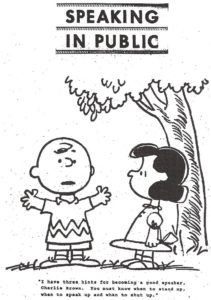 I’ll skip the part where I ask if public speaking scares the bejeezus out of you. If you’re like most of the rest of the people on the planet, the answer is yes.