Blog

Dreaming of words

A few weeks ago, I wrote about dreaming in action, about how ‘dream’ is both a noun and a verb. I encouraged us all to live our dreams every day. It was lofty, existential stuff.

This week, I’ve been dreaming about words. That’s right. Words. More precisely, I’ve dreaming about a day when the English language would catch up with the awesomeness that is the work being done every day to make the world a better place.

As readers of this blog know, I’ve long dreamed of a day when we in the non-profit world would define ourselves by what we are versus what we are not. That dream turned into an experiment in crowdsourcing an alternative to the word ‘non-profit. (Non-profit meaning non-progress, after all. Ew!)

But I’m also dreaming about other words. We talk about mission and cause and impact and inspiration and that’s all important. The problem is they’ve all been used so much that they’re losing their meaning. They might, gulp, end up on Big Duck’s Words to Avoid List!

It’s not that they’re bad words. It’s that they’ve become blah. Sort of like ‘innovative technology solution’. (What is that anyway?! As opposed to, what, an un-innovative technology solution?) I’m dreaming of infusing those words with vim and vigor so they get your blood pumping and your heart racing. They need to be resuscitated or replaced.

Am I whining? Yeah, a little bit. I admit it. (And as I say to my kids, “I don’t speak whine.”)

So instead of whining, I’ll redirect my energy toward something more positive and productive–scouring the globe for words that do justice to the work of  all the hard-working people who are making the world a better place.

So tell us: what words do your work justice?


State of the Union 2012: Top 10 Words

(Click on image above or go here for larger view.)

A lot goes into a speech. Vocal intonation. Gestures. Dramatic pauses.

And then there’s the words.

It is not by happenstance that certain words are used more than others in a speech…especially not when it’s a Presidential address. So I thought it’d be interesting to put President Obama’s 2012 State of the Union address into a Wordle to see what themes emerged.

Wordle takes a set of words and creates a “word cloud” that shows the relative importance of each word based on how often it is used.

The top 10 most used words from President Obama’s speech were:

  1. American
  2. America
  3. Americans
  4. Jobs
  5. New
  6. Energy
  7. One
  8. Every
  9. Tax
  10. Right

Interesting collection. The top five are no surprise. The relative position of #6 and #9 would seem to  indicate that the speech had a longer-term focus vs. getting caught up in the week’s hot topics.

For mission-driven readers, #7 and #8 stand out as they spotlight a common conundrum–how do you speak to a whole while recognizing the importance of its parts?  See, even the President has to use some messaging Aikido, on occasion!

What does list say to you?

Let’s name this thing

I’ve gotten loads of comments, questions, thought bubbles, etc. in response to my crusade to rename the non-profit sector the iSector.

Here’s what people said:

  • Yes, we want to do away with referring to ourselves in the negative, particularly after learning that ‘non-profit’ means ‘non-progress’. (Ugh.)
  • Yes, we agree with the key attributes, distinguishing characteristics and unique differentiators as captured in the Five Is. Some could do without intrepid, but overall, we’re good.
  • Yes, we’re ready to find something new.
  • No, I can’t see myself saying/writing iSector.

Even though I’m the iSector instigator, I concur with this last point. It feels a bit trendy, a tidge flashy, a little too Apple-esque.

So let’s name this thing together!

Below is a list of options that have been floated as alternatives to ‘non-profit’.

  • For Cause (shout out to @Susan_Chavez on this one)
  • For Mission
  • Charitable Sector
  • Community Benefit Sector (shout out to @HildyGottlieb on this one)
  • Voluntary Sector
  • Third Sector (brought to us by our friends in the U.K.)
  • Unsectored
  • Progress Sector (I’m personally kinda liking this one right now…)
  • Social Good Sector
  • Social Benefit Sector
  • Social Impact Sector

Which do you like and why? Other suggestions?


Brand is Lame

I’ve been thrilled to hear more and more mission-driven organizations talk about their brand. It’s downright happy-making.

In this day and age, understanding your organization’s brand is imperative if you want to stand out while staying grounded. When the three elements of brand (visual, narrative and experiential) come together in a compelling and consistent manner, you create an engagement-rich environment.

Here’s what doesn’t thrill me. When someone uses the word ‘brand’ instead of  ‘organization’. To illustrate:

“Donors just love our brand!”

Really? Have you heard a donor say: “I support Organization Awesome because I just love their elevator pitch.” Or perhaps, “Organization Awesome is my #1 partner-in-good. I mean, look at their logo!” Might how you talk about your organization (narrative aspect of your brand) and your logo (one piece of the visual aspect of your brand) resonate with a donor? You bet. But it’s that you are effectively speaking to what they care about through these things that makes their hearts go pitter pat.

What donors–and anyone else engaged with your organization–love is your cause and your mission. They care about what you do and how you do it (your mission) and why you do it (your cause). (Here’s more on the difference between cause and mission, if that last sentence made you furrow your brow.)

The word ‘brand’ is trendy. That’s fine. It risks ending up on the Banished Words list, but it’s fine.

What’s not fine is if you let its current celebrity status distract you from the whole point of having a clearly articulated brand–so people can connect with your cause and engage in our mission!

In Sum: Brand for brand’s sake is lame. Brand for the purpose of connecting with supporters who are passionate about your cause and lit up about your  mission is awesome.

[DIY Moment: If you’d like some help figuring out your brand, here’s a free resource.]


Cause & Mission: Big Diff

You often see ’cause’ and ‘mission’ used interchangeably. Not sure why. They’re quite different.

Here’s what I mean:

Cause=Why

Mission=What/Who/How

Causes can be broad (example: improving public education) or specific (example: music education in elementary schools in East Vancouver). Importantly, multiple organizations share a cause. This makes sense. We’re tackling big problems and it’s going to take lots of people-power to make progress on them. One organization isn’t going to single-handedly improve public education, right?

Mission is about your WHAT/WHO/HOW. This should speak to how you are advancing your cause, whether you’re an individual or an organization.

WHAT do you do?

WHO are you helping?

HOW are you doing it?

Each of these questions need a specific answer that, as a whole, is unique to your organization. And I mean ‘unique’ in the true sense of the word: something of which there is only one.

Share your cause. Own your mission.

Does this make sense? Do you know the difference between your cause and your mission?


Dream: verb and noun

When you have a dream while sleeping, that happens in spite of you. You’re asleep, after all.

When you have a dream while awake, it happens because of you. Your dreams reflect who you are and what you stand for. It is both verb and noun. “I dream of a better world and I’m making that dream come true.”

Martin Luther King, Jr. epitomized dreaming in action. His “I Have a Dream” speech is as resonant today as it was on August 28, 1963.

Below shows another dream in action. It’s the dream of Severn Suzuki as described in an address she gave to the United Nations. She is 13 years old.

What’s your dream? Are you working every day to make it come true?

[youtube]http://www.youtube.com/watch?v=TQmz6Rbpnu0&feature[/youtube]

Righteous

For years, whenever I’ve heard the word righteous, I’ve thought of surfers and skateboarders and other people who seemed cool when they said, “That’s righteous, dude!”.

But then I was reading Barry Johnson’s book about managing polarities vs solving problems and it was written like this: RIGHTeous.

In the world of cause and mission, being right has currency. Being right doesn’t give you the right to be righteous. It gives you an opportunity to be humble.

3 Simple Steps. 1 Great Plan.

[vimeo]http://vimeo.com/34927265[/vimeo]

Why plan?

Why create a marketing plan? It takes time, energy and usually isn’t all that fun. Plus, you have your plan in your head so you should be all set, right?

Wrong.

According to Kivi’s 2012 Trends Report, only 24% of organizations have a written plan that has been approved by leadership. And yet, writing down your goals has been proven to up your odds of achieving them.

With no written plan, you are at risk of falling prey to shiny object syndrome. You will hear about a new social media tool that sounds fab and decide everyone else is using it and you must use it, too. Or a board member will suggest you do a big PR push and off you’ll go, in full pursuit of the latest shiny object.

This is the tail wagging the dog. Maybe these are great ideas, maybe they’re not. It depends on your goals. Twitter, Facebook, PR, websites, blogs, newsletters, annual reports—these are all simply a means to an end. Planning makes sure you achieve your goals in the most effective and efficient way possible.

How to plan?

Now that you’re convinced you should have a written marketing plan, the question is how do you develop one given limited time, money and, let’s be honest, enthusiasm for the task at hand?

Enter the 1, 2, 3 Marketing Tree, a tool I developed to  make it simple for you—the mission-motivate of the world—to get laser-focused on your marketing goals and how you’ll achieve them.

The 1, 2, 3 Marketing Tree demystifies marketing and reveals the three questions you really have to ask and answer in order to reach your goals.

  1. WHAT does marketing success look like for your organization?
  2. WHO do you need to reach in order to be successful?
  3. HOW will you reach them?

Ready to get started? Download a free version of the Tree or buy the poster-size version (featured in the video above so you can see it ‘live’) and get planning!

Because We Can! A Tribute to Senator Scott White

Senator Scott White
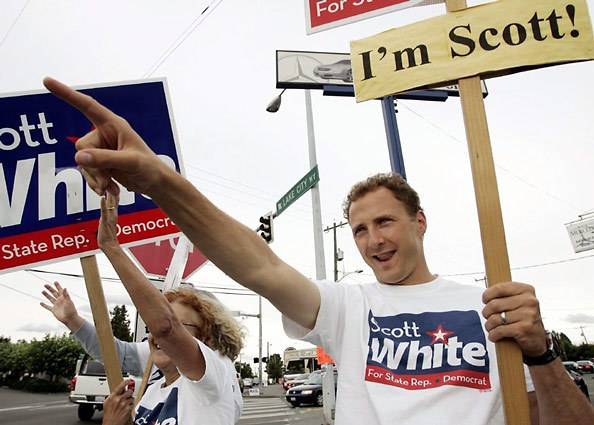
Scott White: waving to voters the day after he was elected

On Tuesday, October 4, 2011 at 2:14PM Pacific, I published a blog post on the iSector.

On Friday, October 21, 2011 at 6:11PM Pacific, I got a phone call from my dear friend, Alison Carl White.

On Saturday, December 24, 2011 at 8:24AM Pacific, I was running around the seawall in Vancouver, B.C. in gale force winds and torrential downpour.

This three moments are inextricably linked.

The iSector was the outgrowth of my long-held belief that the name of our sector–currently, the Nonprofit Sector–does a huge disservice to what we are trying to accomplish. I can’t say I love the name ‘iSector’, and I will continue to search for a better name, but at least it gets us away from referring to ourselves as the ‘Non-Progress Sector’.  Publishing that post was a big moment for me.

The phone call from Alison was another big moment, but in a very different–and tragic–way. She was calling because she had just learned that her husband, Senator Scott White, had died. Alison is 39. They have two young children. Scott embodied health, energy and leadership. To say this was a shock would be the understatement of 2011.

What struck me most about Scott was his belief that so much was possible. While most of us would scratch our heads, shuffle our feet (looking a lot like Eeyore), and wonder how we’d get out of this mess (insert whichever mess might cause you consternation, e.g. education, transportation, the environment), Scott was bounding along in pursuit of a better path forward (sort of like Tigger, with the brains of Owl).

I imagine Scott knew a roadblock when he saw one, but he never seemed to focus on its presence. He always seemed focused on how to find a dignified way around it that would make the world a better place. He was pragmatic, for darn sure. But he was also an optimist.

And this brings me back to that gusty run. As I came around the point, it blew so hard I actually fell over (not a pretty moment). I was so wet that my shoes were making a bizarre squishing noise every time my foot struck the ground. You’d think I would’ve been cursing this run.

Instead, I was grinning ear to ear.

Why? Because I could be running in that crazy weather. Because I had a choice. Because it was possible.

In moments like these, I now think about Scott. I think about what’s possible. I try to think bigger. As big as Scott thought about what’s possible.

I believe it is possible for us to  truly make the world a better place. Call me a Polyanna. Call me naive. I really don’t care.

I believe–regardless of tax status and official sector name–that if you get up every morning set on making the world a better place, that you can. And that you do.

On that run, I had a vision of a sea of people with t-shirts, badges, ball caps, tattoos, and buttons that all said: Because we can!

Because we can make the world a better place. If we couldn’t, why bother trying?

We should try. Every day. In ways big and small. We should try.

We should make the world a better place, because we can.


Top 3 Resolutions for Mission-Motivated Marketers

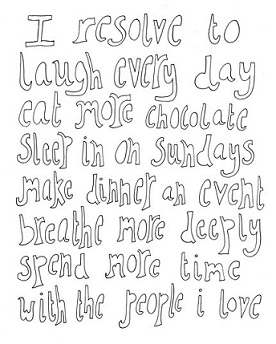
Historically, at the end of each year, I set six resolutions: three personal and three professional. This year, I would like to add three more to the mix.

These three are the resolutions I’d love to see all mission-motivated marketers stick to in 2012. Like drinking 8 glasses of water a day or stretching after every run (two of my three personal resolutions), these aren’t fancy, far-flung resolutions. They are the ones that, if you stick to them, will yield Big Results in 2012.

  1. Do Less: Release yourself from the notion that you have to do it all. Facebook, newsletters, Twitter, annual report, Foursquare, Tumblr, Storify. All can be great tools when it comes to marketing your mission and they all take time and money (as ‘time is money’) to do well. Both of those are scarce resources. Do less and you have time to do it well.
  2. Keep your on-line presence fresh: A languishing website makes supporters think you’re a languishing organization. Let your awesomeness shine through! At least once a month, go to all your on-line properties and make sure they’re up-to-date. For your website, update at least one page with brand new content. Block the time on your calendar now.
  3. Post your Top 3 Goals where you can see them: Research shows that writing down your goals and sharing them with someone else ups the chances you’ll achieve them by 33%. I haven’t found research that putting them where you can see them also helps, but have seen first-hand what a different it makes. Write ’em down. Put ’em up.
Those are my top 3 resolutions for mission-motivated marketers. What resolutions do you have for 2012? How do you plan to make them stick?

Do you communicate as effectively as you think?

X

Do you communicate as effectively as you think?

X