Blog

It happens under the surface

Janet Evans: elevated the art of beneath the surface swimming

Have you ever noticed someone swimming who is going really, really fast yet makes it look effortless? There isn’t a bunch of splashing or arm flailing. Instead, there’s a wake behind them.

I saw someone like this was in the pool this morning. He was in the Very Fast lane. (Interesting aside: There’s no longer a slow lane. Only medium, fast and very fast. Apparently, none of us are slow swimmers. Good for morale.)

I was in the fast lane, formerly known as medium. At one point, we came into the wall to do a flip turn at the same time so I had the chance to see (in a topsy turvy way) his turn. There were no extraneous movements. There was precision and speed and power. And yet–he made it look so easy.

All the work happened under the surface. Ditto for his strokes and his kicks. There was a lot of work being done, but if you watched from the surface, you saw none of it.

Next time you’re admiring an organization that seems to have it all figured out, don’t confuse output with effort.  You are likely seeing the result of a lot of work being done beneath the surface.

The Inspiration Sector

It has always irked me that our sector is defined by what it is not, i.e. the ‘non’ profit sector. Even more irkesome is when you go back to the roots of the word profit, which Dan Pallotta does in his book Uncharitable, and realize ‘profit’ means ‘progress’. So we’re the non-progress sector. Hmmm.

Last time I checked, we were very much about progress. Progress on education, poverty eradication, sustainability, public health, the arts. You name it, we’re pretty much in it to make progress that will lead to a healthier planet with happier people living on it. It’s pretty audacious to think we can achieve this type of  progress given how challenging the issues are that we’re tackling. Like President Obama, we have the audacity of hope.

I think this type of audacity is inspiring.

Many alternatives to ‘non profit’ have been floated–third sector, social change sector, social sector. [And as Chanelle Carver pointed out in the comments below, there’s a logical extention of Hildy Gottlieb‘s concept of Community Benefit Organizations to Community Benefit Sector. Thanks Chanelle for making this connection!)

I’d like to add an alternative to the list: the Inspiration Sector. (And, if someone else has already floated this, then I’d like to second the submission!)

I realize it’d take time for us to adjust to an entirely new name and that there are pragmatic implications (think of all that web copy we’d need to update!), but I, for one, would love to wake up every day and say, “I’m off to work in the Inspiration Sector!”

Want work in the Inspiration Sector with me?

You’re a marketer

I’ve run off and on for, oh, 20 years or so. I’ve run a marathon (thanks to Team in Training) and multiple half marathons, including the Mercer Island Half Marathon earlier this year. I get up around 5:30am about three times a week to run anywhere from three to seven miles.

And yet I would never call myself a runner.

Every time I run, I see someone who I consider to be a true runner. Their feet barely hit the pavement, their arms swing effortlessly at their sides, there is a rush of wind as they pass me. Now those people are runners. Clearly.

This is a goofy mentality. It focuses on labels instead of product, effort, impact and achievement. It’s a little bit of a bummer when it comes to me and running. It’s a big, fat bummer when it comes to nonprofits and marketing.

When I do a training or a workshop, I will frequently start by saying, “You are all marketers.” A small, but notable, shudder makes its way across the room. “Me. A marketer? No way. Egads.” People shift in their seats and look visibly uncomfortable.

Most non profit professionals refuse to think of themselves as marketers. Why is this? If marketing is telling a story that inspires people to take action that will make the world a better place AND the way that story gets told is primarily via the actions of the people working for non profit organizations, then every single person who works for a non profit is a marketer.

Twitter, Facebook, e-newsletters, brochures, websites, taglines, elevator speeches. These are all tools we use to tell our story. But they are not the story itself. In and of themselves, they do not inspired action and engagement.

I may not wear Vibrams (the five-fingered, barefoot running shoes), but I’m still a runner. And you may not have ‘marketing’ in your title or your job description, but your enthusiasm for your mission makes you marketer anyway. You inspire people to action every day. Is that so bad?


Jolkona’s Social Media Goodness

Every once in awhile, you come across an organization and you think: “Dang, they’ve got it going on!” One Day’s Wages, Not for Sale, and the Surfrider Foundation all come to mind.  (And keep your eye on a child’s right if you want to see some serious awesomeness…)

Seattle-based Jolkona is one of those can’t-take-my-eye-off-of-you organizations. And Laura Kimball, their Director of Communications & Social Media, elevates “social media goodness” to new levels. So I asked if she’d be willing to tell us how Jolkona has used social media to go from relative obscurity to can’t-be-missed powerhouse in such a short period of time.

Here are her top tips:

  • DO be human: This isn’t a new piece of advice, per se, but Laura and Jolkona show you how to do it on a platform like Twitter, which many think of as a glorified spambot fueled by ego-maniacal dolts.
  • DO get management genuinely on-board. Again, we’ve heard this before, but Laura explained how. Position it as an extension of your other efforts, as a logical extension of existing conversations, instead of New, Shiny, Possibly Distracting thing. If you’re meeting resistance, try something small and show the results. Make it easy for them to see how it relates to organizational goals and invite them into the conversation.
  • DO measure. Laura first joined Jolkona as a volunteer. She spent six months trying, tracking, and bench marking. Then she knew what worked and what didn’t. Which topics got the most comments on their Facebook page? Which Tweets sparked interest? Which blog posts got people excited? It’s not enough to have a bunch of fans and followers–engagement drives action which leads, eventually, to results (whatever that means for your organization). Measure early and often.
  • DO train volunteers well. It’s tempting to bring on volunteers and expect that they’ll just handle all the social media, liberating you to do other tasks. Laura explained that it doesn’t work that way. Her advice? “Make sure they’re social media savvy. This is easy to figure out because you can follow them on Twitter, Facebook, etc. You can tell if they genuinely love social media.” Once you’ve found a volunteer who is enthusiastic about social media AND your mission, plan on some QT. “Sit side by side with them at first. Explain to them why you use certain words and not others. Share your philosophy. For instance, Jolkona will never use .@ to get into someone’s stream. We care about conversations, not getting noticed. These nuances are what create your on-line personality and that reflects your values. Volunteers shouldn’t have to guess that stuff. Take the time to train them.”
  • DO create a social media persona. Are you a 26 year old music-crazy tech geek or a 57 year old gardening fiend? This informs both which channels you chose and how you act when you’re there. The persona can be used on-line and off to bring consistency across platforms.
  • DO give people trust, access, empowerment, autonomy and accountability if you ask them to contribute to your social media efforts. Laura uses these five elements as a filter. “When something isn’t going well, it’s usually because one of these isn’t happening,” Laura explains matter-of-factly. “And so we fix it.”
  • DO play! “No one has this all figured out. That’s what makes it fun. Try stuff. Social media is very forgiving. If you mess up, say so, and move on,” Laura counsels.

When I asked Laura what the biggest challenge she’s faced so far has been, she laughed and said, “Giving up control of Jolkona’s Twitter handle.  Since it had been me from the beginning, it was scary to open it up. But it’s going great! It had to happen.”

A big THANK YOU to Laura for giving us access to her great, big brain. Check out Jolkon’s site for a serious dose of inspiration.

Tell us: In your social media experiments, what have you tried that has worked well or totally flopped?


Marketing Main Street

Yesterday, I joined 13 of Washington state’s Main Street Managers in Mt. Vernon. Our task was to figure out how each could engage their communities in the unique awesomeness their downtowns offer.

At most trainings I do, each organization has a different Belief Proposition. In this case, they shared a common one–a belief that downtown revitalization leads to lasting, positive economic impact.

That’s what made it so interesting when we started working on messaging. It was tempting to think that since they believed the same thing, they could talk about that belief in the same way and have it be compelling in all communities. Not so!

Since each downtown was so unique, their messaging had to be as well. Here’s a smattering of the Lean-In Lines (otherwise known as Elevator Pitches or a response to the question “What does your organization do?”) the participants created (or at least a close proximity based on my recollection):

We’re leading the charge to make downtown THE place to be!

We’re helping our community rediscover downtown.

We energize small business and celebrate our small town charm.

We bring Meeker Days and so much more right to the downtown core. (Note that this also rhymes which makes it fun to say and easy to remember.)

All are about downtown yet not about any ol’ downtown–THEIR downtown. The lesson: frame your messaging in a way that highlights what’s unique about your organization and what’s most compelling to those you need to engage in your mission.

This group of dedicated, fearless Main Street mavericks made me pine for a Main Street in my (not-so-small) town that was as amazing as theirs. To find a Main Street community near you, check out the Washington Trust for Historic Preservation’s handy listing of Main Streets around the state.


5 Steps to a Funective* Brand

Here are a few brand questions to ponder:

  1. Should we have a live receptionist or an automated phone system?
  2. Should we have offices with doors or open cubicles?
  3. What type of coffee should we have for staff and guests?
  4. Should we offer incentives for taking the bus or biking to work?
  5. Which paper should we use for our letterhead and business cards?

Sure, these are questions about administration (a), office space (b), purchasing (c, e) and HR (d). Your answers to these questions reveal much about your organization, however, and should directly–and consistently–reflect your brand.

Here’s that I mean: if you’re an organization working on childhood literacy and value being approachable, friendly and transparent, you’d have a live receptionist and an open, kid-friendly floor plan. If, on the other hand, you’re a domestic violence shelter, trust and discretion would be closely-held values and you might opt for an easy-to-use phone tree with confidential voicemail and offices with doors.

And this is why brand matters. Because a clearly defined brand makes it easy to make decisions—work for, donate to, volunteer for, advocate on behalf of, stay involved in, buy from…tune out. It’s hard to tune out an organization when  their words, visuals and actions consistently and compellingly say, “This is what we believe. This is what we stand for. Join us if you stand for this, too!”

By following the 5 Steps to a Funective Brand (fun+effective=funective…in case you were wondering), you can create an irresistible and enduring brand. Put another way, you will make it easy for people who care about your cause to find you and engage with you. And who doesn’t want that?!

This is a brand new tool so feedback is welcome! Was the process funective for you? How can we make it better?


Just stop saying just

When did misusing the word ‘just’ become so popular?

Just is either an adjective (“That was a just response to the claim.”) or an adverb (“We just submitted the grant.”) But we’ve started using it as a weird, apologetic qualifier.

“I just wanted to check in and see how that report is coming along.”

Just a quick note to say we’re still interested in meeting.”

“It’s just me.”

In all of these instances, it’s being used to say, “Hey, I don’t want to bug you…” It’s a subtle apology. Sometimes subtle apologies are in order. But there’s a disproportionate use of the word just to the amount of apologizing that needs to be happening. Especially when it comes to nonprofits and their work.

“We just wanted to let you know that we tutored 827 students this year.” This sentence could have been plucked directly from many a donor communication piece. If you’re the donor, you want to hear that your money is having the impact you wanted it to have. You don’t want your attention diverted to what didn’t happen. By simply taking out the word, it changes the entire tone.

“We wanted to let you know that we tutored 827 students this year.” Heck, without the word just, I’d be tempted to throw in an exclamation point.

So, please, just stop using just. You have no reason to apologize.


Nonprofit Messaging Sweet Spot

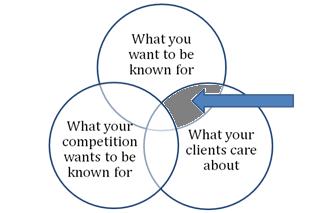
Aim for the gray spot!

In preparing for a recent client meeting, I took a stab at creating a visual to explain the ‘messaging sweet spot.’ It ain’t the prettiest picture you’ve ever seen (I’m no artist!), but it gets across an important point.

We usually aim for the middle of a Venn diagram. Not so with messaging, non profit or otherwise! If your messaging lands in the middle, you’re working harder to stand out because you’re using words that your competition is also using. The goal is to stand out, not blend in.

Does your messaging hit the sweet spot?

Seth Godin in Seattle

Seth Godin, June 24, 2011 | Photo by Kathy E Gill (@kegill)

Seth Godin’s brain processes information at warp speed. Today, members of his tribe–myself included–got to see his brain in person. Well, we didn’t actually see his brain because that would be icky, but we got to see his brain in action. Meaning he answered questions for 2 hours straight.

The questions ranged from personal (e.g. how do you produce so much quality content every day?!) to thought-provocating (e.g. from Lara Feltin, Co-Founder and CEO of Biznik who asked about assets and freemiums). Here were some of my favorite quotes and take-aways:


“Find music for your listeners, not listeners for your music.” In other words, bring as much value as you can to people who are already engaged with your organization, rather than chasing after people who may or may not be interested. Susan Howlett and other fundraising thought leaders have been pounding the ‘retention’ drum for quite awhile. Seth would definitely second that.

“Let’s slather some Facebook on that.”  This was probably my favorite quote of the morning. Facebook is huge and nonprofits should be using it to its full advantage. However, Facebook isn’t a silver bullit. Yes, you’ve heard this before…but have you ever thought that maybe you’re using Facebook as a scapegoat for a poorly designed (or not done) marketing plan?

“You can’t build a brand on-line. You can build the privilege of getting someone’s attention.”  Seth is all about permission marketing. This is in sharp contrast to interruption marketing (think TV ads before DVRs and mute buttons), which was how all those mad men made bank. Permission takes time, yet it is enduring. For mission-driven organizations constantly worried about cash flow, this can be a tough pill to swallow. However, if you’re focused on bringing music to your listeners, it makes a ton of sense.

If you were there, what stuck out for you. If you weren’t there, anything you wish you could’ve asked Seth?

Leaders & Doers

At today’s Tune-Up Tuesday meet-up, leadership came up again and again. It’s one thing to set strategy and it’s another thing to implement the strategy. Marketing strategy is decided by leadership (usually) and marketing implementation is done by managers, coordinators, assistants, etc. (usually).

The thing is once you start implementing you put the strategy to the test. And sometimes it doesn’t pass the test so you need to revisit. And this is where it can go sideways.

For the one doing the implementation (a.k.a. the ‘doer’), they need input/buy-in from leadership. But it can be nigh onto impossible to get their attention if it’s not ‘strategy season’.

So what’s a doer to do? Make a specific, actionable suggestion for how to course correct and show exactly how it ties to organizational goals.

Example: Our fundraising goal for the year is to increase our median gift size from current donors. However, our Facebook objective is to acquire new donors. Given our limited resources, I suggest we adjust our Facebook strategy so that we deepen relationships with current donors rather than attract new ones.

Be concise and specific. Be clear on which changes require leadership sign-off and which ones the doer can venture forth and figure out. Role clarity is key.

Related note: The more your organization uses social media, the more you should be open to failure. It takes a lot of tinkering to figure out what works. If you’re afraid of failure, you won’t tinker. If you don’t tinker, you won’t figure out what works. Permission to fail is one of the biggest gifts a leader can give.

Do you communicate as effectively as you think?

X

Do you communicate as effectively as you think?

X