Blog

Lady Gaga on Nonprofit Marketing

Whether she knew it or not, Lady Gaga offered some great advice to non profit marketers in a recent interview when she said, “There is magic in reality.”

Here’s how this relates to you: the reality of the person doing the marketing (that’s you, if you’re reading this) is different than the reality of the person to whom you are marketing. If you want to be able to engage people who care about your cause, you’ve got to figure out what the magic of their reality is. As forward and uncomfortable as it may sound, you’ve got to get in their heads.  

If you are the one in charge of marketing your non profit, you–by definition–lack perspective. (No offense. It’s just how it is.) You’re thinking about, reflecting upon and proactively doing something about getting people’s attention. The person on the receiving end is wondering if they should have a second butterhorn for breakfast. They’re in a different head space. Your job is to get into their  head space.

Here are two resources for helping you get into the heads–and hearts–of people who want to help you advance your mission:

Have you made personas for your organization? Any other ideas for how to get in the heads of people who care about your cause?
Portlandia Do Gooders

Last Friday, I found myself surrounded by 35+ of Portland’s most impressive do-gooders in the board room of the United Way of Columbia-Willamette. And they are doing some serious good, let me tell ya!

I was there thanks to an invite from WVDO and Creative Cares. We covered a lot of territory in our 7  hours together (here’s the Prezi so you can see what I mean) and this group gave me lots to think about. Here are a few of those thoughts:

  • Strategy THEN marketing: We started by setting marketing goals (a.k.a. 1E on the 1, 2, 3 Marketing Tree.) It never fails that some folks get really stuck on this part. Marketing is a means to an end. If you don’t know what the end is, it’s mighty hard to know how to get there. Look to your strategic plan or fundraising plan for goals that marketing might help you achieve. If you can’t clearly articulate your goals, stop spending resources on marketing. (Seriously. Stop. Now.) Use those resources to identify your goals and then turn back to your marketing.
  • Progress ≠ Change: We all want to make progress–it’s fun and gratifying! But we rarely want to make change. Change is uncomfortable. When you introduce something new–e.g. a new way to talk about your organization–expect resistence. Plan for that resistence.
  • Manage expectations: We were all fortunate that Ash Shepard, of NPower NW’s Portland office, was able to join us on Friday to share his wisdom and insight on using social media in your marketing. One of the points that really stood out was how mindfully we need to manage people’s expectations when we use social media. For instance, if you have a presence on Facebook but you really want to build community on your blog, say so. If you just have up a Facebook page without letting us know what to expect from it, we will expect that you  have the same intentions as everyone else, i.e. to use Facebook to build community. If that doesn’t happen, we’re disappointed. Disappointment erodes trust. And that’s not good for anybody.

If you were at the training, what are your thoughts? If you couldn’t make it, do any of these points hit home or do they miss the mark for you?

Stories…Impact

Yesterday, I got a great piece of feedback from someone working at a food program in New York. He had watched this week’s Tune Up Tuesday video. The video advocates for using relativity and specificity so that your supporters can connect with your cause. This is based on research about making issues ‘human scale’, and is articulately explained in Made to Stick by the Heath Brothers. (They’re so dang smart!)

As this viewer explained, he can tell a variation of the following story…

Jennifer hadn’t eaten in three days. She struggles with multiple chronic diseases that prevent her from leaving her house. This lack of food was not uncommon for Jennifer and the level of weight loss was significantly damaging her health. Our program brought food right to her doorstep and now she’s eating healthy and getting healthy!

…and it might be an effective way to connect with some individual donors. However, this viewer’s point was that for many funders, especially foundations, he has to then draw the connection to the bigger issue and show broad, measurable impact. In the case of Jennifer, for instance, he would go on to say that 75% of their clients show progress toward achieving a healthy weight after being in the program, i.e. Jennifer represents an overall trend they see in their work, which is that it works.

It comes down to audience and sequencing. (Yes, yes, I know you all know that I don’t like the term ‘audience’, but sometimes you just gotta use it.)

Human beings are hard-wired to understand and relate to stories. That’s why starting with a story works. In order for some donors to make a connection–or make the case–for supporting your organization, they will also need the facts and figures to back it up. It all comes back to one of the cornerstones of effective nonprofit marketing: Know Thy Audience.

Thanks to this viewer for bringing up a REALLY important point!

What have you found with your supporters? Is storytelling an effective way to inspire action for your organization or do you need the facts and figures?

The Story of Lance

When you tell your story, or the story of your organization, your believers see themselves as part of it. Honor that because you might just be someone’s story of hope.

Here’s what I mean.

In July 2000, my mum was bald. She had just gone through chemo for non-Hodgkin lymphoma. She now has all her hair and is happy and healthy–thank goodness!

At the time, however, we didn’t know if the chemo would be successful. I was training for a marathon with the Leukemia and Lymphoma Society’s Team-in-Training. I needed a little hope to keep me going.

And so, when we found ourselves a few kilometres away from the Tour de France that summer, we trekked to see it. I didn’t know the first thing about cycling. That didn’t matter. I wasn’t going to see the peloton. I was going to see what cancer could look like on the other side of chemo. I was going to see hope on a bike. I was going to see Lance Armstrong.

Ever since that fated day, I have been one of Lance’s biggest fans. He is wowerful to watch on a bike and he has created an awareness about cancer that is rivaled only by Komen. His name has become synonymous with cancer, hope and living strong.

Lance’s story of hope became my story of hope. It was a story about being able to not just survive cancer, but to thrive in its wake.  It was a story about coming back from cancer and conquering mountains–both literally and figuratively–on sheer will, hard work and determination.

Then came last night’s 60 Minutes with its allegations and testimonials about doping. This is not the first time Lance has been accused of doping. Not by a long shot. (Skewering Lance has practically become a national sport in France.) The allegations have always been part of the story. As a believer, however, I simply convinced myself that the allegations couldn’t possible be true. There was no room for doping in a story whose power was predicated on its epic nature.

Now it seems undeniable that the story of Lance includes doping, drugs and EPO. It may still be a story of hope, but it is no longer my story of hope.

How Lance handles these latest accusations will determine his legacy because they will be some of the most critical chapters in his story. Lance is a masterful marketer. Can he be an honest storyteller?

With the Greg Mortenson scandal in full swing, Lance would not be alone in the “fallen philanthropic hero” category. What will that do for the cancer community? If he hadn’t done the drugs, would he have won anyway? If he hadn’t won, would he have been able to raise as much awareness and money for the cause? Impossible to know.

What I know is that I probably need to start looking for another story of hope. If you have one, please let me know. You’ll make my day… and probably the day of a lot of folks whose story of hope was the story of Lance.

It’s Not About the Grim Reaper

May 19, 2011 was Planned Giving Day here in Washington state. I confess I only knew this because the Washington Planned Giving Council was kind enough to ask me to come present at their conference.

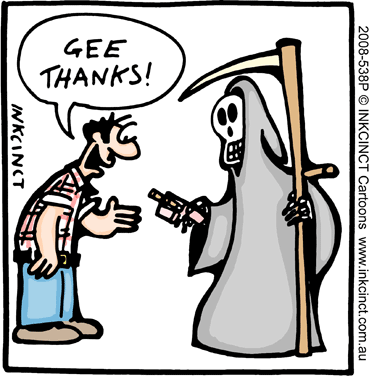
What I realized in preparing for my talk and at the conference (which included a great talk by Lawrence Henze of Blackbaud, who wittily shared info from their cornucopia of white papers and analytics) was that planned giving isn’t simply about the grim reaper. It’s about legacy.

That word–legacy–is interesting. We generally hear people talk about leaving a legacy. To me, “leaving a legacy” sounds like you’re leaving your luggage or leaving Las Vegas. It sounds passive and doesn’t inspire action… until you’re dead, at which time it’s tough to take action.

“Building a legacy”, on the other hand, sounds important and epic. It sounds like something worth doing something about. It makes me wonder how I can build one.

Often times, we take phrases for granted because we say them so often. If we’re going to inspire people to take action, we’ve got to constantly revisit the words and phrases we use–both those that are said and read. Otherwise, people might get stuck on the Grim Reaper and never get around to building their legacy.


Thinking Big at #WSNPC

Earlier today, I spoke at the 17th Annual Washington State Nonprofit Conference. My goal was to offer up content that gave people something to think about and something concrete to do. Some big thinking and some let’s get ‘er done.

Sessions on trends are hard. There are a ton of trends so which ones do you highlight? My litmus was this: is this something that, if it goes to scale, could be a HUGE boon for individual organizations, the people they serve, and the sector as a whole?

I opened with what I hope will be a headline from Clay Holtzman of the Puget Sound Business Journal on May 6, 2012.

Donations & volunteerism at all time high
Nonprofits cite stories and smart phones as secret to success.

If we can think big yet stay focused, I really think we can make this happen. If we fall prey to shiny object syndrome, we’ll be looking at a different headline. And that’ll be a bummer for everyone.

Here is what Zan McColloch-Lussier (@zanarama) took away from the session. (And a big hat tip to Zan for drawing my attention to the importance of niche social networks.) And Jen Power (@comradebunny) did a super summary on her blog as well.

If you attended, what were your take-aways? If you didn’t attend, what jumps out at you from the presentation (handily available below)? What trends do you plan try or watch? Which ones would you advise nonprofits to avoid?

Pitching Inspiration

For the last four years, I have the great good fortune of teaching in the University of Washington’s Certificate in Nonprofit Management program. Earlier this week, we had the ‘2011 Pitch-Off’, which meant five student groups gave an elevator pitch for this quarter’s organization of choice, the Seattle Youth Symphony Orchestra.

Sure, it was a class assignment so they HAD to do it. But they didn’t just come up with something to stick in a “good enough” box. They went beyond. They inspired.

They encouraged us to think about music as a window to the soul. They connected the dots between discipline, focus and orchestra as community. They dazzled us with the idea that when you put instruments into a child’s hands, you tune their minds and hearts. They introduced the concept of an air violin–which a young boy played for a month because there was no  money to fix his real violin. They challenged us to think of what our world would be like without music.

They could’ve simply blah blah’d about the features of the orchestra–that it’s the oldest and largest in the country. Or they could’ve enumerated its strengths–number of students, number of orchestras, number of performances. Our heads would’ve been choc-o-bloc full. But if a nonprofit doesn’t connect with someone’s heart, they are unlikely to inspire them to take action.

In his post today, Carrots and marketing to the poor, Sasha Dichter proclaimed: “Benefits don’t sell.” That might be true if you’re trying to market shampoo in the developing world, but it’s not true if you’re trying to engage mission-minded people in your cause. (No offense to Sasha who writes one of the most on-point, thought-provoking blogs in the social sector, in my humble opinion.) The two B’s–beliefs and benefits–matter a lot. Together, they speak to both our hearts and our heads. It’s a matter of  aligning what you and those committed to your cause believe with the benefits they care about most (and that you presumably offer) in a way that is clear and compelling.

In the Pitch-Off, students found ways to nestle the benefits the Seattle Youth Symphony Orchestra has to offer (endangered instrument program, anyone?)  into what we believe–that music lessons are life lessons.

Tuesday I was reminded of why I love teaching so much–it’s because I get the privilege of learning. I learn way more from my students than they could ever learn from me. It’s humbling.

Hats off to all the students–especially those brave enough to stand and deliver–for speaking to our hearts…and then our heads. You pitched inspiration. Well done.

Being human

April’s theme is elevator pitches–the good, the bad and the ugly. So when we gathered for our monthly Meet-Up, we talked about just that. What to say, how, when, tone of voice, words, meaning. We covered all that. But when you get right down to it, what we talked about was being human.

Here’s what I mean.

We spend so much time crafting pithy, punchy responses to the question, “What do you do?” that they end up feeling contrived. Robotic automatons are not engaging. No offense to C3Po, but robots aren’t generally inspiring. They don’t make us want to ask follow-up questions. If they inspire anything, it is efficiency, i.e. how quickly can I get through this conversation and move on. You’re human. Play to your strengths!

Here are some tips we covered for being more human when you’re getting a conversation started:

  • Remind yourself that an elevator pitch is a door opener, not a deal closer.
  • Don’t call it an elevator pitch. The term conjures up visions of grinding metal, gunky buttons and cloying perfume. Call it your snappy one-liner or your lean-in line or something that makes you smile and want to say it.
  • Talk about a specific person that benefits from your work, not the millions that could potentially. For instance, if you work with orphans in India, talk about Rajit, a five year old who has lived in an orphanage in Delhi since his parents died of AIDS two years ago. Your listener can relate to Rajit. He or she can’t relate to the 31,000,000 orphans living in India. It’s too big. Contrary to popular opinion, bigger isn’t always better.
  • Draw comparisons we can wrap our brains around. Make it easy to visualize. For instance, if you work to end water-related illnesses say, “We’re on a mission to end water-born illnesses. Why is this so important? Because more children die every day from these preventable diseases than live on Bainbridge Island. Imagine if Bainbridge just disappeared. It happens every day. And it doesn’t have to.” Pick a town close to where you live or, ideally, where your listener lives. I can visualize Bainbridge Island disappearing and it’s shocking.

What’s your compelling why? Do you make it specific, relative and human?

Elevate Your Elevator Pitch

On a recent Wednesday, I spent the day working with 10 different non profits. This was an opportunity for them to work on their most pressing, aggravating, ulcer-inducing marketing challenges.

Guess what topped the list? Elevator pitches. 9 of the 10 identified their elevator pitch as a trouble spot.  This didn’t surprise me too much since elevator pitches come up a lot under the heading of  ‘things that we know are important, cause us consternation and yet we wish we could just ignore’. 

What was striking was that most organizations were struggling with the same thing: diving right into what they do vs why they do it. We’re human: we’ve gotta get the why before we care about the what.

Let’s do a comparison:

Example #1:  We provide clothing, scholarships and other services to people in need.

Analysis: It’s technically accurate, yet vague and uncompelling. It’s also a mish-mash that doesn’t quite make sense, i.e. I don’t expect clothing to go with scholarships, so I’m not likely to remember exactly what they do. It’s also passive because they used the word ‘provide’. Never good and always avoidable.

Example #2: Do you remember being a teenager? What you wore mattered, right? It still does. Yet a lot of low-income kids have to wear clothes that make them feel embarassed. That’s why we’re on a mission to make sure all kids feel cool when they go to school.  If you have the chance, stop by our Thrift Store and you can see what I mean.

Analysis: Does this tell you everything the organization does? Nope. But it gives you a taste of what they do and, more importantly, tells you why they do it. And then it takes you to a place you can easily remember–the awkward teen years–so you can feel the importance of what they do without having to think about it. Emotion is memorable and compelling.

If you believe what they believe (i.e. if you’re someone who would rank high on their Belief-o-Meter), you’ll ask questions and learn more.  And that’s what an elevator pitch is all about: starting a conversation. It’s a door opener, not a deal closer.

For more tips on elevator pitches, check these out:

Are you stumped by your elevator pitch or do you have one you love?

Relativity, Narrowness and Names

My son, who is three and a bit, is obsessed with organizing things by size. Cups, toys, trains. Is the red cup bigger than the yellow one? Is the brown bear smaller than the white one? It’s all about relativity. Why is this?

At a workshop I gave in Bellingham on St. Patrick’s Day, I shared that there were 36.5 million people of Irish heritage in the U.S. That’s nine times the population of Ireland. Which number do you think they remembered at the end of the workshop: 36.5 or 9? That’s right, 9. And not just because it’s smaller. But because it was relative.  We train our brains from a very early age to compare and contrast. Absolutes are tough to wrap our brains around. My son will not grow out of his penchant for comparing; he’ll grow into it.

We spent a fair amount of time at Tune-Up Tuesday thinking about relativity as it relates (ha, ha) to messaging.

Lesson: use relativity to your advantage so people remember your organization and mission.

Two other key take-aways from this month’s meet-up:

  1. Personas are powerful. They are also hard to do. They force us to be specific and think deeply about one type of person who cares about our cause rather than the universe of people who might. Lesson: Deep and narrow beats shallow and wide when it comes to messaging.
  2. Names matter. A lot. If your organization goes by an acronym, be consistent about using that acronym. If you have an acronym AND you use the full name, you’re managing two brands. That’s expensive and erodes brand equity. Lesson: When it comes to names and acronyms, use one or the other but not both.

For those that were there, anything to add? For those that coudn’t join, what were you hoping to cover?

Do you communicate as effectively as you think?

X

Do you communicate as effectively as you think?

X