Blog

Fashionistas Flocking to Goodwill?

With the economy down, what’s a money-minded fashionista to do? Head to Goodwill, of course!

There was a time when ‘Goodwill’ and ‘fashionista’ never would have been uttered in the same breath. But the times they are a-changing. And Goodwill, to its great credit, is changing right along with them.

And it’s paying off. Even though times are tough, Goodwill is thriving and the DC Goodwill is no exception.

It used to be that you were either a donor or a shopper, but rarely both. A few years ago, the Goodwill of Greater Washington noticed the people donating clothes were also buying clothes. And that the shoppers weren’t just looking for any old bargain–they were looking for stylish bargains and had a particular penchant for vintage. These shoppers were young, hip, and fashionable.

And what did the savvy marketing team at DC Goodwill do with this newfound knowledge? They went where their hipsta shoppers already were: online.

In 2007, they hosted The Fashion of Goodwill, an online fashion show & auction. The event was covered by CNN, as well as the local ABC and NBC affiliates. The 2008 show ended up on the cover of the Washigton Post’s business section. Clearly, they were onto something.

Emboldened by the success of their online forays, they launched what has become a gem of a blog: DC Goodwill Fashionista. Written by people who are Goodwill fashionistas themselves, the blog dishes up fashion tips, reveals current trends and connects readers with what they love: fashion. It is a huge success.

Brendan Hurley, Senior Vice-President for the Goodwill of Greater Washington, is the first to say that, although it hasn’t always been easy, it’s been worth it.

“We knew we needed to change perceptions and engage these new shoppers,” Hurley explains. “We’ve always used a multi-channel approach. We needed to make sure the message that we have good merchandise at a great price reached them. That meant experimenting online.”

One of their key goals was to “match the customer experience with the brand promise.” This meant making the in-store experience consistent with the on-line experience they had come to know (and love!) via the DC Fashionista. They upgraded their stores, changed lighting and rearranged merchandise all with fasionistas in mind.

And it’s working. “We feel like we’ve caught lightening in a bottle with our social media,” says Hurley.

Here are Hurley’s key lessons for nonprofits looking to integrate social media into their marketing:

  1. Go into it with a long-term view. Social media is about relationships and we all know that relationships need to be cultivated and maintained over time. Don’t expect overnight success or you’ll be disappointed.
  2. Experiment and expect some experiments to fail. DC Goodwill had a clunker when they tried to start a LinkedIn discussion group. They shut it down after two weeks. Failure isn’t fun but it’s par for the course when you’re trying out something new.
  3. Start small. No one batted an eye when Hurley pulled the plug on the ill-fated LinkedIn attempt. Why? Because the marketing team had a series of small wins (and some really big ones!) that all together made for a successful track-record. Small may not be flashy, but it works.

Hurley remains humble about their success. “The more we grow, the more we realize how little we know.” With plans to bring on a staffer dedicated solely to social media staff person in the near future, it’ll be exciting to see what Goodwill of Greater Washington does next.

Follow DC Goodwill Fashionista on FB and Twitter to have all the best in fashion and shopping…at your fingertips!

Suggested Resource: For a great primer on integrating social media into your marketing efforts, check out Care2’s recent webinar.  Hot or Not: What’s Sizzling in Online Fundraising?

Dancing the Marketing-Fundraising Tango

Silhueta - Casal dançando TangoYou’ve undoubtedly heard the expression: It takes two to tango. What you might not have realized is that, if you do nonprofit marketing and/or fundraising, you’re part of a tango-ing twosome.

That’s right. As a nonprofiteer you are as passionate about your mission as Argentinian tango masters are about their lifts, twirls and sultry gazes. Unfortunately, the Marketing-Fundraising Tango often involves two dancers swirling around the dance floor on their own, rather than as a dynamic duo.

We all know that when marketing and fundraising coordinate their steps, it’s a sight to behold. Donors get a print newsletter with a hand-written note from their fav development officer. Volunteers are highlighted in a blog post that then gets forwarded to fans and friends. Donor profiles are so compelling they end up in Facebook posts all over the world wide web. And messaging is clear, consistent and compelling regardless of who wrote it, says it, or tweets it.

You might be rolling your eyes and thinking, “We dance more like Elaine from Seinfeld than [Argentinian tango legend] Mariana Mazzola!” Don’t worry–anyone can learn to tango. Really.

To get you started, here are three simple things you can do to dramatically improve your Marketing-Fundraising Tango:

  1. Write short n’ sweet job descriptions for your marketing and fundraising teams. If you write a job description, it becomes clear who is in charge of what. No two organizations are alike. In some organizations, the fundraising team handles the newsletter. In others, that’s up to the marketing team. Same with the website, annual report, blogs, events, etc. The point is to get clarity for your organization so you can dance in concert. The job descriptions shouldn’t be long or take long. Try to keep them to 2-3 sentences. Then share them with both teams and discuss at your next All Team Meeting (see #3 below).
  2. Once you’re clear on which team is in charge of what, have each team set their top 3 goals for the year. Then make sure everyone knows what they are. It sounds so obvious, but it’s shocking how little info-sharing happens between teams. It’s handy if you know where your partner is headed on the dance floor! [Note: Even if you are a team of 1, do #1 and #2. It’ll bring clarity and focus to your work, which is especially important if you’re  a super small shop!]
  3. Dancers get good because they practice. They learn to read the other person’s body language and adjust accordingly. So hold weekly All Team Meetings where everyone from marketing and fundraising gets to know what’s going on across both teams. Since most of us need an extra meeting as much as we need two left feet, think about merging existing team meetings or at least shortening them so you’re making the most of the time you’re already investing in meetings. By knowing what your partner is doing and thinking as a marketing-fundraising duo, you will naturally begin to think about how fundraising and marketing efforts can augment each other.  For example:  if your marketing department posts a great article, the development director could send the link to a donor to make sure they saw it. Or the development department could post a story highlighting a top donor once a month on the blog and the marketing department could then use the profiles in the quarterly newsletter. Over time, you will be able to anticipate each other’s steps and take full advantage of your partner’s fancy footwork.

With job descriptions, goals and weekly meetings, you’ll be doing the Marketing-Fundraising Tango in no time!

The Major Gifts Symposium Gets Sexy

afpAFP-WA’s Major Gifts Symposium was a downright sexy affair.

It all started when Peter Drury of DZO Strategists explained that many boards were engaged in risky business and weren’t using protection. (Goodness!) Peter’s contention is that if success is gauged solely on whether you achieve this year’s cash goals, you might put your organization at risk long-term.  Luckily, he offered protection in the form of the Beyond Cash Fundraising Dashboard.

Then at lunch, Susan Howlett was on fire as she gave a smouldering keynote that involved a life-size picture of Michelangelo’s David. Eventually David got some clothes on, but it took some doing. If you want to learn what the clothes-less David has to do with inspiring leaders to raise money joyfully, check out Susan’s new book, Boards on Fire.

We left the Symposium feeling incredibly proud and honored to be part of Seattle’s sexy–and seriously talented, committed and inspiring–nonprofit community.

Has anyone read Susan’s book or used the Beyond Cash Fundraising Dashboard? What do you think of these home-grown tools?

Belief is a terrible thing to waste

profiles in courageOn April 25, 1944, Dr. Mary McLeod Bethune and others incorporated the United Negro College Fund. They believed that it was time to “reject the prejudices of the past and consider the inner person.” Their first fundraising effort garnered $760,000, which would be worth about $8.6 million today. In 1959, Sen. John F. Kennedy donated the proceeds of his book, Profiles in Courage, to the UNCF. In 1972, famed ad man Forest Long came up with what is perhaps the most widely recognized nonprofit tagline ever: “A mind is a terrible thing to waste.”

Why has the UNCF garnered such unbridled enthusiasm?

In our humble opinion, UNCF has attracted and retained loyal supporters because they have stayed true to the reason they created the organization in the first place–their belief that “it was time to reject the prejudices of the past and consider the inner person”. They have undoubtedly experimented with new programs, new messaging, and new ways to raise money. But their core belief has remained the same.

The articulation of this core belief is an organization’s Belief Proposition.

The for-profit sector focuses on Value Propositions. But in the nonprofit sector, our currency is beliefs, not value. (Note: Values are of course important to us nonprofiteers. That is different from value, with no ‘s’.) Belief Propositions are the philanthropic sector’s raison d’etre.

Your Belief Proposition answers the question: “Why do we exist?” Most organizations tell you what they do and how they do it. But very few tell you why. This is a huge missed opportunity since people engage with a cause because it speaks to their hearts, not their heads.

Don’t believe me?  Think of the organization to which you’ve given the most money, time and energy over time. Did you do that because you were struck by their admin to program ratio? Probably not. You might have seen that ratio and nodded your head in approval, but it wasn’t what inspired you time and again to engage. We engage because we believe in why the organization is doing what they’re doing and we like how they are doing it.

When you lead with why you believe, you build strong relationships with others who share your belief. This has been true for UNCF, as well as thousands of other organizations that, over time, have not just survived but thrived.

What does your organization believe?

Avoiding Messaging Mayhem

Remember the game ‘telephone’ from grade school? The first person would whisper something to the next and it would make its way down the line until it got to the last person who would announce the then mangled sentence. I love that game. But I don’t love it when it happens to nonprofits and it happens a lot.

We talked about this game when I recently spoke at the Washington Food Coalition’s Annual Conference because there was a lot of angst about “losing control of our message” among this great group of folks.

My suggestion was to focus on making it really easy for people passionate about their organizations to spread the word about your organization. That means picking one thing that everyone will focus on. One thing; not your everything.

When it comes to messaging, success isn’t everyone repeating the same one phrase verbatim; success is when your fans can consistently convey the most important and compelling thing about your organization while still making it feel personal.

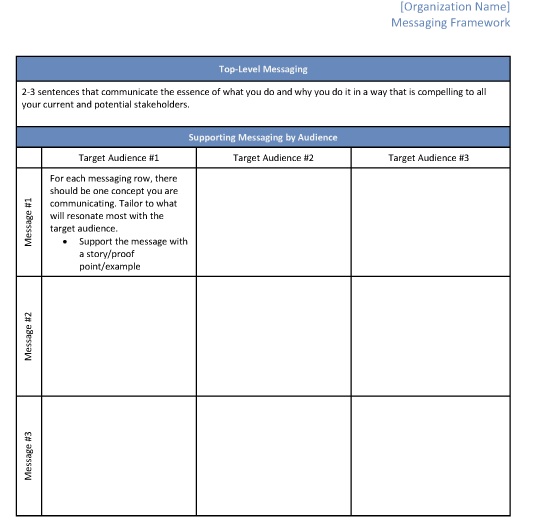
This is why all organizations benefit from having a simple Messaging Framework. You should see the relief on the faces of staff and volunteers when they know how to talk about the good work you’re doing.

Here is a template that will help you develop a Messaging Framework Template.  It’s simple, straight-forward and will make people jump for joy at the opportunity to learn more about what you’re doing and why you’re doing it.

Top Three 2010 Nonprofit Must-Reads

2010 has been a mighty good year for books packed with ideas for people wanting to make the world a better place. Below are three of our favorites. They had us nodding our heads, posting snippets on Facebook, and saying things like “Exactly!” and “Right on!”over and over again.

As you cozy up for some autumn reading, we urge you to add these to your stack. And, if you buy them off Amazon today, you’ll get 34% off the list price. Nice! Buy them. Read them. Take notes. Share them. You won’t regret it.

Three 2010 Nonprofit Must-Reads:

1. The Networked Nonprofit: Connecting with Social Media to Drive Change, Beth Kantor and Allison H. Fine

Our Favorite Quote: “Tools will come and go, but strategy sustains organizations.”

2. The Nonprofit Marketing Guide, Kivi Leroux Miller

Our Favorite Quote:  “Focus on the basics first, and do them well.”

3. Uncharitable, Dan Pallotta

Our Favorite Line:  “If we have the courage to be true to our most daring ideas, the ideology will have to surrender to their magnificence and our determination to make them real.”


Are we missing any good ones?  Please share your suggestions below.

DIY Marketing for Nonprofits

Here’s one thing we know about marketing: if you have a plan, you are way more effective. And yet, very few nonprofits have a marketing plan in place. We must put an end to this, people!

A plan is easy, especially if you take a DIY (do it yourself) approach to marketing, which most nonprofits do. You’ve got to have your plan or you end up working really hard and doing a bunch of stuff, but not necessarily getting results. Not good.

As a way to help our fellow do gooders create mission-driven marketing plans in record time, we created the ‘1, 2, 3 Marketing Tree’. It guides you through the process of figuring out your plan in 3 simple steps. Watch this video in which Erica explains how this great tool can make your life so much easier!

In order of importance, here are the three steps:

  1. Define WHAT success means for your marketing.
  2. Figure out WHO you need to reach for your marketing to be successful.
  3. Figure out HOW to most effectively reach your ideal supporters.

Click the  template here to download your very own ‘1, 2, 3 Marketing Tree’. Get planning!


Do you communicate as effectively as you think?

X

Do you communicate as effectively as you think?

X