Makeovers. They’re all the rage. And nonprofits deserve them just as much as Norma Jean (who became Marilyn after she was made over).
Instead of thinking of extreme, think ‘mini’. Check out my presentation from the 2012 Washington State Nonprofit Conference for examples of how to make over attitudes, actions, visuals and words to achieve greater impact.
A non-word is a word that’s not recognized as “legitimate” or not approved given the circumstances. Non-words can be handy. They include gems like blub, proact, and maximizer.
The beauty of the English language is that it’s fluid. Unlike French or some other languages where new words have to be approved, the English language made its name by morphing. This is a boon for those of you who want to do good and get noticed.
There’s something to be said for a well-placed non-word. It jumps out. It grabs your attention. It makes your reader (or listener) ask, “What does that mean?”
In short, it can be a great way to engage.
Should you use words that people know? Yes. Most of the time. And then every so often, a non-word might be a really good move.
It turns out that “maximizer” isn’t an official, Old English Dictionary-approved word. This is weird to me.
The people I know in the iSector--or social good space or for cause or whatever else you call it–are full-on, all-out maximizers. If we’re not trying to maximize our impact–our collective shot at making the world a better place–then what are we doing?
Based on a quick Internet search, it appears that a tanning product is the world’s foremost “impact maximizer”. This is more than a little discouraging. You and I are in the presence of people who maximize impact for a living and yet it’s a tanning product that gets all the glory.
I’m pretty sure the world will end up a better place if “maximizer” becomes synonymous with “someone who maximizes impact to make the world a better place” instead of “something that does a good job of tanning my skin.” So I don’t care that “maximizer” isn’t technically a word. I’m still going to use it. To seal the deal, I added it to the Claxon Lexicon. (Take that, OED!)
If you’re in throes of planning for GiveBIG, you’re probably wondering how someone could NOT know it’s GiveBIG tomorrow?!
Because they have a lot going on.
AND even if they know it’s GiveBIG, they may not have decided whether they’re going to give to you. Bear in mind they’ve been asked by a lot of non profits to give.
If you’re sending out a Day Of email (which you should), here are 5 tips to up your open rate–a critical step on GiveBIG day:
Put the most important information at the beginning of your subject line: It’s now or not until next year. Make it happen today. Right now. Stat!
Stand out: Again, lots of donors getting lots of email on a busy, busy day. That’s the scenario. Make them laugh. Make them pause. Shock them. Delight them. Make them see how they can play a Big Role on the Big Day. Don’t simply say it’s GiveBIG. That’s expected and they’ll read it a bunch of time. Say it in a way that’ll make them notice YOUR email.
Keep it short: 40-50 characters max. This also goes for the content of your email. This isn’t a ‘getting to know you’ moment. It’s a ‘get on it’ moment. Quickly remind them why they should give and then get out of their way and let them do it.
Use ‘You‘: By using ‘you’, you help people see how they fit in. Sure, it’s about all of us and you’ll be tempted to use ‘we’. In the subject line, it’s all about the ‘you’.
One Call to Action (CTA): Don’t distract with other Calls to Action. In your follow up email (which, of course, you will also send), give them other ways to engage. On May 2, it’s GiveBIG or go home.
Last week Seattle nonprofits were gearing up for GiveBIG on May 2. There was a lot of pre-thanking going on, e.g. “Thanks in advance for supporting us on May 2!”
Of lesser importance but relevant to this post, last week was also my birthday so I’ve been thanking people left, right and center. (It was a really good birthday!)
All this thanking got me wondering: what does it really mean to thank someone?
The phrase “Thank you” comes from Old English. Over time, we shortened it from “I thank you” to simply “thank you”.
On balance, this isn’t a big deal. Language evolves. But when it comes to non profits and donor communications, by losing the ‘I’, we lose an opportunity to deepen our relationship with our supporters.
It’s easy to toss around “thanks” or “thx” or “TY” (twitter-speak for Thank You). Using the whole expression makes you think about what comes after with more intention.
I thank you for joining the fight to find a cure for cancer.
We thank you for joining the fight to find a cure for cancer.
Thank you for joining the fight to find a cure for cancer.
Very similar but very different. Simply by adding one little word (and therefore being clear about who is thanking whom and for what) you can create a deeper sense of connection to your organization and your cause.
Next time you thank someone for supporting your cause or volunteering or advocating or joining or anything else, try using the original phrase beginning with ‘I’ or ‘We’. How does it change the feeling of the sentence? How does it make the person on the receiving end feel?
I thank YOU for reading this post…and for making the world a better place every day!
At this morning’s Claxon Forum we talked a lot about the Seattle Foundation’s GiveBIG, which is coming up on May 2. GiveBig is a “one-day, online charitable giving event to inspire people to give generously to nonprofit organizations who make our region a healthier and more vital place to live.” There’s a pool of funds allocated to “stretch” gifts made that day.
As a result, it’s a flurry of donor outreach around here! Donors are getting emails, letters, tweets, postcards, and Facebook posts about this opportunity from organizations they know and love.
Problem is: most donors (myself included) know and love a lot of organizations. It’s one day. How will we decide which non profit(s) to support?!
Based on the organizations and donors I talked to last year, decisions were based on 1) a really good just-in-time final reminder and/or 2) an organization’s ability to stand out during the lead up to the big day.
This could be a really good time to DTO–Do The Opposite. Switch up your messaging. Try something new. Grab them by the proverbial lapels and get their attention! In a case like this, a little DTO could go a long way.
If you’re planning to participate in GiveBIG, how will you stand out? If you’re in another part of the world, is it time to DTO?
Although this won’t work for everyone, TeamRead’s unconventional approach with Mr. GiveBIG Chicken was a big success last year. We’ll see how he fares this year!
Earlier this week, I made the case for having a good Elevator Pitch. But let’s be honest: creating an elevator pitches can be stress-inducing. It doesn’t need to be! Watch this short video for tips on how your nonprofit can open more doors with a simple elevator pitch.
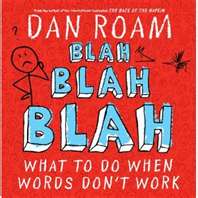
In Roam’s new book, Blah, Blah, Blah, he posits that the person–or organization–who can best describe a problem is in the best position to solve it. This should give us all pause. Consider how much time we spend trying to fix things vs. making sure we’ve clearly identified the most important things to be fixed…makes you want to bust out a marker and hit the whiteboard.
Here’s my beef: Sauntering on up to a whiteboard, or whipping out a napkin with pictures on it, isn’t a practical substitute in certain instances.
Envision with me, if you will, the following: You’re at the airport waiting for your flight. You strike up a conversation with another waylayed traveler. After awhile, your new-found companion asks: “What do you do?”
There’s no whiteboard to be found and passing him or her a napkin that shows what you do would be downright awkward!
Let me be clear: the case Roam makes is that we need to get our visual and verbal minds back in balance. He’s advocating that we flex our visual mind muscles more than our verbal muscles for a spell to get them in shape. Our verbal mind has been honed, shaped and forged through years of school and testing. Our visual mind, not so much. (At no point on any standardized test are we graded on our ability to draw an answer to a problem, right?)
I agree 100% that using our visual mind to better define problems yields superior results to relying solely on words.
That doesn’t mean you stop fine-tuning your elevator pitch.
Here’s what I’d recommend: Use the visual grammar that Roam teaches in his book to define the problem you’re tackling. Then do the word+picture combo to articulate your unique approach to solving the problem. Then come up with a word only version you can use next time you’re stuck at the airport or a cocktail party or networking event or…you get the point.
Do we overuse words? Yes. Are we often sloppy with our words? Yes. Are they still useful? Yes.
If you’re intrigued by visual thinking, read Roam’s book. See how you can apply it to your mission, your work, your cause.
“Stop knocking lightly on the door of change. We’ve got to knock it down! People are counting on you.”
By day, Jeff Shuck runs Event 360. By night (or perhaps in the wee hours of the morning as he has 4 kids!), he blogs at Your Part Matters.
At the 2012 Nonprofit Technology Conference, Jeff gave a session on using data to effectively segment your audiences. There was talk of regression and p-values and pivot tables. Not what many would consider “inspiring”, although highly useful.
That’s why his closing was so unexpected…and awesome.
After geeking out for 87 minutes, Jeff took the last 3 minutes to implore the audience to get serious about doing good. To do more. To do it louder. To get more people involved. To really give this making the world a better place stuff everything we’ve got.
I said a really loud “Amen!” and whooped a lot at the end. If it’d been remotely appropriate, I would’ve stood on my chair and cheered.
We’d spent the morning listening to Dan Roam, author of Blah, Blah, Blah, so we all had visual representation on our minds. But Jeff’s words gave us all a mental picture that we can use every day to gauge our effort, if not our impact:
Did we knock the door down today or simply lightly knock, hoping not to disturb anyone with our do-gooder ways?
Perhaps it’s not realistic that every day we’ll knock the door off its hinges. But just by asking the question, we’re way more likely to way more often, right?
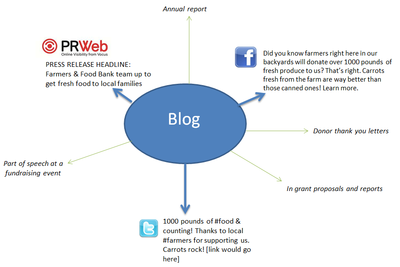
Last week, I did a guest blog post over on NPower NW’s blog. It gives you a specific approach for keeping all your communications channels aligned called the “Hub and Spoke Model.”
We tend to think about one channel at a time. When updating Facebook, we think about Facebook. When posting on Pinterest, we’re all about Pinterest. And when we’re prepping the next newsletters, that newsletter rules our life—who cares about those other channels?! If you don’t take time to align them, they quickly get out of alignment and, just like you’re car, everything goes wonky.
Read the NPower post to learn how to get and keep your channels in sync—donors, supporters, volunteers and fans like well-aligned channels so it’s worth it.
If you want to see what a lean, mean non-profit channel machine looks like, check out these organizations’ well-aligned channels (oh la la!):
 It turns out that “maximizer” isn’t an official, Old English Dictionary-approved word. This is weird to me.
 If you’re in throes of planning for GiveBIG, you’re probably wondering how someone could NOT know it’s GiveBIG tomorrow?!
 Last week Seattle nonprofits were gearing up for