Blog

Inspirational Messaging: Treehouse

“Would you like to give foster kids a childhood and a future?”

This wasn’t what I expected the volunteer elf to ask when I was buying tickets for my family to ride the holiday carousel in downtown Seattle. But she did.

What the elf meant was that all proceeds from the carousel are going to Treehouse, a Seattle-based organization that provides a wide range of services for foster kids and families.

Now, if the elf had asked if I wanted to support an organization that provides services to foster kids and their families, I probably would have said, “Sure.” But her delivery was so much more compelling that I said, “Absolutely!!” and joyfully jumped at the opportunity to do so.

Inspired to learn more, I went online and was thrilled to see that Treehouse is extremely consistent across its many communications channels. Yeah, Treehouse–compelling and consistent! (See this post about Global Partnerships for more on the importance of consistency.)

It would be understandable for Treehouse to want to explain everything they do because all of it is critically important. Instead, they focus on their essence: giving foster kids a childhood and a future. Nuff said.

As Seth Godin recently explained, “The answer is simple,” is always more effective than, “It’s complicated.”

If you are tempted to say that what your organization does is so complicated it can’t be distilled into a compelling, easy-to-understand message, just remember: if Treehouse can do it, so can you.

P.S. If you want to give foster kids a childhood and a future, there’s still time to go ride the carousel!


Inspirational Messaging: A Child’s Right

In last week’s post, we invited you to embark on a messaging journey. As inspiration to do so, we shared a video featuring Scott Harrison, Founder & President of Charity: Water, an organization that brings clean, safe drinking water to people in developing nations.

This week, we find inspiration from another water-focused organization.

A Child’s Right: Every child has a right to clean water.

Whether you consider this an irrefutable truth or pie-in-the-sky, you know what A Child’s Right is all about: kids and clean water. Eric Stowe, the organization’s Founder & Director, doesn’t muddy the waters (pun intended) with a bunch of details. And whether you peruse their annual report, check out their website, or see one of their water filtration systems in action, it’s always the same message. Concise, consistent…compelling.

Some of you are probably thinking something along the lines of, “Yeah but what we do is so much more nuanced and complicated.” A Child’s Right brought clean water to 250,000 in four years. And they are going to bring clean water to 1,000,000 more in the next ten years. How’s that for complicated?

A Child’s Right keeps their top-level messaging focused on the belief that motivates them every day, the ‘why’ behind their work. It makes you want to ask, “Yeah, but how?!” (For anyone wondering, here’s how.)

Let the Messaging Journey Begin!

last minuteMessaging is critical to your nonprofit’s ability to captivate and cultivate people who care about your mission. It’s a way of engaging people in your work on an ongoing basis.

As cliche as it may sound, messaging is a journey, not a destination. It isn’t something you do once and then check off your to-do list. Depending on your organization, legs of the journey might include crafting a tagline, developing a messaging framework and coming up with an elevator pitch that makes people say, “How can I learn more?!”  Yet just as a journey through Europe wouldn’t be complete if it consisted only of visiting the Eiffel Tower, your messaging journey isn’t done as soon as you have a snappy tagline.

So many organizations settle for messaging that is mushy, muddled, or mediocre– your mission deserves more! It’s time to embark on your very own messaging journey.

To get you excited about your journey, in December, we will showcase messaging that inspires and informs, that compels action and awe, that makes you want to do something big and bold to make the world a better place. Then, in January, we’ll kick off a Free DIY Messaging Bootcamp. More on that later in the month, but in the meantime, make sure you sign-up for Tune-Up Tuesday Videos coming in January! These will be short (~2-3 minute) videos that are specific and practical, delivered straight to your inbox.

To get the inspiration flowing, here’s a video featuring Scott Harrison, Founder & President of Charity: Water, an organization that brings clean, safe drinking water to people in developing nations. He talks about the role messaging has played in their ability to grow from an idea to an organization serving more than 1,000,000 people.

Fundraising, Social Media & Social Capital?

When Robert Putnam’s book Bowling Alone came out in 2000, ‘social capital’ became a social sector buzz word. We realized that social capital was what allowed nonprofits to ask volunteers for their time, donors for their dollars and legislators for their support. The more you had, the more you could do.

With its potential for such goodness, we wondered: how does an organization generate social capital? We learned this equation:

Trust + Reciprocity = Social Capital

Generally speaking, honest, effective nonprofits garner high levels of trust. The stumbling block has been reciprocity. This is where social media comes in.

When social capital came on the scene, social media wasn’t yet on our radar. Our ability to reciprocate was limited and, often, expensive, which hampered our ability to generate significant amounts of social capital. But with social media, we can now give updates, newsflashes, and tantalizing tidbits of information to people who care about our cause and ask nothing in return. We can reciprocate with abandon!

For instance, if your organization is using the Beyond Cash Fundraising Dashboard created by Peter Drury of Splash, this gives you an easy, low-cost, low-resource way to dramatically increase your Non-Ask Ratio (i.e. the number of times you interact with a donor without asking for financial support). If you’re an organization that relies heavily on volunteers–e.g. EarthCorps or Habitat for Humanity–think of all the wonderful ways you now have to show how important they are to your organization.

There is much talk about how to use social media for fundraising. Here’s how: focus on its ability to generate social capital. Rather than thinking of Facebook as a vehicle for asking for donations, think of it as a way to shine a bright, joyful spotlight on the impact you’re having in the community so donors can see on a regular basis how–by working together with you–they are making the world a better place. Then when you do make an ask, they will be excited at the opportunity to give.

We may still be bowling alone. But social media offers the social sector a golden opportunity to usher in an era of e-bowling together.

Social Networking

Participants’ Key Take-Aways

1. This confirmed my feelings about how social media is about establishing relationships rather than just getting followers.

2. I want to explore separating our online channels to focus each tool on one audience or creating two accounts within a certain tool that each target a separate audience.

3. I know I need to work with my board to talk about our long term goals. We need to know our key messages and audiences.

4. I like the idea of using a donor-centered approach to our social media rather than an organization-centered approach.

Conversation Re-cap

Social Media Concerns and Questions Discussion & Conclusions
We have too many target audiences and we have a hard time figuring out what to post since we have different audiences. Pick one tool per audience. Find out where your audience is online and what they are doing before you choose a tool. [Tip from Erica: If your organization has more than 5 target audiences, you probably have more than you can manage well. Narrow your list!]
How do we get our supporters to be involved and share with each other on our online portals like Facebook. Know your audience so that the content you provide will spark a discussion. Some organizations have personally asked their best supporters to stimulate conversations online. [Tip from Erica: Be clear on your goals. Some organizations use their Facebook feed as a way to stay top-of-mind with supporters and therefore wouldn’t be concerned if their “likers” weren’t actively engaged in discussion. Lack of “likes” isn’t always a terrible thing.]
Older donors and supporters who are offline are saying that they don’t see any marketing materials anymore. Go back to your goals. Are you meeting them? If you are meeting your goals and you have a limited budget, you’re doing fine. [Tip from Erica: Just because you “could” doesn’t mean you “should”.]
We see other nonprofits doing matching campaigns on Facebook where you advertise that your organization is getting $1 for every new “Liker”. Is this effective? It depends. Who are you reaching out to? A local organization that was effective at this reached out to former tutors who were very engaged with the organization at one time. They asked them to like their page because they’d get $1 for every new like. This worked to engage the former tutors to become re-engaged. [Tip from Erica: Except in select instances, use Facebook as a way to deepen relationships so your asks are more effective, rather than a vehicle for making the ask.]
We’ve struggled with knowing how fun or personal we can be on social media sites. We’re not sure about what rules to create. Social Media Policies can be helpful. Once you are clear on your audience and messaging, that will inform your social media decisions. You’ll understand your audiences better and be able to make more informed decisions about what to post and where. [Tip from Erica: Having a Brand Dashboard can help you address this issue, as well.]
There seems to be new tools all of the time. Tools will change. Geolocation is becoming all the rage for example with tools like Foursquare and Facebook Places. Don’t over-invest in a tool because people will move on. [Tip from Erica: If you invest in knowing how to decide which new tools to use based on your goals and target audience(s), you’ll be in good shape long-term!]


November Handouts and Resources


1. Read the Nonprofit Social Media Decision Guide.


2. Watch Idealware’s Video: Facebook vs Twitter.


3. Read ‘5 Must-Follow Non-Profits Making a Difference With Social Media’.


4. Download and Review the ‘Claxon_4 Social Media Tools for Nonprofits‘.


5. Check out Social Media Club Seattle The Seattle branch of Social Media Club, a national organization with the purpose of sharing best practices, establishing ethics and standards, and promoting media literacy around the emerging area of Social Media. Our members are present across a wide variety of networks and we encourage you to reach out and join us. (Thanks for the tip Eileen!)


Thanks to our Special Guest: Carrie Zanger

Carrie Zanger of True Good Creative shared her technical expertise with us as well as a story about the It Gets Better Project initiated by Dan Savage. Why did this become viral? There was an authentic moment and people related to that very deeply. It immediately inspired and sparked great interest. Thanks, Carrie!

Global Partnerships: Focus Pays Off

Global Partnerships (GP), a Seattle-based nonprofit, expands opportunity for people living in poverty by supporting microfinance and other sustainable solutions in Latin America. They partner with innovative, mission-driven microfinance institutions that reach people traditionally left behind—such as women and the rural poor—with microloans and other services that can help families break the cycle of poverty.

They are a shining example of a nonprofit that knows how to deeply engage with people who care about their mission.  In recent years, they’ve integrated social media into their marketing mix–with excellent results. We recently sat down with Elisa Murray, Director of Communications, and Chris Megargee, Director of Community & Corporate Relations, to learn more about their experience navigating the social media waters.

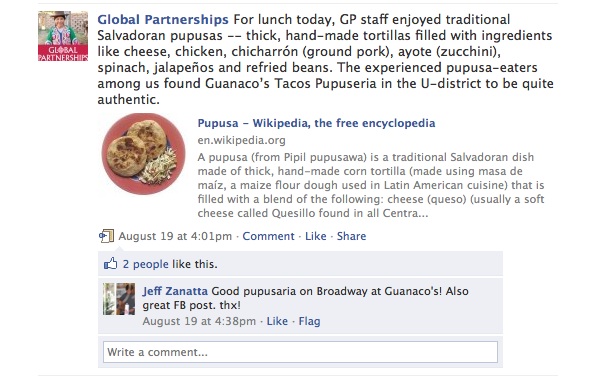
How did GP get started with social media? Global Partnerships works in Latin America, far, far away from where their supporters live. This makes it hard to get a sense for the impact their partners have on the lives of those they serve. A few GP supporters go on PartnerTrips but most don’t have the opportunity to see the work first-hand. Knowing how much the PartnerTrips mean to those who did have a chance to go, GP was inspired to explore ways for supporters to be able to have that experience while staying local via photos and videos. They wanted to share their great videos and photos from these trips abroad, as well as local events like the awesomely successful Business of Hope Luncheon. (‘Awesomely’ is our word, not theirs, by the way.)

It was 2008 and they had a website with loads of great information but it was time consuming to update and fairly static.  One day, they attended an NDOA event where they learned from nonprofiteers who were dipping their toes in social media. It was there they realized that social media might be a great way to connect supporters with their work on the ground.

They went back to the office and signed up for personal Facebook accounts. This was before we had Facebook Pages like we have today, so they experimented with Facebook Groups and a Facebook Causes page. Eventually, they created a Global Partnerships Facebook Page, which turned out to be a perfect fit with their overall communications strategy.

The Results? They have measured their website visits since launching the Facebook page and their website visits have gone significantly up, an excellent sign that they’re achieving their goal.

Advice from GP

  • Identify your goal and your audience before the tool. They knew they wanted 1) to deepen their relationship with current supporters who couldn’t travel and 2) to reach out to women and younger people interested in improving the lives of women in South America. Facebook was a logical place to engage with their target audiences since they are already active Facebook users.
  • Start by focusing on one tool and doing it well enough to make it worth it. Of all of their time spent on communications and outreach, they have the resources to spend only 5-10% on social media–a fairly common situation for nonprofits.  Pick one and go with it.
  • Just say ‘no’. Over the past couple of years, they were tempted to start a blog but realized that they didn’t have enough resources to do a blog well at the moment.  Based on their goals and their capacity at this point in time, they decided to say no to a blog.
  • Say ‘thank you’. Facebook is a great way to thank volunteers.

  • Be human. Your supporters don’t want to know about every latte run you go on, but sometimes sharing what you had for lunch make sense. People engage with people, so don’t be afraid of being human.

  • Change it up: Adding variety and focusing on those outside your organization keeps your page lively and interesting.

  • Master your message: Make sure your messaging is consistent with other communications. Supporters should come away with the same impression of the organization whether they come across you on-line or on-land.

Many thanks to Global Partnership for sharing how they’ve gone social without going crazy!

Do you have a social media success story to share?

How Social Media Can Help You Do 5 Things You’re Already Doing

Group of Hands Holding Speech Bubble with Social Issue ConceptsJohn Janstch of Duct Tape Marketing constantly offers great advice that is as relevant to nonprofits as it is to the small businesses he works with every day. A few months ago, the Claxon crew got to see him in person in Seattle. Fantastic!

This post is modified from a recent post of his called “5 Ways to Use Social Media for Things You Are Already Doing.” What person working in a nonprofit doesn’t like the sound of that?!

Thinking that sounded pretty great, I took his key points and made them specific to nonprofits. (My changes are in [brackets].) The terminology may be different, but the advice is the same. And it’s good!

1) Follow up with [prospective donors]

I love using social media tools as a way to follow-up with [prospective donors] you might meet out there in the real world. So you go to an [AFP or NDOA] event and meet someone that has asked you to follow-up. Traditionally, you might send an email a week later or call them up and leave a voice mail. What if instead you found them on LinkedIn, asked to be connected and then shared an information rich article that contained tips about the very thing you chatted about at the [AFP/NDOA] mixer. Do you think that next meeting might get started a little quicker towards your [mission]? I sure do.

2) Stay top of mind with [donors]

Once someone becomes a [donor], it’s easy to ignore them, assuming they will [donate] next time they [want to] or, worse yet, assuming they understand the full depth and breadth of your offerings and will chime in when they have other needs. Staying in front of your [donors] and continuing to educate and [move them up the ladder] is a key ingredient to building marketing momentum and few [nonprofits] do it well. [Because it’s really hard to do everything well with so few resources!]

This is an area where a host of social media tools can excel. A blog is a great place to put out a steady stream of useful information and success stories. Encouraging your [donors] to subscribe and comment can lead to further engagement. Recording video stories from [donors] and uploading them to YouTube to embed on your site can create great marketing content and remind your [donors] why they [donate to] you. Facebook Fan pages can be used as a way to implement a [supporter] community and offer education and networking opportunities online. [For a great example of this, check out The Pride Foundation.]

3) Keep up on your industry

Keeping up with what’s happening in any industry is a task that is essential these days. With unparalleled access to information many [donors] can learn as much or more about the products and solutions offered by a [nonprofit] as those charged with suggesting those products and solutions. You better keep up or you risk becoming irrelevant. Of course I could extend this to keeping up with what your [supporters], competitors, and key industry journalists are doing as well.

Here again, new monitoring services and tools steeped in social media and real time reporting make this an easier task. Subscribing to blogs written by industry leaders, competitors and journalists and viewing new content by way of a tool such as Google Reader allows you to scan the day’s content in one place. Setting up Google Alerts and custom Twitter Searches or checking out paid monitoring services such as Radian6 or Trackur allows you to receive daily email reports on the important mentions of industry terms and people so you are up to the minute in the know. (Of course, once you do this you can teach your [donors] how to [learn more about the mission you both care about] and make yourself even more valuable to them – no matter what [your mission may be].)

4) Provide a better [donor] experience

It’s probably impossible to [do too much donor recognition], too [provide too] much of a great experience, but you can go nuts trying.

Using the new breed of online tools you can plug some of the gaps you might have in [cultivating donors] and, combined with your offline touches, create an experience that no [other organization] can match.

While some might not lump this tool into social media, I certainly think any tool that allows you to collaborate with and serve your [donors] qualifies. Using an online project management tool such as Central Desktop allows you to create an entire [donor] education, orientation, and handbook kind of training experience one time and then roll it out to each new [donor] in a high tech [donor] portal kind of way. This approach can easily set you apart from anyone else in your industry and provide the kind of experience that gets [donors engaged].

5) Network with potential partners

Building a strong network of strategic marketing partners (i.e. another organization that cares about the same cause as you and offers complementary services) is probably the best defense against any kind of economic downturn. One of the surest ways to attract potential partners is to build relationships through networking. Of course you know that, but you might not be viewing this kind of networking as a social media function.

If you identify a potential strategic partner, find out if they have a blog and start reading and commenting. Few things will get you noticed faster than smart, genuine blog comments. Once you establish this relationship it might make sense to offer a guest blog post. If your use a CRM tool (and you should) you’ve probably noticed that most are moving to add social media information to contact records, add your potential partners’ social media information and you will learn what’s important to them pretty quickly.

If you know how to set up a blog already, offer to create a blog of network partners so each of you can write about your area of expertise and create some great local SEO for the group.

Maybe you’re not doing all of these things, but you’re probably doing at least a one or two.

Take John’s advice and you’ll definitely engage your donors more effectively. And who doesn’t want that?!

6 Steps to Going Social Without Going Crazy

Integrating social media into your marketing mix can be daunting. So many options, so little time! In an effort to save you time and keep you sane, we’ve created the following six step process and actionable item checklists for the most popular tools.




Claxon’s 6 Step Process to Going Social Without Going Crazy

    1. Use IdealWare’s fantastically helpful workbook in their Nonprofit Social Media Decision Guide to figure out which tools make sense given your goals. (If you don’t know what your goals are, first do the 1, 2, 3 Marketing Tree.)
    2. Pick 1 or 2 tools. Most organizations don’t have the capacity to do more than two well enough to make it worth it.
    3. Find the accompanying checklist(s) below and decide which items you’ll tackle. Remember: it’s better to do a few things really well, than a bunch of things only so-so.
    4. Identify who will be in charge of each tool and have them block out the time needed each week to do it. (Even though the tools are free, it requires time to make them pay off!)
    5. Review your progress monthly.
    6. Assess strategy vis-a-vis goals annually.

Checklists by Tool

Facebook

Expect to spend 2-4 hours per week, ideally with at least one post per day.

  • Create a Facebook Fan page and get a customized url for your fan page. John Haydon provides a great video with detailed instructions.
  • “Like” the nonprofits you partner with that also have Facebook pages. Engage with those organizations by commenting on their posts and engaging with their supporters.
  • Be consistent and commit to what you will post on Facebook.  It will help you to think about who you are trying to reach and what action you want them to take.
  • Use Ads to direct people to useful information on your Facebook Page or website.  (Don’t try to sell or fundraise with Facebook Ads.)
  • Repurpose content – post images, video, slides, etc. and drive people to take action such as signing up for your e-newsletter or visit your website.
  • Promote your Fan Page in your email signatures and on your other online outposts.
  • Create a “Facebook Fans Only” offer, do it to see who engages and make your Facebook fans feel special at the same time.

Twitter

 Expect to spend 1.5-2 hours per week, ideally with at least one or two posts per day.

  • Use Twitter Search to find people to follow who are talking about your organization or topics related to your mission and aggregate into lists using free tools like Tweetdeck or Hootsuite.
  • Follow a number of people in your topic area and community and re-tweet their posts.
  • Create a list on Twitter of everyone that re-tweets your posts.  Then, promote your list to your other followers.
  • Repurpose your content such as your blog posts and Facebook posts.
  • Add link to your blog or website and customize with your logo.
  • Promote your Twitter account in your email signatures and through your other online mechanisms.
  • After you hold an event, help spread the word by creating a specific hashtag for your attendees to use.  For example, if you are hosting a speaker, put up a sign near the speaker that says, “If you are tweeting about this event, use #xyz.” (For an example of how we did this at a recent event, search for #NPlab.)

Blog

Expect to spend 4-8 hours per week, ideally with at least one post per week (the time per week includes not only the writing time, but time spent following other related blogs, generating comments and responding to comments)

  • Create a list of 5 influencers who are passionately blogging about your industry – regularly read and make thoughtful comments.  (Tip: Setup Google Reader as a listening station.)
  • Be consistent by having a clear strategy for what you’ll write about.  Start with 5 or 6 relevant categories and rotate through them.
  • Drive traffic to your blog by linking your blog to your website.
  • Search engines love blogs so figure out what people are searching for related to your organization’s mission and write about that.  Read this post to learn more about improving your nonprofit website’s search results.
  • Ask for comments and install share buttons such as a Facebook ‘Like’ button or a ‘Share This‘ to engage your readers.
  • Post customer case studies, educational pieces, and invite guest bloggers to write. This helps bring personality to your blog and can increase traffic to your site or store.  Here’s an example of a guest blogger on the Getting Attention! Blog.
  • Give your biggest fans another way to keep up with your blog or podcast feed by placing an email subscription form on your site with a service like Feedburner or Feedblitz.

Linkedin

Expect to spend 1-2 hours per week, ideally joining in at least one conversation per week.

  • Read this post explaining effective uses for nonprofits using Linkedin.
  • Look for groups or other organizations who are discussing your cause.  Sign-up for email updates and join the conversation.  As an alternative, you could also add relevant Linkedin Questions-Answers to your RSS Reader.
  • Post updates on your individual account to share relevant information with your supporters who are connected to you.  Note that Linkedin works with Twitter and vise versa.
  • Refer and make recommendations for past employees, volunteers, and board members.
  • Start a Linkedin Group, and encourage your organization’s key employees and board members to have their own profiles and join the group so that each member becomes an ambassador for your organization.
  • Use for prospect research and finding out who knows who. If you start a Linkedin Group, you will be able to see all the Linkedin contacts for each of your group members, making it easy see if there is anyone to whom you’d like an introduction.
  • Add your blog RSS feeds to your Linkedin Profile. Here’s one way to do it: How to Add a Blog to your LinkedIn Profile with BlogLink.

Flickr (or other photo sharing website)

Depending on your goals, time and frequency spent on photo sharing sites will vary.  For example, you may spend more time after an event or while trying to build a particular group of followers.

  • Tag your photos to let people easily find or submit photos.  If, for instance, you have an event, tell all your event attendees to upload their pictures on Flickr and tag with your selected tag.  Example:  O’Reilly Emerging Technologies conference in 2006.
  • Embed your Flickr account photos on your website and include a link to your website on your Flickr profile.
  • Use your photos to drive people to your website in your next e-newsletter.  For example, you could include a link to pictures from a recent event.
  • Look for cause-related groups and comment on existing photos to discover new partners and supporters.  For example if you are a organization focused on microfinance, try doing a search for other organizations posting on Flickr by searching for groups with “microfinance” in the description.
  • Search for keywords that include your organization name to see what people are saying about you.

Youtube (or other video sharing website)

Again, depending on your goals, time and frequency spent on photo sharing sites will vary.  However, it is a good idea to check-in at least a couple of times per week to read and respond to any comments.

  • Watch Youtube’s Basic Tips
  • Ask your supporters to share videos with their family and friends to spread your message.
  • Share, embed and link your Youtube videos on your other online portals.
  • Encourage your supporters to send in their own videos to build a repository about your cause.
  • Use your videos to tell stories and drive people to your website in your next e-newsletter.
  • Look for cause-related groups and comment on existing videos. For example, if you are an education focused nonprofit in Seattle, try doing a Youtube search for “education+seattle+nonprofit” to discover new partners and supporters.
  • If you are a larger organization like The Bill and Melinda Gates Foundation, search for keywords that include your organization name to see what people are saying about you.

Are we missing any key action items that have helped you maximize your use of the tools above?  Let us know!

Marketing-Fundraising: A Happy Continuum

We chose to focus on the Marketing-Fundraising Tango this month because so many of our nonprofit friends and colleagues voiced confusion, frustration or consternation at how this works (or more accurately doesn’t work) at their organizations. The amount of brow-furrowing over this is interesting to me since marketing and fundraising are simply different means to the very important end of engaging people with your cause.

Here’s perhaps a different (and hopefully helpful) way of thinking about this. Rather than thinking of these two functions separately, think of them as points along a relationship continuum. On one end, you have marketing and the other fundraising. On the marketing end of the continuum, you focus on attracting new supporters to the organization by reaching out to groups of individuals (otherwise known as target audiences). These are largely one-to-many activities such as advertising, community events, and PR.

As you slide further toward the fundraising end of the continuum, the activities become more tailored to an individual, rather than a collection of individuals. They are personalized activities meant to deepen a supporter’s relationship with your organization.

When you think of marketing and fundraising as a continuum, then you simply adjust your position to support your current goals and objectives. If you have had above-average attrition and need to attract new donors, you might settle on a spot closer to the marketing end of the continuum. If you have a solid donor base and want to increase the number of major donors you have, you’d likely slide over to the fundraising end.

Fun with Network Mapping

fallingFundraising and marketing teams often trip over each other’s feet when dancing the Marketing-Fundraising Tango. This can be especially true when it comes to managing relationships with individuals who engage in multiple ways, e.g. someone who volunteers, hosts a table at the annual auction and is a major donor.

An exercise called Network Mapping is a handy way to avoid those awkward missteps and deepen relationships with key supporters.

We learned about Network Mapping in Beth Kantor and Allison Fine’s excellent book, The Networked Nonprofit. The authors of the book, along with Danielle Bridiga and Marc Sirkin, gave a Care 2 Webinar on the Networked Nonprofit.   (Here’s a link to a summary and the recording over at the Care 2 Frogloop blog…great fodder for a rejuvenating lunch.)

In a recent blog post Beth Kantor summed up the questions you ask when doing Network Mapping, “When you map your network, it tells you a story.  Who is connected to whom?  How are they interacting?  Where are the clusters?   Who are the influencers? Who are the bridge builders between clusters? Who is in the edges?  Who isn’t connected? Who should I spend my time responding to and cultivating?   The analysis looks at frequency of interaction, relationship structure (two-way, one-way), and helps reveal structural similarities.”

See how handy it could be for fundraising and marketing teams to have a shared understanding of the answers to these questions?!

There are many ways to do Network Mapping, many of which are laid out in this blog post by Beth Kantor, the Network Mapping It Gal of our time. Our favorite approach for first-time mappers is to use low tech tools like crayons or post-it notes to map out your network.  Sounds old-school and it is–it also works really, really well.

Has your organization mapped its networks? Any success stories to share?

Do you communicate as effectively as you think?

X

Do you communicate as effectively as you think?

X