Blog

Want Your Writing to Flow Better? Try These Five Things.

[This is the latest weekly post from our intern, Tessa. You can find all her posts here.]

Typing

Did you ever read a letter from a nonprofit and feel that something was not quite right? Maybe you found it hard to read and weren’t sure why. When writing, you want your flow to be as “on” as possible. Here are five things to remember that will make your flow as smooth as possible.

1. Be Consistent

Inconsistency is one of my pet peeves. If you capitalize a noun in one place, make sure you capitalize that noun every time you mention it again. For example, The French Club shouldn’t evolve into the French Club or the French club throughout your piece. The same goes for abbreviations. If you introduce an abbreviation at the beginning of a letter, don’t start referring to it by its full name again half way through. People will get confused.

2. Don’t Liberally Toss Your Articles Around

I read a cooking article the other day that mentioned four things: The peppers, the onions, the carrots, and the garlic. Four words there are unnecessary. The whole thing is bulky. Keep it to peppers, onions, carrots and garlic. Only use articles like the, a, and an when they’re required.

3. Alliteration is Nice

If you can swing it, throw some alliteration into your piece. Clear, concise and compelling flows better than clear, brief and engaging. (By the way, you should be all of these things.)

4. Write in Threes

I’ve done a whole blog post dedicated to this topic, but I’ll summarize here. There is something about the number three that sticks in people’s heads and makes your writing or speaking sound better. If you have two and can come up with a third reason, adjective or example – do it. The same applies if you have four and can eliminate one.

5. Split Up Your Sentences

There’s no benefit to a sentence with three conjunctions, six commas, and endless words. When you can, split up your clauses into independent sentences. It will be easier to read and understand, I promise!

Get Out of Your Own Head

[This is the latest weekly post from our intern, Tessa. You can find all her posts here.]

Get Out of HeadI’m often guilty of this: Because I like spicy food, cats and Dostoyevsky so much, when someone tells me they don’t like these things, it doesn’t make sense to me. I think things like, “How can anyone think that bland food tastes better??” and, “But look how cute its little face is!”

I have to consciously step back and realize that my reality is not the reality of others. We all have different personalities, experiences, and cultures that have shaped who we are and how we respond to things. I have to remember that long Russian novels are not for everyone.

Every marketer must keep this in mind when they’re crafting their messages and finding their mediums. I check Twitter when I wake up in the morning, I read articles that my friends share on Facebook. I’m attracted to satire and corny humor. For my nonprofit, I could create a marketing plan that exclusively uses Facebook, Twitter and blog posts with a satirical tone. And there’s a good chance that would get me absolutely nowhere. I’ve seen firsthand very clever marketing ideas shut down because the person with decision-making power thought it wouldn’t work. What she really was saying was, “This wouldn’t work on me.”

You have to get out of your own head and into your audience’s head. Figure out: Does my audience even use Twitter? What are their daily routines? Would they respond better to a casual tone, or a professional one? The easiest way to do this is to create a persona – a fictional person that embodies the audience you want to reach.

Get to know this “persona” – know as much as you can about them. You can do this through research, surveys, or just plain talking to people. (This post walks you through building a persona step-by-step.) Find out what they enjoy, what they value, and what drives them. And then speak to their wants, needs, motivations, etc.

No matter what messaging you use, you won’t appeal to everyone.  So you might as well appeal to those that matter most to your cause.

Why ‘provide’ is the lamest verb ever

provide, language, verbs, nonprofit communications, nonprofit marketingLast week, I had the pleasure of presenting at the Food Lifeline conference. Everyone in the room worked or volunteered with a food bank/pantry. They are, as I like to say, foodies.

As I usually do when I have a captive audience, I was harshing on the verb ‘provide’. I explained, as I have many times before, that ‘provide’ is quite possibly the lamest of all verbs a nonprofit could use. It’s boring. Everyone uses it. And, therefore, it does nothing to differentiate you from every other organization. Bad verb, bad.

I have publicly pontificated about my disdain for ‘provide’ in front of thousands of people. Grad students at the University of Washington, Seattle University and the University of Chicago. Hard-working do-gooders in Arizona. Executive Directors visiting from Russia. All of them, plus a whole bunch of others, have heard me go off on ‘provide’. People general nod and agree that it is, in fact, rather lame. No one has ever questioned my vehement disapproval of this seemingly innocuous verb (possibly because after my anti-‘provide’ diatribe they are afraid of me, but let’s assume it’s because they agree that better verbs abound).

So imagine my surprise and delight when a woman came up to me at the Food Lifeline talk and said, “I get that provide doesn’t necessarily differentiate us. But beyond that, why do you dislike it so much?”

Since no one had ever asked me this before, I hadn’t given it much thought, to be honest. I just really, really, really don’t like it. Once asked, I realized it was a bit weird to dislike a word as much as I dislike ‘provide’. Her question forced me to think more deeply about why ‘provide’ gets me so riled up. It’s not like it’s the only lame word out there.

I started to feel badly for lil ol’ ‘provide’. I thought to myself, “It’s just a verb trying its darnedest to be useful, Erica. Stop picking on it.” Then I snapped out of it.

The brave woman who asked me about ‘provide’ made me realize that, in addition to being overused, the reason I don’t think ‘provide’ is a good word choice is because it implies a one-way street. You provide something to someone. No reciprocity. No two-way street. 

And yet, most nonprofits exist to make the world a better place for a group of people–kids, cancer patients, low-income people living with HIV/AIDS, homeless families, victims of domestic abuse, etc etc etc. These people deserve the dignity of a verb that acknowledges that your organization gets as much from them as they do from you.

And so I’ve come full circle–I’m back to really, really, really disliking the verb ‘provide’. There are better verbs out there. Pretty please with sugar on top, go find them!


5 Online Tools to Help You Write

Let’s be honest – good writing is hard work.

 Frustrated Writer 2

Yet so much of your nonprofit’s success depends on the words you use and how you use them. These words can come in the form of text on your website, donation appeals, annual reports – even the e-mail you send to a prospective donor. Writing is everywhere in your organization. Here are my five favorite online tools to help with various aspects of the writing process: finding content, having clarity, and staying focused.

  1. HubSpot’s Blog Topic Generator
    This one is for all you fellow bloggers out there. As you probably know well, sometimes it’s hard to find fresh content to write about. You want to be informative, relevant and valuable to your readers… but you sometimes you flat out don’t know what to say. The blog topic generator can help get your thought process started and give you topics ideas.
  2. WordCounter
    No one likes to read a paragraph with the same word used over and over and over. WordCounter can take a block of text and tell you which words you’re using the most. You might be surprised at how you overuse a certain word or words. Then you can go back to your text and find more creative ways to tell your story.
  3. Readability-Score.com
    This is an online version of the Flesch-Kindcaid readability tests feature of Microsoft Outlook and Word. It uses a formula to rate the readability of your text, using a scale from 0 to 100. The closer you are to 100, the easier your writing is to understand. It also gives you an average grade level score – for example, a grade level 8 means that someone with 8 years of education could easily understand your writing. If you find yourself writing for high school or graduate level audiences, you may want to ease up on the big words.
  4. Cliché Finder 
    According to Merriam-Webster, clichés are: “1.  a phrase or expression that has been used so often that it is no longer original or interesting. 2. something that is so commonly used in books, stories, etc., that it is no longer effective.” Overused,uninteresting, and ineffective. That doesn’t seem like what you want. It’s okay to clichés every now and again, but don’t get into the habit of relying heavily on them. This tool will find all the clichés in your writing, so you can make the choice to choose a different, more unique, and more memorable phrase.
  5. Written? Kitten!
    This one is my absolute favorite; I’ve actually blogged about it before. When you write a certain number of words (decided by you), you get rewarded with a picture of a cute cat. It’s a tool to keep you writing and keeps the ideas flowing. You can always edit later. What happens if you’re not a cat lover, you may ask? You can substitute the “kitten” for whatever you want. Do roses make you really happy? Add  /?search=roses after the Written Kitten URL, and this is what you get! Substitute “roses” for “puppies”, “sea creatures”, “mountains”, “cocktails” – whatever keeps YOU motivated!

Branding Basics for Nonprofits: How to Create an Irresistible Brand on Any Budget

The following is an adapted excerpt from Maria Ross’ new book, Branding Basics for Small Business: How to Create an Irresistible Brand on Any Budget (Norlights Press, April 2014).  Maria uses lots nonprofit examples in her book.  I thought this bit on branding and your reason for being would be particularly valuable to my mission-minded readers. If you like this, I’d encourage you to buy Maria’s book. It’s available online on Amazon, Barnes and Noble and other major book websites or at her website, Red Slice.


BrandingBasics-2ndEdition-Front-560x865What’s Your Reason for Being?

When it comes right down to it, your organization is either in business to make money, raise money or influence people to act in some way. But unless you know the true essence of what your business is all about and its personal impact on people’s lives, you’ll be stuck on the lowest rung of the ladder. In a competitive market where many unknown and new organizations fail, that’s a death sentence.

Marty Neumeier, director of transformation at Liquid Agency (Liquidagency.com) and author of The Brand Gap and Zag suggests giving yourself the Obituary Test to figure out your reason for being: write the obituary of your organization in twenty-five years and outline what it did that was great and why the world is a better place because it existed.

“When you do this, you see something bigger. You see how every symbol, message, and action you put out into the world creates a brand legacy in the minds of customers, which is really where brand lives in the first place,” Marty says. He advises this will not only attract the right employees to grow your business, but will impact everything you do. “When you open a business just to make money, you can lose heart.”

Please don’t overcomplicate how you express your reason for being. It doesn’t have to be big, momentous, or heavy. Alexandra Franzen, a communication specialist and author of 50 Ways to Say You’re Awesome (Sourcebooks), advises that the clearest way to express an idea is best. “Think about the last time you read a blog post, heard a TED Talk or listened to a story at a dinner party that really impacted you, that made you want to do something,” she asks. “Was it long, convoluted, unnecessarily detailed? Or was it simple, clear, direct and conversational?” Alexandra adds, “Writing about the work that you do—your ‘reason for being’—is a form of storytelling. And if you want to inspire people to take action, a simple story is best.”

In her work with entrepreneurs, she finds that many people—especially those with a purpose-driven, passion-driven business or organization—get overwhelmed when it comes to describing their work. Many business owners feel their “reason for being” ought to be “bigger” or “more complex” than it actually is, she says. But again: simplicity is best.

“Maybe you’re an illustrator and your ‘reason for being’ is to add more beauty to the world. How refreshingly simple is that?” suggests Alexandra. “Or maybe you’re a yoga teacher and your ‘reason for being’ is that you’d like to help one thousand people in your lifetime feel more comfortable in their own skin. Once you release the idea that your ‘reason for being’ has to be dense or complicated, it’s like a huge weight off your shoulders. Things start to make sense—for you, and your audience, too.”

When writing about our organizations, we tend to overcomplicate and seek something that sounds big and meaningful, when what is really meaningful is often expressed in the simplest way.

A clear Brand Strategy, based on your larger reason for being, makes it easier to focus your organization’s activities around one true cause. It helps you easily determine which products or services to offer, how to price them, what your logo should convey, what experience your website should evoke, and even which people to hire. Making such decisions without a strong brand foundation is akin to throwing darts at a moving target. You’ll waste time and money with designers, website programmers, and writers because either everything will look good, or nothing will. And more importantly, people will tune out your message because they don’t have the time to unravel what it is you really do or mean and how it applies to them. Without a guidepost, any road looks like the right one, even if it leads to a dead end!

More about Maria

MariaRoss_AuthorPhotoMaria Ross is a consultant, author and speaker who believes cash flow and creativity are not mutually exclusive. As chief brand strategist and creator of Red Slice, she advises start-ups, solopreneurs and small to midsize companies on how to craft irresistible brands. Maria is the author of Branding Basics for Small Business and her humorous and heartfelt memoir, Rebooting My Brain. A dynamic speaker, she delights audiences ranging from The New York Times to the Chamber of Commerce to BlogHer with her wit and wisdom and has appeared in numerous media outlets, including MSNBC, ABC News, The Huffington Post, Forbes.com, NPR and Entrepreneur Magazine. Maria lives in the San Francisco Bay Area with her husband, their precocious Black Lab mix and a new son on the way Spark a convo with Maria @redslice or join her Facebook tribe at www.facebook.com/redslice

8 Quick, Easy Tips to Boost Engagement

8 Quick Tips

Crafting messaging for your nonprofit can be hard work. How do you get someone to hear your message, let alone remember it?

No one-size-fits-all formula for engaging writing exists– especially since each of us have a different audience. However, these 8 easy-to-follow tips will likely increase your listeners’ engagement, no matter who your audience.

  1. Use Active Voice
    A few months ago, I wrote a post about how to convey confidence through writing. Confidence gives the impression that you really know your stuff, and that’s important. The number one way to convey confidence is to write with an active voice. This means reducing your number of “to be” verbs such as “are”, “is”, “was” and “will be”. “We are preserving the environment” and “Our building is a safe space for homeless youth” improve with just a few minor adjustments: “We preserve the environment” and “Our building offers homeless youth a safe space.”
  2. Involve Your Listener
    We all want to feel like we’re a part of something. See my post on You and Your for advice on how to bring your listener into your story.
  3. Tell a Story
    Speaking of your story, make sure you’re telling one! You may think the facts will speak for themselves, but without a story to frame them in, people will forget them or overlook them all together. It’s in our nature as humans to enjoy and respond to stories. So, pick a good one and get writing. And promise to tell true stories, because people can see through a lie or embellishment.
  4. Be Clear
    Don’t use sentences that last for nearly a paragraph. Don’t use fancy, long words that people have to stop and think about what they mean. And don’t use jargon that only people within your organization will understand. Your listener will appreciate it.
  5. Choose Better Words
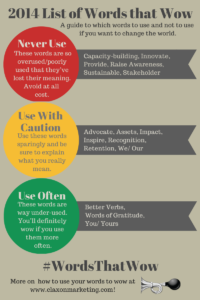
    We’ve have a whole series on word choice called #WordsThatWow. Check it out!
  6. Keep it Short
    There’s nothing worse than a three-page letter from a nonprofit, a webpage that requires an extraordinary amount of scrolling to get to the bottom, or a person that talks for five minutes straight when asked about their organization. Know your key information, and figure out the easiest way to say it.
  7. Leave Room for Inquiry
    You want people to engage with you. If you spew out pages upon pages of everything anyone could possibly want to know about your organization, you close to door to inquiry. Say enough to get people interested. Interested enough to ask more questions.
  8. Be Yourself 
    No one wants to feel like they’re talking with a robot. Let your personality and the personality of your organization shine. People relate to other people, not distant-sounding, colorless words.

Your & Yours – Use Often [#WordsThatWow]

[This is the latest post in our #WordsThatWow series. We recently wrote about We & Our. Today, we move to a different set of pronouns that merit your attention: You & Yours. Thanks to Tessa, our intern for writing this post and reminding us of the power of pronouns!]

Some of the best marketing advice I’ve ever received, from Claxon’s own Erica Mills (who was quoting Peter Drury), is this: “Donors don’t give to you. They give through you.”

In other words, people give to you because of the difference you can help them make in the community. You are a conduit. By giving you money, they allow you to rock at what you do–be that caring for kids, feeding the homeless, or fighting cancer. But it’s about the people and places you help–not you, the organization. And yet, many organizations speak and write to their donors as if the organization is at the center of–or is the hero of–the story.

For instance, does this sound familiar? (Imagine a recent donation thank you letter you’ve received, or maybe even sent).

Thank you for your donation to Organization Awesome! We have made huge strides this year. We have successfully implemented three new programs to move our mission forward. But there’s more to be done. In the coming year, we plan to…blah, blah, blah. 

If you write messages like that, your donor will not feel like they’re a part of the change. Why? Because it’s all about you. Not about them and the amazing things they have made possible.

But how about this?

You are amazing! Your recent donation to Organization Awesome has made so much possible for our community. For instance, did you hear about the three new programs we implemented this year? They having a huge impact and we couldn’t have done it without you! Your donation allows us to continue making progress on behalf of the people we serve and the community we all love. With your help, our mission will be achieved. Thank you again.

A simple change in pronouns can make a huge difference. The first example was all about ‘we’ and ‘our’. The second was all about ‘you’ and ‘your’.

This shift in pronouns doesn’t apply just to donation letters; it also applies to any of your messaging. Imagine a conversation in which you are telling someone about your organization. Hearing you and your will show your listener how the cause relates to them, make it more personal, and is more likely to get their attention. For example:

We make Seattle safer and healthier by stopping harmful chemicals from contaminating the air.

vs.

We make your city safer and healthier by making sure the air you breathe is clean.

So, go out and get personal! Use your and your as much as you can. If you have someone’s name, use that too. When you make it personal, people are more likely to get and stay involved with your organization.

Would You Say This Out Loud?

[This is the latest weekly post from our intern Tessa. You can find all her posts here.]

Simplicity Quote

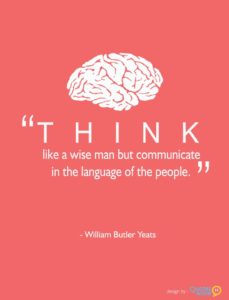
“Think like a wise man but communicate in the language of the people.” -Yeats

While I don’t particularly esteem this quotation because of its condescension to “the people” and its gender exclusionary term “wise man”, it does present a worthy sentiment.

For those of you that I didn’t lose already, let me rephrase that:

I don’t like this quote because it’s condescending, and it excludes anyone who isn’t male. But it does make a good point.

(You can obviously see the difference.)

To get your message noticed, it’s helpful to use unique words rather than the same old same old. However, there’s an important disclaimer to that advice: Make sure you are using words that are easy to understand. The key word is easy. You don’t want people to have to re-read your mission statement three times to finally get what you do. You don’t want to sound like you wrote your donation appeal with the help of a thesaurus. And you don’t want to overwhelm your audience with syllables.

An easy test you can use is this: Ask yourself, “Would I use this word/ phrase/ sentence in casual conversation?” Most people understand a “worthy sentiment”, but most people wouldn’t say it out loud. To make your message accessible, write like you speak. There are some exceptions that may have the opposite effect, such as using slang words and jargon that outsiders wouldn’t understand. But in general, if you can’t see yourself using it in conversation, don’t use it in your nonprofit’s messaging.

“Think complex thoughts but communicate with simplicity.” -my revision of Yeats.

[Photo retrieved from QuotesWave.com. Website:http://www.quoteswave.com/picture-quotes/2618]

When You Can’t Name Names

[Here’s this week’s post from Tessa, our word nerd-erific intern. You can find all her posts here.]

Yesterday, I was attempting to reduce the large quantities of e-mail I get from companies and organizations in the Seattle area. (I’m moving to San Francisco soon, so many will no longer be relevant to me). After requesting to be removed from a particularly large and well-known organization’s e-mail list for the Pacific Northwest (I won’t name names), I was surprised at the message I got. It started out well, taking me to a place where I could manage my e-mail subscriptions. (Only want to hear about international issues? Great, we can do that!).  So far, I was impressed. And then I hit unsubscribe for the Pacific Northwest List. It

Dear Constituent

took me to a page saying they were sorry to see me go, I could sign up again at any point, etc. And it was addressed “Dear Constituent”. Dear Constituent.

The coldness of this word may not have hit me so hard if I wasn’t a donor to the organization. But as such, it made me feel disconnected, unappreciated and just another “constituent”. Granted, I know they probably don’t have a system to determine which of their e-mail subscribers and donors and which aren’t. And maybe I didn’t enter my name when I signed up. That’s all okay. You can make everyone feel included and welcome, whether or not they have given you money or their name. Here are some alternatives to starting with “Dear Constituent”:

Dear Friend,
Dear Valued Supporter,
Dear Ally,
Sorry to see you go!

Here are some alternatives not to use:

Dear Recipient,
Dear Stakeholder, (More on why ‘stakeholder’ is such a bad word here.)
To Whom it May Concern,

How do you refer to someone in your messages when you don’t have his or her name?

We & Our – Use with Caution [#WordsThatWow]

nonprofit, nonprofit marketing, fundraising, language, best practices

[This is the latest post in our #WordsThatWow series.]

We. It seems like such a nice word, doesn’t it? Like a big hug. Only it’s a word. A word-hug, as it were. Ditto for ‘our’. 

“We are creating opportunities for girls across our state.”

‘We’ implies we’re all in this together. Working hard to make our state a better place. That’s a good thing,  isn’t it? Yes, it is, but here’s the thing: often ‘we’ aren’t all in this together.

“We’re putting an end to human trafficking.”

“We make sure every kid can become a great reader.”

“We feed our neighbors.”

When you read those sentences, to whom is the ‘we’ referring? That’s right, the organization. And this where ‘we’ goes awry. It’s not about you and your organization. It’s about the people you serve and the people who make it possible.

Often, when using the word “we”, nonprofits actually alienate the very people they want to include. We, us, our and ours (a.k.a. first person plural pronouns) quickly become an exclusive group, with the organization on the inside and donors, volunteers, supporters looking in. (Hence the cliché “us versus them”.)

The good news is: It doesn’t have to be this way. You can use these first person pronouns as a tool to include everyone who plays a part in helping your organization meet its mission.

Check out the phrases Tessa, our word-erific intern, used in a recent thank you letter:

 “We appreciate your commitment to a sustainable future. Together, we will create a world free of environmental injustice.”

Did you catch which “we” was referring to the organization’s staff, and which was including the donor? It’s the same word, but the distinction is in the context.

This is why we, us, our and ours can certainly be used, but should be used with caution. Sometimes, they can be powerful tools to make others feel involved in your cause. But other times, they can make people feel separate from your cause. Pay attention to your context.

We appreciate you reading our blog post. By learning more about language, we can better achieve our missions. (Get it?!)

Do you communicate as effectively as you think?

X

Do you communicate as effectively as you think?

X