Blog

The Belief-o-Meter

Deep pockets don’t necessarily mean big gifts.

A deep belief in why and how your organization does its work is a much better predictor of deep engagement–volunteering, advocating, donating.

That’s why we designed the Belief-o-Meter. It’s a silly (yet seriously effective) way of reminding you to focus on your Believers. They are the ones who can–and will–help you advance your mission most dramatically.

If all this talk of believers, agnostics and atheists has you baffled (or offended!), watch this vid.  You’ll learn all about these three important target participants categories and also get a specific suggestion for how to use the Belief-o-Meter on a day-to-day basis.

Do you believe the Belief-o-Meter can help you achieve your mission?
Hearts and Heads


Mark Phillips writes A Bloody Good Fundraising Blog. (It really is a bloody good blog.)

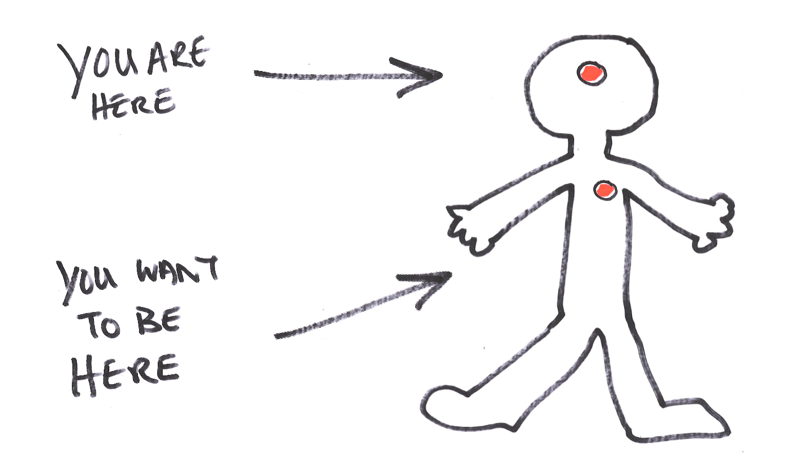
Among the many gems on his blog is The Idiots Guide to Fundraising. The stick figure at left comes from this post and it really says it all. It was the inspiration for this week’s Tune-Up Tuesday video about speaking to people’s hearts rather than their heads.

Then I read the ebook, Homer Simpson for Nonprofits, by the smart folks at Network for Good, Sea Change Strategies, and event360. This awesome little read bolstered my conviction that we need to stop trying to get people to engage by stuffing their brains with facts and figures. It also gave very specific, practical, effective ways to speak directly to people’s emotional  minds.

Are you making people’s heads hurt or their hearts sing?

Sharing is Caring

Bootcamp Week #9: Share & Use

(this week’s vid)

You’ve got your Messaging Framework. Now what?

Now you make sure staff, board and volunteers all know about it. And you make sure that everyone practices the Top-Level Message for at least three months before they start tweaking.

That’s right. Three months. Why? Because that’s long enough to figure out what was simply uncomfortable vs what isn’t working. Anything less than that and you’re just giving in to the status quo, reverting to what’s comfortable but not necessarily compelling.

Resist.

It’s also time to do an inventory of all your communications and marketing materials, both on and off-line. Then go through and make everything consistent. A bit boring perhaps, but worthwhile. Very worthwhile.

This Week’s To-Do’s

  1. Send to board and staff. Ideally, hold a training and give them the chance to practice, practice, practice.
  2. Inventory your materials and make all messaging consistent.
  3. Give yourself a great big high-five–you made it through the Nonprofit Messaging Bootcamp!

About Claxon’s Nonprofit Messaging Bootcamp

This is week #9–the final week–of our Nonprofit Messaging Bootcamp. If you’d like to get your messaging booty in shape, here’s what you do.

DIY Nonprofit Messaging Bootcamp: Step-by-Step

Over 300 organizations survived the inaugural Nonprofit Messaging Bootcamp. Congrats to each and every one of them!

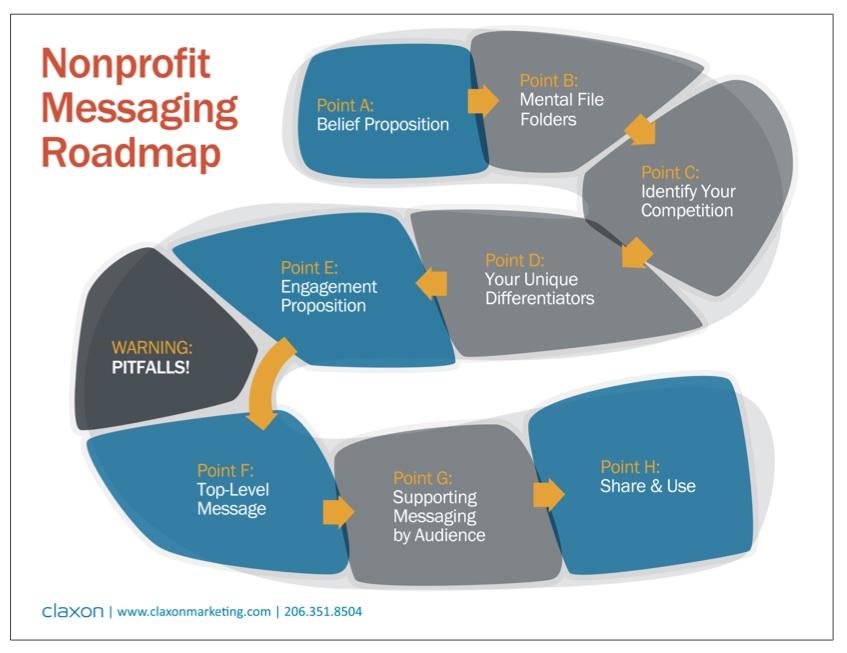
If you still want to get your organization’s messaging booty in shape, download the Nonprofit Messaging Roadmap and a Messaging Framework and then work your way through the blog posts and videos below.

We know you’re busy so everything is short and sweet–you’ll be in fab shape in no time!

Point A: Your Belief Proposition | Blog Post | Video
Point B: Mental File Folders | Blog PostVideo
Point C: Identifying Your Competition| Blog Post | Video
Point D: Unique Differentiators | Blog Post | Video
Point E: Engagement Proposition | Blog Post | Video
Point F: Pifalls to Avoid | Blog Post | Video
Point G: Top-Level Message | Blog Post | Video
Point H: Supporting Messaging by Audience | Blog Post | Video
Point I: Share & Use | Blog Post | Video

Participant-Powered Engagement

Mea culpa. For years, I’ve referred to ‘target audiences’ and ‘target markets’. I did this because knowing who you are trying to engage in your mission is important.

But audiences and markets sound like nebulous blobs. Faceless, feature-less, and certainly not able to help you advance your mission.

What we’re really after is passionate participants. Individuals, organizations, and institutions who want to help power your mission.

Inspired by Nancy Schwartz and Kivi Leroux Miller, I would like to suggest that we start using the term ‘target participant’.

How then do nonprofits go about identifying, connecting and engaging target participants?

  1. Identify your goal. What do you want people to do? What will be different for your organization and the community if people participate in making the change happen? Make it S.M.A.R.T.
  2. Identify target participants who would want to help you achieve your goal. Who are they? Why would they care?
  3. Write a hypothetical persona for each target participant. [Don’t worry about this step yet. We’ll tackle it later in the month.]
  4. Craft messages that will resonate with those personas.
  5. Test the messages with real-life people who match your persona.
  6. Push the messages out via channels that your target participants use. (You’ll figure this out when you do the personas. Again, don’t stress about it yet.)

I’m not going to lie: participant-powered engagement takes some work. But you’re working hard anyway, so why not make that hard work pay off for you, your mission, and your community?!

Messaging Fluency & MSG

Bootcamp Week #8: Supporting Messages by Audience

(this week’s vid)

What’s the difference between ‘advanced’ and ‘fluent’ when it comes to speaking a language? Your ability to calibrate to different audiences and settings.

For instance, it’s one thing to tell your colleagues that you tried the latest spot from the MSG150 food blog. It’s quite another to relay that same information to a chef from Le Cordon Bleu.

It’s about your audience and what matters most to them. That’s why it’s important to come up with your top three target audiences (the groups of people who are most important to the success of your organization) and know what they care about. Really, truly care about.

If you’re the Seattle Aquarium, visitors, volunteers and donors are all extremely important to you. But what they need to hear in order to engage differs dramatically.

This Week’s To-Do’s

  1. Download the Nonprofit Messaging Framework template.
  2. Brainstorm a list of target audiences.
  3. Narrow that list to your top three.
  4. Write a short paragraph describing what matters most to each target audience.
  5. Create two to four messages for each audience.
  6. Put proof points and stories for each supporting message that will motivate them to take action to take action!

Next Week

Sharing and using your Messaging Framework.

About Claxon’s Nonprofit Messaging Bootcamp

This is week #6 of our Nonprofit Messaging Bootcamp. If you’re just joining the Bootcamp, here’s what you need to do to get started.

Bias from a bygone era?

If you missed the front-page article in the Seattle Times yesterday on the Gates Foundation and the media, it’s worth skimming. Quickly. Over your morning cuppa joe.

It’s an odd piece. It reads as if there’s a ‘gotcha’. I waited for the gotcha. Really, I did. I kept thinking there was going to be something that made me think, “Well, yes indeed, that does give me pause. Hmmmmm….” But there wasn’t.

Instead, there were sentences like this:

Foundation officials say they don’t require ABC to report positive stories, though one of the grant’s goals is to “inspire and motivate the millions of viewers to take action.”

Oh no! How awful! The largest foundation on the planet wants to raise awareness about issues that ravage the developing world and yet get little attention in the developed world. TB, rotavirus, malnutrition. All killers. All largely ignored.

The more interesting article would have been this: In an age of blogs, Facebook, paper.li, and Twitter, is the quest for unbias coverage still relevant? Is unbias media democratic or is it antiquated?

An article like that would merit more than a cursory skim. It would spark debate and civic discourse. It would be newsworthy.

Make ’em lean in

Bootcamp Week #7: Top-Level Message

(this week’s vid)

Your answer to the question, “What does your organization do?” should make someone lean in. Actually, physically lean in. Or, depending on the listener, they might raise their eyebrows. Or tilt their head to the side while making a little ‘o’ shape with their mouth.

You get the point.

If that doesn’t happen, revisit the other points on the roadmap because you’ve either skipped one or not dug deep enough to come up with a top-level message that does justice to your cause.

Yesterday, I judged 14 teams at University of Washington’s Global Social Entrepreneurship competition (GSEC). Three of the 14 made me lean in. One of those three, Sanergy, made me lean in AND laugh. Although all three were fantastic, that’s the one I remember. That’s the one I still want to know more about.

This Week’s To-Do

Try it! Say your top-level message to as many people as possible. Start with co-workers, friends and family. Then move on to others. Keep track of who you say it to and how they respond.

Next Week

Making your message resonate with Supporting Messaging by Audience. (It’s more exciting than it sounds.)

About Claxon’s Nonprofit Messaging Bootcamp

This is week #6 of our Nonprofit Messaging Bootcamp. If you’re just joining the Bootcamp, here’s what you need to do to get started.

Down with jargon & the general public

Here are key take-aways from the bevy of convos I’ve had this month about messaging and the Nonprofit Messaging Roadmap, including at yesterday’s Tune-Up Tuesday:

  • There’s still a lot of jumping to the how and what of your work. Say it with me: “Why first. Then what and how.” If you’re on a mission to eradicate adult illiteracy (for instance), you’ve got to share that first. Then you can move on to the fact that you’re doing this by mobilizing a cadre of passionate literacy advocates, etc. etc. etc. Frame it up before you serve it up.
  • Jargon. Egads, do we ever love jargon. Even if you think your audience knows what ‘wrap-around services’ or ‘field-tested diagnostics’ are, there’s still probably a more straight-forward way of saying it. Say it that way.
  • Everyone and the general public still aren’t target audiences. Sorry. Your nonprofit doesn’t have the resources to market to ‘people’. You have the resources to market to your best supporters, your believers. Who are they? If you don’t know, figure it out.
  • Messaging should reflect your organizational goals and strategy. Check out this great post on the Getting Attention blog for some food for thought on this.

Since identifying and engaging target audiences is still such a significant roadblock for many nonprofits, March’s theme will be (you guessed it!): Identify Target Audiences. Here are some of the things you can look forward to:

  1. Writing Target Audience Personas (no more than 3).
  2. Building an Editorial Calendar based on the experience of one of your ‘Personas’.
  3. Organizing a Communications Advisory Committee made up of your best supporters who fit your ‘Personas’.

We’ll have templates and how-to’s so as long as you read the March newsletter and blog posts, you’ll be all set.

If you’d like some in-person support, we’d love to have you join us on March 15th for our next Tune-Up Tuesday at the Hearing, Speech and Deafness Center in Seattle.

Any other lessons learned or thoughts to share on all this?

Engaging in diffusion, differentiation and dissonance

This Wednesday, I had the pleasure of being in the room with some of Seattle’s leading thinkers on all things nonprofit, philanthropic and do-good-y. How’d I get so lucky? Well, late last year, me and my colleagues Peter Drury and Zan McColloch-Lussier kicked off something called The Lab. We decided it was high-time that super-smart do-gooders had an opportunity to think deep thoughts that would lead to great action.

The first time we met, we talked about listening. This week, we talked about engagement. We picked this topic because listening leads logically to engagement and yet the word engagement seems to mean a whole lotta things to a whole lotta people. Given its meteoric rise to ubiquity, we decided it was important to come to a shared understanding of this popular word (lest it end up on the Banished Words List!).

There were more good points and astute observations than you could waggle a mission statement at during our two hours together–these were my three favs:

  1. Diffusion: Technology makes it easier to engage. This is great in many ways; it also means individuals are bombarded with engagement opportunities. So, although it is technically easier to engage, it is more difficult to get people to engage because their attention is drawn in so many directions. Don’t let ease of access trick you into believing engagement is easy.
  2. Differentiation: Arcs, spectrums, ladders, pyramids. Whatever you call it, organizations benefit from thinking about how to differentiate their engagement opportunities by audience and then getting clear on how engagement leads to more engagement for each group. Be explicit. Be specific. Then you know where you want which folks to go and they know where they’re going. Happy, happy.
  3. Dissonance: We agreed that engagement is a two-way street, that both parties derive mutual benefit from engaging and have skin in the game. Engagement is active. All well and good. And yet organizations and individuals usually seek different benefits from the engagement. Or at least that would seem the case. Unless, of course, you can stay focused on the benefit you both care about: advancing mission. It was fascinating to see how this end-user vs. organizational-initiator dynamic played out in the conversation. Rigorous focus on mission mitigates dissonance.

To get more highlights and tidbits from the convo, check out #nplab on Twitter. Also, check out Zan’s great summary here. And last, but certainly not least, see what Beth Kanter (yep, THE Beth Kanter!) had to say about engagement when we interviewed her at Tech for Good, where she delivered a totally amazing training.

How do you like to engage and be engaged? How does your organization engage? What does ‘engagement’ mean to you?

Do you communicate as effectively as you think?

X

Do you communicate as effectively as you think?

X