If you want your year-end fundraising to be successful, please, please, please don’t mess with your logo!
See those logos to the left? They are examples from a recent promotion from Vertical Response.
Enticing, right?! You could really do a number to spice up your logo and make it color coordinated with the season/holiday on hand. But stop, and think, what message are you sending to your donors? Does adding a turkey to your end-of-year giving appeal really have anything to do with your mission? Or is it simply a shiny object? Nice to look at (sort of, if you like holly in your Italian food) but not great for brand cohesion and consistent messaging.
You risk confusing your donors. And confused donors are too busy being confused to make a gift.
I’m not saying to be boring with your appeals (or your thank yous). I’m simply saying: unless you’re Google, keep the holly and turkeys away from your logo.
Most people passionate about what they do have one of two reactions when someone asks about their work.
Reaction #1: In a blur of words and hand gestures, they share every single amazing tidbit of info they have in their brain about their mission, vision, values. The impact they are having. The change they are making. The awesome that they are unleashing in the name of making the world a better place! They pause only long enough to ask themselves: “How could someone not jump at the chance to be a part of something that is so, so, so, so fabulous?!!!!!!!!!”
Reaction #2: They give the most boring account ever of what they do and why they do it. No passion is present. It evaporates into thin air. Poof. Gone.
Both of these reactions happen for the same reasons: these poor people have fallen into the “elevator pitch” trap, which mushes three pitches into one, AND they don’t know how to channel their enthusiasm for their work. So they either over talk or under talk. Either way. It’s ain’t pretty.
If you want donors to donate, volunteers to volunteer, board members to serve, etc etc etc, you have to create a clear engagement path that is supported by a series of pitches. I went into this when introducing the #FixMyPitch contest I’m doing with Beth Kanter, so you can get all the details in that post. The bottom line is you need to divide your pitches into three categories: know, understand and engage. (Note that there is no ‘elevator pitch’ category. Like phones with chords, that category is a thing of the past.)
In the coming weeks, we’ll be revealing the before and after pitches for the contest winners. In the meantime, ask yourself: “do I have a clear engagement path with supporting pitches?” If you don’t, read the #FixMyPitch post, watch for the before and after examples, and start structuring the passion in your pitches by divvying them up into three tidy categories, rather than mushing them into one extinct category!
The idea is simple: many worthy organizations and individuals have pitches that need fixing, but aren’t sure how to do it. You enter your pitch (or kindly forward the info along to someone who might have a pitch that could use some fixing) and we pick the three pitches most in need of sprucing up.
One Extra Super Lucky Grand Prize Winner will win a free coaching session with me during which we’ll perform (drum roll please…) an Extreme Pitch Makeover! (Sounds kind of painful, but is actually quite fun.)
Susan Howlett brought me a question her class had asked about personas that had “stumped” her. It takes a lot to stump Susan so I figured, if Susan’s stumped and her class is stumped, you might also be stumped. This post is an effort to de-stump-ify you if you are, in fact, stumped by how to handle personas.
Before we get to the question, let’s be clear on what a persona is. Personas help you decide how to most effectively engage with your believers. They are a fictional representation of your ideal supporters. They help you get into the heads and hearts of the types of people who would be part of one of your target audience groups. What do they care about? Where do they get their information? How do they engage with organizations online? (For a blow by blow on how to create personas, download this awesome resource from Hubspot.)
A very specific point before we move on: If we’re being honest, we rarely write a piece from the perspective of the reader. Instead, we use ourselves as a proxy, i.e. we sit down and write something that we ourselves would want to read. If we like it, won’t everyone like it? No. What resonates with you and hits your emotional hot buttons doesn’t really matter. (Sorry to be harsh, but it had to be said.) What matters is what matters to those supporting your organization. So you have to get out of your head and into theirs. Thus personas.
Now that you know why you need personas and how to create them, the question then becomes: “If I have a whole bunch of personas and each of those personas is motivated by different emotions and, therefore, different words, how the heck am I supposed to make sure my annual report/newsletter/blog post/speech resonates with all of them!?”
The short answer is: you don’t.
The slightly longer answer is: you can’t please all the personas all the time. If you did that, you’d end up with boring, bland stuff that no one would want to read because you’d be trying to appeal to everyone. The whole point of having personas is to be able to craft messages that hit the mark for that particular persona, right? If you try to hit on everything that might possibly, conceivably matter to all of your personas at the same time, it’d be like unleashing a blaze of arrows at the same time—they’d go hither, thither and yon while never hitting the bulls eye. So sad.
Here’s what you do: you optimize each piece for one persona.
Every time you sit down to write something, ask yourself the following questions:
What is the goal of this piece?
Based on #1, which persona does this piece need to resonate with most in order to be successful?
Optimizing for one persona doesn’t mean it won’t resonate with other personas. It means it will resonate most with the types of people you need to connect with in order for that particular piece to be successful. For instance:
Is your Annual Report optimized for ‘Erin the Existing Donor’ Or ‘Patty the Potential Donor’? Erin will be delighted to learn more about what her donation has done, but really what’s in it for Patty? Usually not as much as we’d like to think. Optimize for Erin.
Is your newsletter really, truly optimized for ‘Dawn the Dutiful Donor’? If, based on your research while building your personas, you learn that the Dawns of the world prefer hard copy newsletters, then sending it electronically, although less expensive in the short-term, might be costing you money in the long run.
At first, optimizing for one persona will feel scary. But try it a few times and, usually, the results will speak for themselves.
Quick Tip: Zan McColloch-Lussier shared this tip with me many moons ago and it’s a really, really good one. Whenever you sit down to write something, write down the name of the persona for which you are optimizing. Yep, like write it down where you can see it. You’ll be stunned and amazed at how much more on target your messaging becomes when you have a crystal clear mental image of who will, eventually, be reading it. (Cuz as we covered above, it ain’t you.)
Jargon. It seems so benign. What could be so wrong with using the expressions ‘wrap-around services’, ‘collective impact‘, or ‘philanthropic value proposition’?
As David Ogilvy so eloquently stated: “Our business is infested with idiots who try to impress by using pretentious jargon.” Put another way: You may think jargon makes you sound smart. But the “smarter” you sound, the dumber your listener likely feels.
If you want people to engage, invest, support, donate, volunteer and/or serve as your advocates or fans, you’ll be well served by systematically eradicating jargon from your marketplace of words.
NOTE: It costs you nothing to stop using jargon. It costs you everything if you don’t succeed in getting people engaged in your work and talking about it to others! Don’t let something as simple as jargon get in your way.
There is an Official Adjective that speaks to leadership in an organization: leaderless.
Yes, that’s right. We have a word to describe a lack of leadership but not one to describe a surfeit of leadership. Nope, not one to describe the idea of an organization being filled with people imbued with the confidence to–regardless of title or status–be leaderly.
We have a word that speaks directly to the terrible state of affairs of being, gulp, leaderless. But not one that speaks to the awesome state of affairs of being filled to the brim with people who–again regardless of title or status–can and will step up and lead.
Awhile ago, I started using the term ‘leaderly’, e.g. “That was a tough situation and you handled it in a very leaderly fashion.” I make up words all the time so didn’t give much thought to this new addition to my personal lexicon. It’s a funny sounding word and therefore catchy. I noticed other people started using it. Again, I didn’t think much of it. People embraced ‘funective‘, so why not leaderly?
Somehow, being leaderly doesn’t feel weighty enough. It lacks the gravitas we tend to append to all things having to do with leading and being in a leadership position. I mean, leaders are the the ones who “go before and with to show the way,” who “guide in direction, course, action, opinion, etc.” These people are serious. They have corner offices. Their smart phones are on over-drive. They are in a league of their own.
And therein lies the problem. We’ve elevated leadership to a level that makes us believe we can only achieve it if we can leap tall buildings in a single bound. Since only a scant number of people can do that, it’s easy to opt out.
This isn’t just a problem for one (word-obsessed) professor preparing for one class at one university. This is language getting in our way in a seriously egregious manner. This is a fundamental issue that, I contend, is undermining our efforts, and ultimately our ability, to make the world a better place.
We may not all be Leaders, with a capital ‘L’. We may not have the right title or pay grade or a reserved parking spot. But we can all lead. We can all, in ways big and small, go before others, and with others, and guide them in direction, course, action and opinion.
There’s a difference between being a Capital ‘L’ Leader and being someone who leads. If we’re going to make the world a better place, we need both. In spades. We need as many verbs, nouns and adjectives as possible to describe this idea of forward momentum, conviction, vision and execution.
It begs the question: how will you be leaderly today?
In honor of National Punctuation Day, I’d like to offer a few tips on exclamation point usage. Of all the punctuation out there, why the exclamation point, you ask? Because I’m seeing a naughty trend in how y’all are using it. #ShameOnYou
Before we get to the naughtiness, let’s get something clear: Exclamation points are the cheerleaders and rabblerousers of the punctuation world. As such, you should only use one when you have a truly strong emotion–excited, mad, elated, indignant, astonished, etc–about whatever is in the sentence it is capping off (yep, I know that’s a dangling participle).
Now for the naughty: We (and by ‘we’, I mean ‘you’) are all too frequently making the poor exclamation point do the yucky work of masking a sub-awesome reality.
A few examples and suggestions:
“The office coffee machine is broken. Good thing there’s a Starbucks just half a mile away!” If you’re used to being able to amble down the hall to get your fix, trudging half a mile is not an adequate substitute. And you know it. Person up and say something like: “The office coffee machine broke. We can either all snip at each other all day or you can take your bad selves down to the Starbucks. The walk will do you good. The machine will be fixed tomorrow. Deal.”
“We didn’t meet our fundraising goals this past quarter. But there’s always next quarter!” Are you really feeling pumped about not meeting your fundraising goals? Probably not. No amount of exclamation points is going to fix the fact that you didn’t meet your goals. Having said that, it’s also not the end of the world. But you do need to address what’s going on and have a discussion about how you propose to move forward. That means having a conversion. That means you need a question mark. “We didn’t meet our fundraising goals this past quarter. Why do you think that is and how can we work as a team to hit them next quarter?”
And your donors see through your exclamation points as well. If you overuse them, they lose their impact. Use them sparingly. If you find yourself sticking an exclamation point on everything, it probably means you’re using boring words (like, say, provide). Let your exclamation points take a nap while you forage for some spunkier words.
Earlier this week, I gave a keynote for the Alliance of Arizona’s annual membership meeting. I got to talk about one of the my all-time favorite topics >> The Language of Impact: how words can make the world a better place.
We covered 7 rules of thumb when it comes to using language, and therefore words, to increase impact.
I focus a lot on pitches because they force you to really pay attention to every single word you use. It’s a useful exercise to see if you can say what you have to say in 10 words or less. It forces you to find the very best words and to prune out the superfluous ones.
Is this easy? No. Mark Twain said, “I would’ve written you a shorter story, but I didn’t have the time.”
Is it worth it? Yes.
Because the above Rules of Thumb take a little explaining in order to embrace, over the next few weeks, you’ll see a follow-up post on each rule. In the meantime, experiment with saying whatever you have to say in 10 words or less. See what stays and what goes.
(If you know anyone else who might be interested in how to use words to make the world a better place, share/forward this post so they can get in on the action, okay? Thanks!)
A note on cats and dogs: At the beginning of my talk, I asked a series of questions so I could factor the audience’s answers into my remarks. One of the questions was whether they were a cat person or a dog person. Someone asked me later how I used that information. (They were too polite to say it, but I think their real question was: do I really use that information or do I just ask it because it’s kinda funny? Either question is totally legit.)
Here’s the answer: I commonly ask the question at the beginning of a talk and, yes, I totally use what I learn. Acknowledging that this is a GROSS GENERALIZATION (and one with which some will take umbrage), here’s how: I use it as a proxy for how extroverted/introverted a group is. I then use this to inform how much I will/can engage the group.
For this particular group, there were way more dog people than cat people in da house. I engaged the audience a whole lot. I called on people individually. I asked questions throughout, etc. If there had been way more cat people, I might not have engaged quite so much. At least not right away. I would’ve eased into it a bit more. Not because introverts aren’t social–because they can be!–but they generally have a different learning style than extroverts. (See this wonderful graphic for more on introverts and extroverts.) This cat/dog approach is not an exact science and has its flaws, but it works pretty darn well.
So there you have it: 7 Rules of Thumb, plus some cats and dogs.
Disclaimer: The above paragraph should not be taken as judgement for or against introverts or extroverts, cat-lovers or dog-lovers or animal-lovers, in general. The world needs all the above, plus the animals they love.
Before we dig in, I want to introduce you to Roxie the Bird. For the record, she has been around longer than Twitter or Portlandia. She’s a seasoned bird. She can guide you to messaging awesomeness. Sometimes she’s bossy (or, as I like to say “directive”), but she knows her stuff, so pay attention to her when you see her. And, yes, you’ll be seeing her more often.
Now that we’re through introductions…
Many organizations are making due with marketing that’s “good enough”. The problem is “good enough” is often not good enough anymore. You’re competing for the heads and hearts of supporters who are on the receiving end of some pretty fantastic marketing from other organizations.
Sometimes you can look at a pitch and immediately say “Oh boy, that one’s a stinker!” But when it’s your own message–one you live and breathe every day—well, it’s not that easy to tell the difference.
At the risk of going all Sham-Wow on you, I have something that can help. I created the 1,2,3 Marketing Assessment to help you figure out if what your marketing is hitting the mark and, if not, why.
Using the tool, you quickly score your current efforts against the three elements required for really great marketing. It’s quick and easy, people, so no excuses not to do it.
Your mission deserves better than “good enough”, does it not?
 If you want your year-end fundraising to be successful, please, please, please don’t mess with your logo!


 Awhile ago, I started using the term ‘leaderly’, e.g. “That was a tough situation and you handled it in a very leaderly fashion.” I make up words all the time so didn’t give much thought to this new addition to my personal lexicon. It’s a funny sounding word and therefore catchy. I noticed other people started using it. Again, I didn’t think much of it. People embraced
  In honor of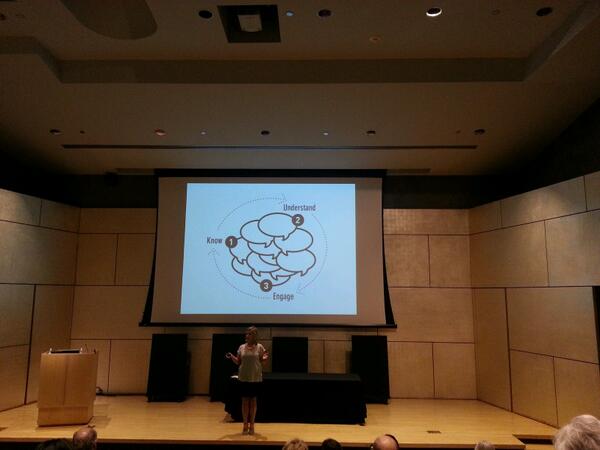
 Before we dig in, I want to introduce you to Roxie the Bird. For the record, she has been around longer than