Blog

Don’t train for a marathon by biking

goals, strategy, tactics, marketing, messaging, leadership
Make your training support your goals.
At the risk of stating the obvious: when you’re training for a marathon, you run. You run a lot. You run so you’re ready for the marathon. So you’ll achieve your goal.

You don’t bike. (Aside from a little cross-training perhaps.)

If your goal is to retain donors, pick tactics that will help you connect with current donors. Don’t get distracted by engaging new ones.

Ditto for volunteer engagement.
Advocacy.
Public awareness.
And any other goal you have.

Don’t do the equivalent of training for a marathon by riding your bike.

You’ll never get to the finish line.

Is your mission guiding or motivating?

mission, marketing, communications, fundraising
Image by © Royalty-Free/Corbis

When something is “mission-driven”, it means it is guided by mission: mission-driven strategy, mission-driven communications, mission-driven staff.

When something is “mission-motivated”, it means the mission offers a motive for action: mission-motivated messaging, mission-motivated marketing, mission-motivated fundraising.

Be clear on when your mission is guiding and when it is motivating. There’s a big difference.

4 questions, 3 words, 1 message

At the NDOA Spring Conference, I gave a presentation on Using Messaging to Engage your Community.

I challenged the group to pick three words that define and differentiate their organization. And then weave those into their messaging across all platforms–elevator pitch, social media, brochures, case for support. You name it. Those three words should come through. Concise, consistent, compelling. That’s what this approach gets you. That’s why it’s effective.

Here are the four questions to ask to get you to the three words:

  1. Why do you exist?
  2. What do you do?
  3. Why you?
  4. Why now?

What are your answers? What are your three words?


The 4 Personalities of Tom Ahern

Tom Ahern, fundraising, nonprofits, non profit,
Tom Ahern, from his site, looking young and happy in France!

Do you have a specific type of reader in mind when you write your fundraising appeal, newsletter, brochure, blog, Facebook post…? You should. This is where personas come in.

Creating a full-blown persona can feel arduous. Thank goodness for Tom Ahern! He gives us four handy personalities to consider when embarking on mission-motivated writing.

  1. Amiable: They crave a good story and engaging images.
  2. Expressive: They want something new. Program, website, trends, reports. New=good.
  3. Skeptical: They’re into facts and supporting evidence. FAQs, testimonials and proof points will make them happy.
  4. Bottom-liner: They’re looking for a very specific, actionable call to action (CTA). Make it easy for them to know what to do.

Each of us has a bit of each of these personalities in us and so do the people you’re trying to engage. Write accordingly. You might mix a bit of amiable with a dose of skeptical for your fall newsletter and then for your year-end appeal, get expressive with some bottom-line.

The point: For best results, write with a specific personality in mind.

Who’s minding your message?

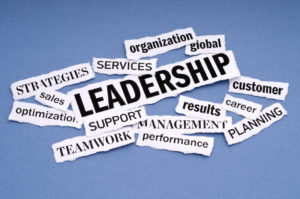
leadership, messaging, words, leading, leaders
Photo credit: CetasKinetic

Newsflash: It’s not the resident English major or wordsmith who should be minding your message. It’s the leaders.

Minding your message is much about culture than it is words. This is where leaders come in.

To successfully use words to advance your mission, leaders have to create an organizational culture that values and prioritizes finding the words that will make you stand out from the crowd.

Easier said than done, you might say, and your to-do list is plenty long as it is. That’s fair. Luckily, organizations that effectively use words to advance their mission have some common characteristics.

For starters, consider these five:

  1. They gain internal alignment before going for external amplification: How can you effectively engage people externally if your house isn’t in order? When you’re internally in sync on your why and your what, the words fall into place.
  2. They are crystal clear on who matters most to their mission: The ‘general public’ is never held up as a potential audience in the hope that if you cast a wide net, you’ll catch at least a few fish. No! Instead, these organizations know exactly what types of people they need to connect with in order to be successful. In this way, they liberate everyone from distraction.
  3. They are willing to fail: You’re not going to hit it out of the park every time. You have to be willing to fail if you’re serious about succeeding.
  4. They embrace competition: There are a lot of organizations on a mission to make the world a better place. (This is a good thing!) By definition, this means there’s competition. Organizations that embrace this speak both to what defines them AND what differentiates them. If you stop at what defines you, you’re only half-way to finding the right words. You’ll be lumped in with every other organization that shares your cause–education, environment, arts, homelessness, hunger. What makes you different from other organizations tackling this issue?
  5. They tow the line: Once you’ve defined and differentiated your organization, you can find your words and create your messaging. But let’s be clear: everyone is expected to say every word exactly the same. BOR-ing. Rather, pick 3-4 key words that you expect staff and board to use consistently. Give examples and let people personalize. And then make everyone stick to it–including yourself. Over time, those are the words that external stakeholders–donors, volunteers, supporters–will use, as well. This is how your organization will establish the mind share it needs to be successful.

Culture change is hard work, no doubt. But how cool would it be to lead an organization that knows exactly how to use words, language and messaging to get your good work noticed? Pretty darn cool.


Analytics on the Brain

analytics, fundraising, statistics, brain science

Last week, I got an infusion of awesomeness from Josh Birkholz and Justin Ware of Benz Whaley Flessner. They did a workshop on navigating the new frontier of social media and predictive analytics.

To make smart decisions for your organization, you’ve got to have analytics on the brain. For marketing, that means looking at what’s working, what’s not and for whom.

Josh pointed out that marketers focus on defining groups of people whereas fundraising data-heads (aka people like Josh who practice predictive analytics) differentiate between groups.

To get people engaged, you learn the art of identifying which types of people are drawn to your organization and create personas based on that. Then you figure out how to get the attention of people who fit that persona.

To keep people engaged, you differentiate by figuring out what works best with different types of supporters in your database.

For-purpose, mission-driven marketing is often more art than science. Organizations generally don’t have the budget to test in a way that produces statistically significant results. However, you can bring some science to the art of figuring out what works with different types of supporters.

Once you’ve created personas for your top 2-3 types of supporters, here are two simple ideas to try:

  • Do A/B testing on your e-newsletters and see what motivates current subscribers to forward it (which eventually leads to more newsletter subscribers and, eventually, supporters).
  • Track which Facebook posts get the most reaction from different types of people, e.g. someone who ‘likes’ you but doesn’t donate, current volunteer, past donor, etc.
Over time, you’ll learn what works with which types of people. You’ll be better able to make decisions about how to align your messaging, content and tactics with current goals.
If you already have plenty of people in your database and want someone super smart to help you make sense of it all so you can better achieve your goals, call Josh. You’ll learn a ton AND have fun.

Fundraiser or Happymaker?

It turns out that money CAN buy you happiness. Michael Norton figured out how. He tells us all about it in the 10 minute TED talk below. (It’s totally worth watching for the dodge ball reference alone.)

Here’s one really interesting finding from his research: the frequency with which people spend money on things that benefit others–things like giving to a non profit, for instance–matters more than the amount.

If you’ve ever needed to make the case for the value of monthly donations to an annual fund, there you have it! Giving on a regular basis makes people happier.

In terms of titles, I’ve long wondered why we refer to the feature (raising funds) over the benefit of raising the funds (increasing happiness and making the world a better place).

It may be awhile before we see ‘Chief Happiness Officer’ on business cards, but wouldn’t it be great for fundraisers to have a title that spoke to their impact rather than their actions?

Event donors: more than a one night stand

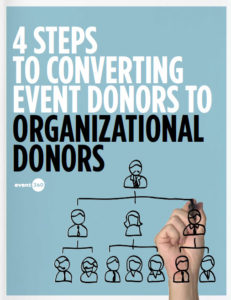
event360, fundraising event, donor communicationsEvent 360 recently released a new white paper: 4 steps to converting event donors to organizational donors. I will leave the in-depth commentary on whether these are the “right” 4 steps to event pros like Shanon Doolittle but will say that the event donor segmentation and sample engagement plan for major donors alone are worth giving over your email address for (which you have to do to download it).

Here’s the thing: Event donors often get stuck in the one night stand camp because we try to go too far, too fast.

Unlike most other forms of fundraising where there is a longer lead up to the ask, event participants go from ‘I don’t know you at all’ to ‘going all the way’ (i.e. making a donation) very quickly.

Even after the event, event attendees barely know you! You’ve had a fling. Even if it was a great fling, it was still just a fling. That’s very different than a courtship.

From a messaging perspective, this means you have to properly introduce them to your organization after the event. In the event follow-up, don’t make the mistake of leaping to the middle of your story. Reinforce what they learned–and felt–at the event. Reiterate the key points from the event. Reinforce why they should like you. Cement their basic knowledge of your cause, your mission, what makes you unique and how they can engage.

This may sound incredibly, painfully obvious. But I’m always surprised how clunky post-event communications tend to be. Take it slow and your event donors can turn into much more than a one night stand.


Honk if you love SMO!

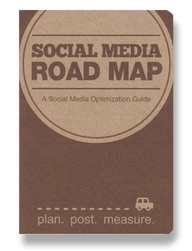
social media road map, SMO books, Noland Hoshino, Zan McColloch-Lussier, Ash ShepherdSocial Media rock stars Noland Hoshino, Ash Shepherd and Zan McColloch-Lussier just released the newest SMO book, Social Media Road Map. This little book is pure genius. Fun, straight-forward and actionable.

Among other bits of awesomeness, they recommend a fab messaging exercise:

“Create a bumper sticker message that reflects your brand, position, and personality. Your message should motivate and excite your audience so they show their support by ‘honking’ along with you.”

They’re recommending this in the context of social media. But this is a good exercise regardless of context. It forces you to get down to the essence of what you are trying to communicate.

Netizens are skimmers, not readers. And your donors, supporters, volunteers and fans are all Netizens. They are bumper sticker hounds.

If finding the right words feels daunting, start by asking yourself if there’s a way you can swap out one or two words so it better reflects your organization’s unique personality, what you stand for, and what you’re asking people to do.

Take, for example, these subject lines plucked from the flurry of emails I recently received on Seattle’s GiveBIG Day. On May 2, Seattle-ites were receiving dozens–if not hundreds–of emails from organizations asking them to participate in this community-wide day of giving. Every single organization and email had the same ask: Give to us today. Perfect opportunity to let your personality shine through, right?

  1. GiveBIG is today.
  2. Get ready to GiveBIG.
  3. GiveBIG. Here. Now!

#1 represents the vast majority of the emails I received. Nothing wrong with it. But it doesn’t have a lot of personality. It doesn’t make you want to honk.

With #2, you might be inclined to at least remind yourself where your horn is. (Seattle-ites don’t honk. It’s not polite, the rationale goes.) But you could easily get distracted by your radio once you found the horn and forget you were going to honk.

#3 reads like a moral imperative. It makes your eyebrows shoot up as you think, “Dang, I better get giving!”

Interestingly, #3 mainly stood out because of punctuation. Punctuation practically begs to be fiddled with–commas, exclamation points, em-dashes, colons.

Try it. Take your current tagline or boilerplate sentence and switch up the punctuation or switch out a word or two. Is there a way you can make it into a bumper sticker you’d be proud to slap on your car?

The bumper sticker exercise is one gem among many in the Social Media Road Map. At $7.95, this is one of the best investments your organization can make.

“I work for a non profit.”

overhead, Dan Pallotta, Charity Defense Council
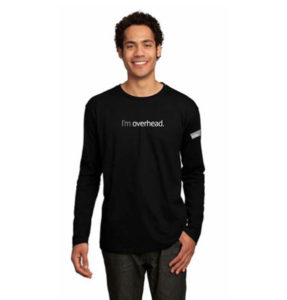
Dan Pallotta's ad campaign to get people "over" overhead.

The topic of renaming the non profit sector came up a lot at the Washington State Nonprofit Conference last Friday. That’s because Dan Pallotta, author of Uncharitable and shaker-upper-of-all-things-traditionally-nonprofit, gave the keynote. He’s the guy who pointed out that, in Latin, non profit means “non progress” and that that’s a pretty lame name for a group of people hell bent on making progress on a better world.

While we continue the hunt for a better name for the non profit sector–one that might actually stick so people would actually change behavior and stop saying it–I’ve got a suggestion.

People who work in the for profit space don’t say, “I work for an S-Corp/C-Corp/LLC/etc.” They say, “I work for a bank.” or “I’m in IT project management.” or “I build websites.”

Why do those in the ‘for purpose’ space, as Pencils for Purpose Founder Adam Braun would say, start with, “I work for a nonprofit. We [insert blurb about what you do]”? Why do we feel compelled to preface our answer by clarifying our tax status?

Taking out the tax status reference would be a giant step toward being known for what we do and why we do it, rather than how the IRS refers to us.

That can only be good, right?

Do you communicate as effectively as you think?

X

Do you communicate as effectively as you think?

X