Blog

Now that’s how you say Thank You!

I’ve written a fair amount on this blog about gratitude and giving thanks. It’s super duper important when it comes to marketing…and life in general.  In addition to ‘non-profit‘ and ‘provide‘, showing gratitude is a soapbox I regularly haul out and hop on top of (look here and here to see what I mean).

So when I got these stupendously awesome thank you notes, I wanted to be sure to share them with you. Cuz who doesn’t need a little inspiration in their life?!

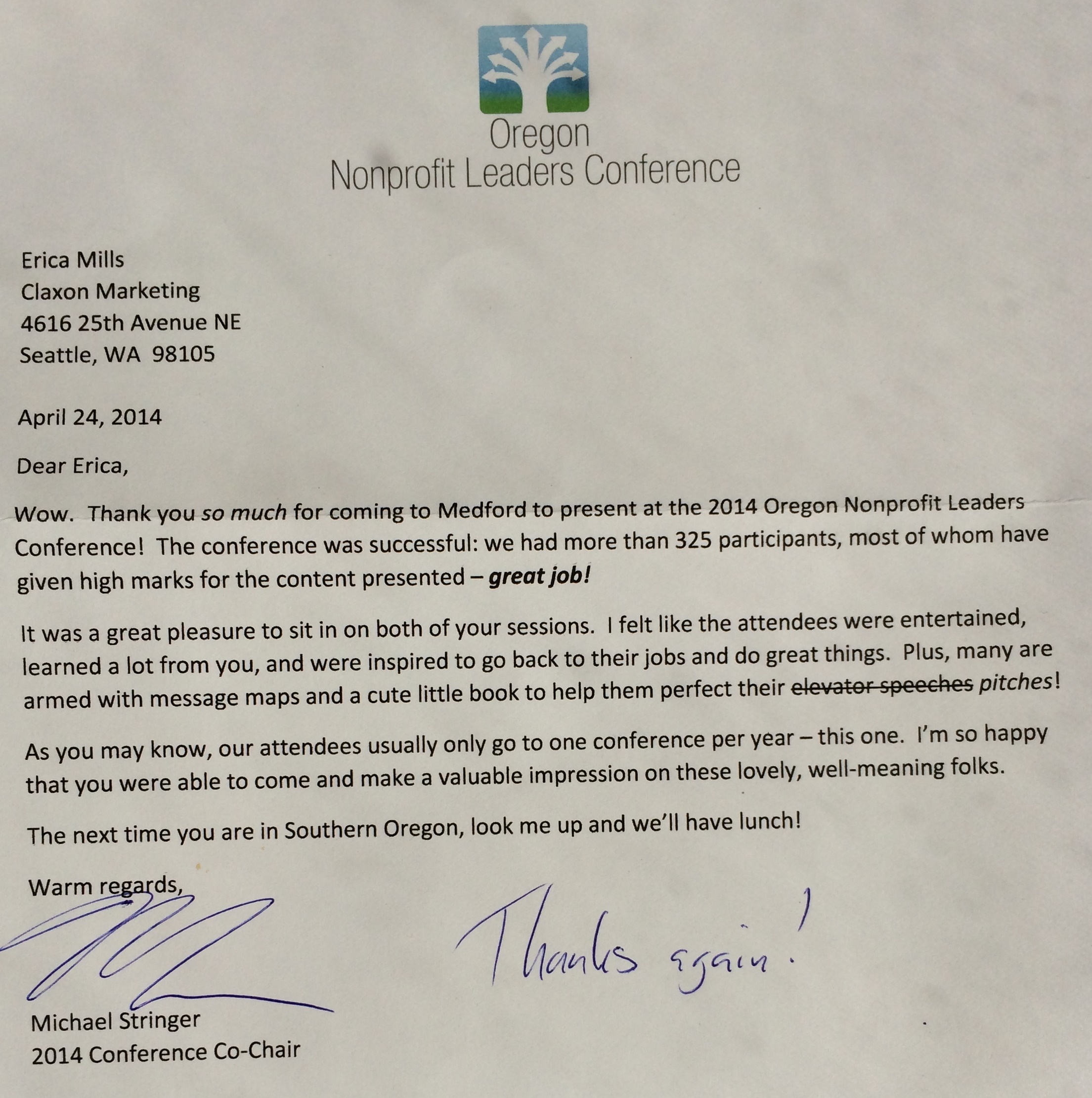
This first one came from Michael Stringer, one of the conference co-chairs of the Oregon Nonprofit Leaders Conference (which, by the way, is possibly the best run conference I’ve ever been privileged enough to be a part of). Although written on letterhead, which can feel more formal, his thank you is warm, genuine and personalized. Look at how he incorporated the content from my sessions into the thank you by swapping out “elevator speeches” for “pitches”. Love this guy!

Oregon Nonprofit Leaders Conference, thank you, gratitude,


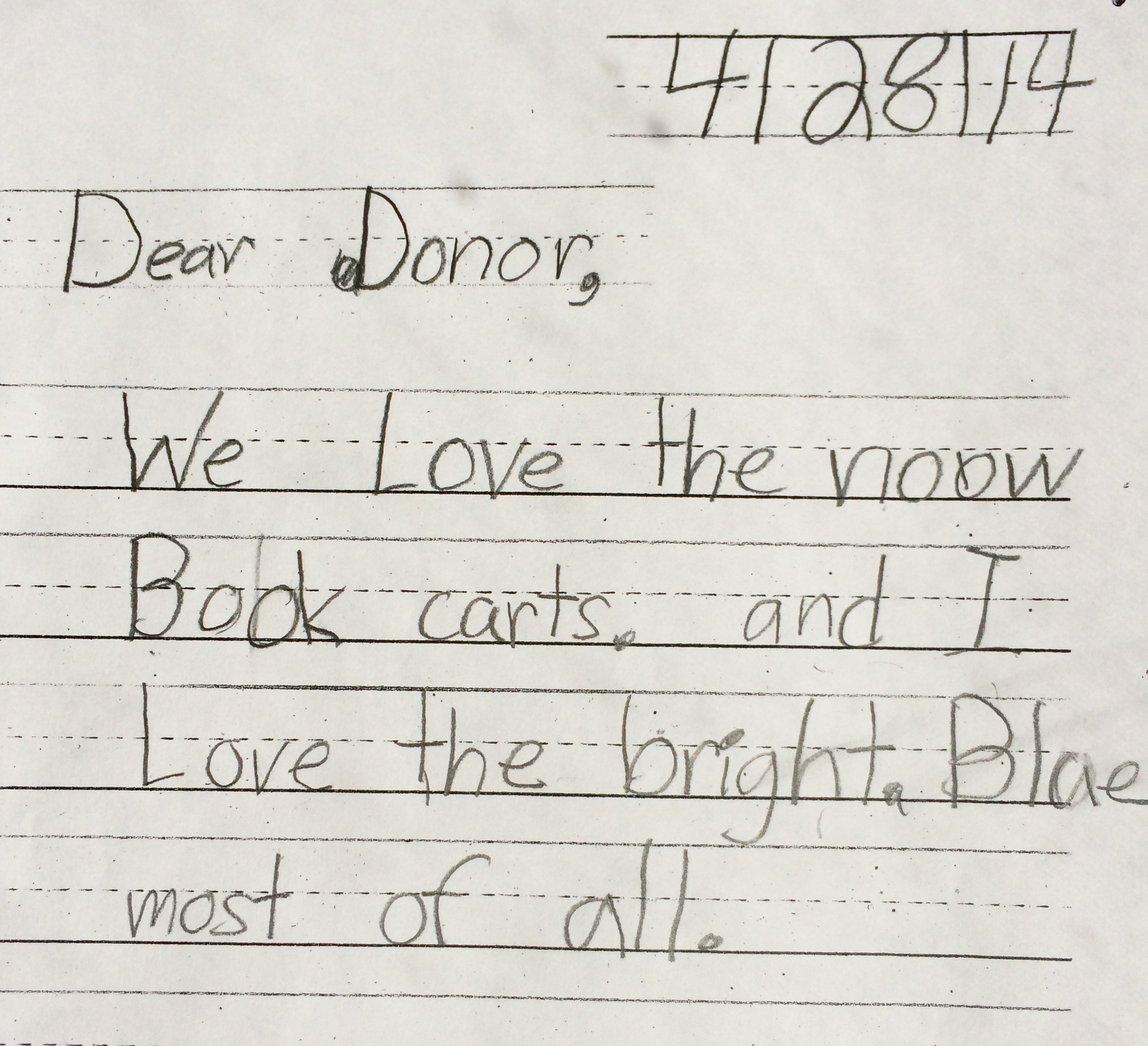
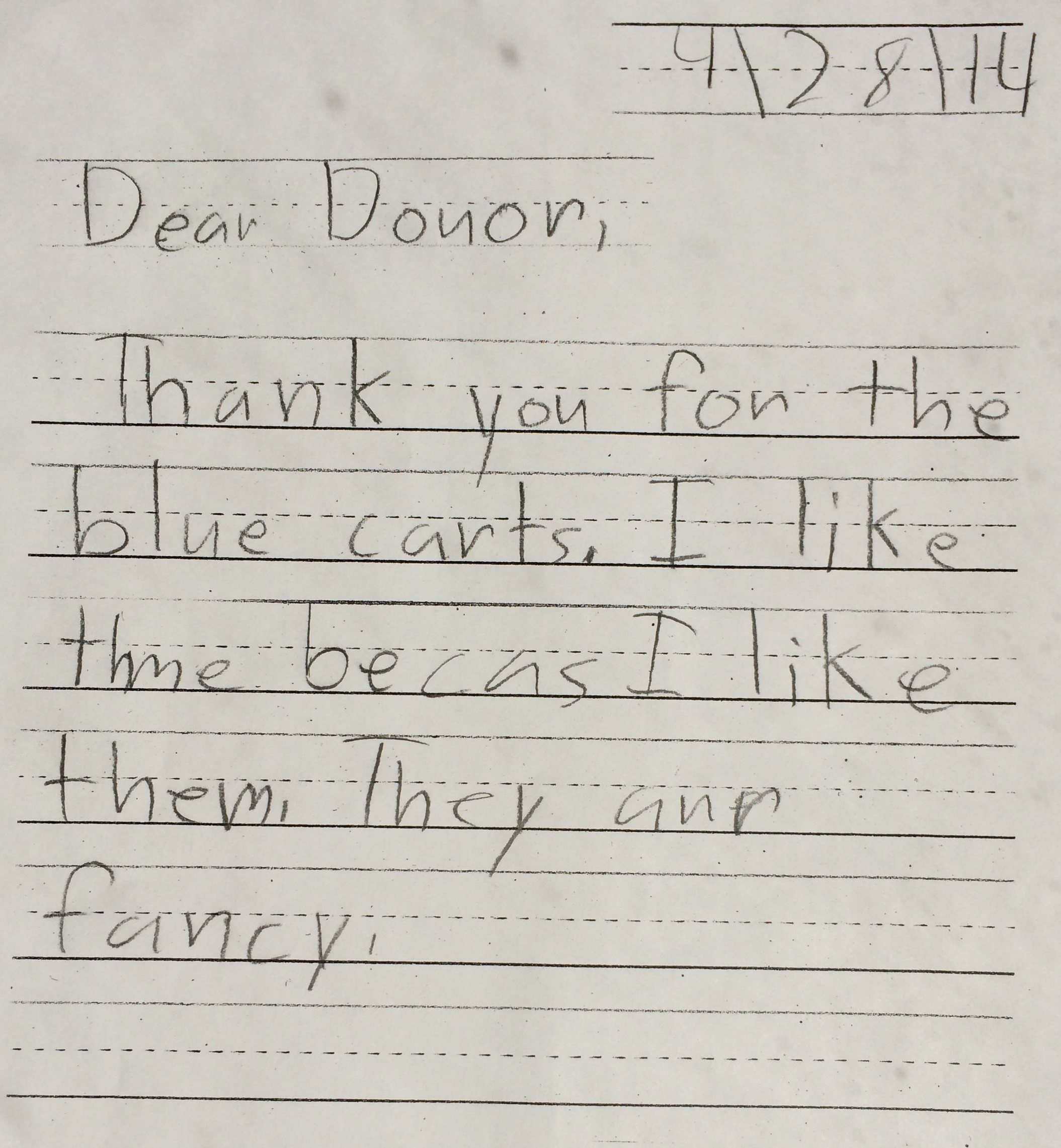
The next two are from came our way because, as a way of showing gratitude to Claxon fabulous clients, we  made a donation in their name via Donors Choose so that a third grade class could start a book club. Every single student wrote a thank you note. Every single one. These are two of about 25 that we received. Um…awesome!

gratitude, thank you notes, Donors Choose

If  8  year olds can knock gratitude out of the park, so can you! Your thank yous don’t need to be fancy–they need to be genuine, heart-felt, authentic.

Be creative. Have fun. Notes, phone calls, social media shout-outs, profiles in your newsletters–the ways in which you can show gratitude are almost endless. How will you show gratitude?

letter2

Check it Out: How to Make Your Writing Error-Free

[This is the latest weekly post from our intern, Tessa. You can find all her posts here.

Editing (improving your initial writing) and proofreading (final reviewing before publishing) require much more than finding grammar or spelling mistakes. You have to remember to pay attention to flow, keep a consistent voice, eliminate jargon, etc. It’s a lot to keep track of. Even the experienced writer can forget to check for everything when reviewing their (or others’) work.

Recently, I stumbled across some articles that offered such a simple solution that I was surprised I hadn’t though of it sooner…. The ever-handy checklist!

Check Mark

HubSpot and Quick and Dirty Tips put together these amazing checklists (one even printable) to have by your side while editing and proofreading:

Your Essential Proofreading Checklist: 10 Things You Can’t Forget

Grammar Girl’s Editing Checklist

Bookmark them and/ or print them. Now. You’ll thank me. Happy revising!

Pitchfalls Winner Announced

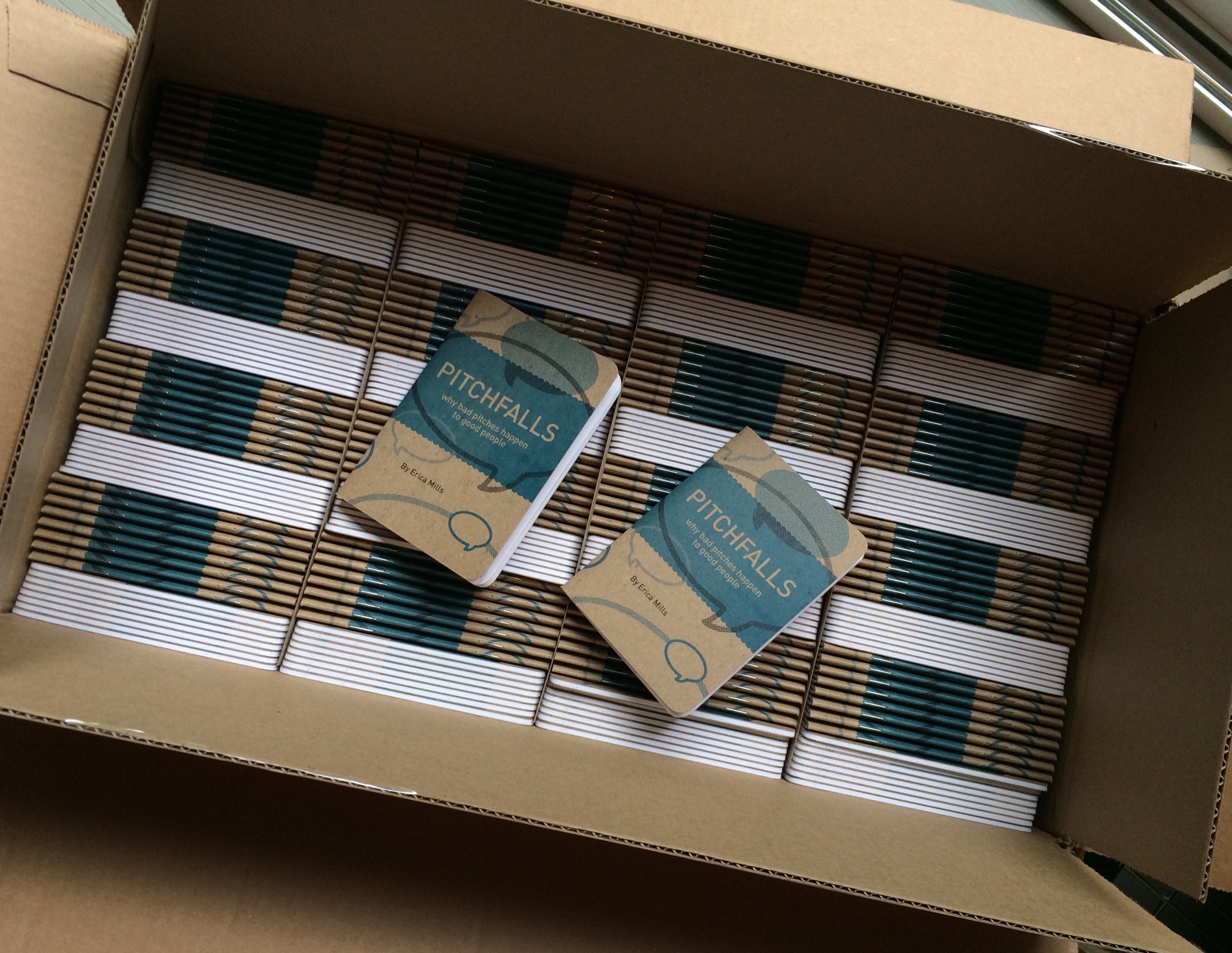
Pitchfalls2In our excitement about selling out of our first batch of Pitchfalls: Why Bad Pitches Happen to Good People, we decided to give away the first copy of the second batch for free. You may have seen us tweeting like crazy last week to let you all know about it. To decide the lucky winner, we randomly chose one of our Facebook followers. We’re happy to announce that the winner is…..

Mieko Van Kirk of Seattle, WA!

Mieko is operations manager at Sightline, a Seattle-based nonprofit that researches best public policy practices for the Northwest. Mieko says, “Thanks, Claxon! Looking forward to sharing what I learn from Pitchfalls with my colleagues here at Sightline Institute.”

Congratulations, Mieko!

For those of you that didn’t win, you can purchase a copy of Pitchfalls on Amazon, or in Seattle at The Elliott Bay Bookstore or Third Place Books.

We Want YOU to Win a Very Special Copy of Pitchfalls

All of us at Claxon are so excited that our first batch of Pitchfalls: Why Bad Pitches Happen to Good People has sold out. Thank you to everyone that played a part in this awesome accomplishment. We like to think we’ve contributed to getting rid of boring elevator pitches forever.

Pitchfalls2

The second batch of Pitchfalls just arrived, and we want to show some appreciation. We’ll be giving away the very first copy of the second batch to one of our Facebook followers. If you’d like to be entered in the drawing, check out our Facebook page and press ‘like’. Now is the time – we’ll be choosing and announcing the winner tomorrow May 9th. Thank you again to all of our supporters, and good luck! Remember, visit our Facebook page now and press ‘like’. We can’t wait to give you your copy of Pitchfalls.

Words of Gratitude – Use Often [#WordsThatWow]

[This is the last post in our #WordsThatWow series. Read the rest of the posts here.]

nonprofit, nonprofit marketing, fundraising, language, best practicesI would maintain that thanks are the highest form of thought; and that gratitude is happiness doubled by wonder. ~G.K. Chesterton

Right, so, here’s the thing–we simply don’t show enough gratitude. By ‘we’, I mean pretty much all of us. Not just nonprofits. Many times in any given day I think, “Dang, I am grateful to that person/ organization/ company/ whatever for that bit of goodness they are putting out to the world.” But thinking it isn’t the same as saying it or showing it. As G. B. Stern said, “Silent gratitude isn’t much use to anyone.”

Words of Gratitude come in all shapes and sizes. Here’s some inspiration!

In short, show gratitude whenever possible. So many people contribute to your nonprofit’s success–donors, volunteers, community supporters, etc. etc. Make sure they know how much you appreciate them. And remember that expressing gratitude not only makes the person you’re talking to feel good, it makes you feel good, too.

Thank you for reading this post!


For Your Mom Only: The Spelling of Mother’s Day

[This is the latest weekly post from our intern, Tessa. You can find all her posts here.

Let’s go there. Apostrophes.

I’ve seen so many misplaced apostrophes in my life. Contractions and abbreviations aren’t usually the problem. Most people understand that when cannot becomes can’t and about becomes ‘bout, that little floating comma comes into play.

It’s apostrophes’ possessive function that usually causes confusion. The reason? Based on whether a word is plural or singular, the positioning of the apostrophe changes. For example, if I were talking about only one apostrophe in the first sentence of this paragraph, apostrophes’ would become apostrophe’s. This causes a lot of questions. What happens if singular word ends in s? (Answer: Still add ‘s to the end). What happens if the plural doesn’t end in s? (Answer: Same thing: add ‘s).

These variables seem to cause other issues. Apostrophes show up where they don’t belong at all. For a thorough yet quick guide on proper apostrophe use, visit Grammar Girl’s Quick and Dirty Tips: Apostrophe Catastrophe.

Anyway, back to the original purpose of this post: Mother’s Day is this Sunday May 11th! Believe it or not, the apostrophe in this holiday is intentionally placed. Mother’s Day was created in its singular possessive form as an indication that each and every mother should be individually honored.

Since so many mothers are celebrated on this day, yes, it technically should be Mothers’ Day. But there’s something sweet about the idea of giving each mother her very own special day. We all know they deserve it. So, happy Mother’s Day, Mom!

My beautiful Mama and me.


Better Verbs–Use Often [#WordsThatWow]

nonprofit, nonprofit marketing, fundraising, language, best practices[This is the latest installment in our#WordsThatWow series. You can read the others here and you can download the infographic here.]

Verbs are very important. They are action words. They are the superheroes of every sentence. They speak directly to the change you want to create in the world.

And yet most nonprofits focus so much energy on defining their nouns–people, places, and things–that by the time they get to picking a verb, they’re all out of energy. Enter the verb ‘provide’.

Provide is such a handy verb–so flexible, so malleable, so ubiquitous.

It is its ubiquity that will be its demise (I hope).

If you’re looking to use your words to stand out from the crowd, provide is not your best bet. In fact, it’s totally lame. Everyone is providing a bunch of stuff all over the place. Booooooring.

I wish I could tell you what the very best verbs are for you. But I can’t. I can’t because it’s not for me to say what verb represents the change you’re making in the world.

Having seen the difference changing verbs has had for thousands of organizations, I can assure you that using better verbs will make it easier for you to engage people in your work. And that’s what all this ‘using  words to make the world a better place stuff’  is all about, right? Right.

3 Easy Ways to Super Size Your GiveBIG Success

TSF_GiveBig_logo_Theme_BLUGiveBIG is King County’s annual day of giving. Spearheaded by The Seattle Foundation, this is a stupendous opportunity for local nonprofits to get donors engaged and get in on some matching fund action.

HOWEVER, there are 1600+ nonprofits vying for people’s attention leading up to, and on the day of, this Give-a-Palooza. Standing out from the crowd is a must.

This is an online campaign, so eblasts are flying like crazy. You’ve got to nail your subject line. Not to sound alarmist, but it can make or break the success of your GiveBIG efforts.

Here are 3 tips for writing click-worthy subject lines:

  1. Make it a question: Subject lines written as questions have an open rate that is, on average, double that of other types of subject lines.
  2. Use ‘you and your’: These are called “self-referencing cues”. Using them makes it about the reader. And academic research tells us that’s a good thing.
  3. Use the word ‘why’: For example, ‘Why you should care about next Tuesday’. It suggests that by opening the email, the reader will find out why. Our brains feel out of sorts until we know the answer. And therefore your readers are motivated to find out.

Here’s how you could super size your success by putting these tips together (like combo meals for your subject lines):

Do you know why next Tuesday is such a big deal?

Why you’re our hero.

You and your awesomeness needed next Tuesday

BONUS TIP

Here’s the headline you should NOT write: “GiveBIG to [insert the name of your organization]”.

It’s not about you and your organization. It’s about the difference you’re making in the community, on behalf of the people you serve. Make it about them and how the donor can be part of that awesome work. They are the heroes.

GOOD LUCK!!!

For Those Just Getting Started: 5 Tips to Get Your Marketing Ball Rolling

[This is the latest weekly post from our intern, Tessa. You can find all her posts here.

StartIn the nonprofit world, this is a common scenario: Your small or new organization has an amazing mission that you want everyone to know about. However, you’ve never had a designated marketing person. A volunteer, intern or staff member offers to give it a go. But where do they start?

If this describes you or your organization, keep reading. These 5 things will help you focus your time and efforts to get the most out of your marketing.

  1. Ask: What results do I want to see?

A lot of organizations think things like: We have to be on Facebook because everyone’s on Facebook. Or, we have to send out a newsletter because we’ve always sent out a newsletter. These are not good reasons to do anything. You need to start by determining what you want to get out of your marketing efforts. It will be different for every type of organization. Is it to get more people in your city to recycle? Is it to bring new people through the doors of your community center? Maybe it’s to get donations to help build a new facility. Whatever it is, determine your goal first. Only then can you determine how to get there. (For more on this and help getting started, download our Marketing 101 Toolkit.)

  1. Create a good website.

I’ve seen this too many times: Organizations spend time and money building a presence on social media. And by doing this, they get people interested. Yay! So, said people visit the organization’s website to learn more, find opportunities to help the cause, and/or use the service. But when they get there, they’re disappointed. Information is either lacking or disorganized. They’re not going to waste their time sifting through a hard-to-navigate website. So they click that little x in the corner of their browser window, and the opportunity is lost. Don’t let this happen. Get your website in shape before you try any other sort of online presence. Trust me, it’s worth the investment.

  1. Find your words.

An important part of marketing is choosing the right words for your organization – words that are unique to you and aren’t being overused by every other organization out there. We have a free do-it-yourself resource to help you find your words. We also created a whole series of blog posts dedicated to words that wow vs. words to avoid. Make your organization stand out. Don’t use the words everyone else is using. Find the words that will do wonders for you.

  1. Don’t take on too much.

It’s exciting once you’ve figured out potential ways to reach your audience. I bet you’ll want to get started right away. But be careful not to start on a whole slew of things at once. Master one or two mediums before you branch out to more. And if you have limited time, it’s better to do one or two really well, than to do four or five half-way.

  1. Don’t expect too much too soon.

Again, starting your marketing plan is exciting. And seeing results is even more exciting. So, it’s easy to get disappointed if you don’t see results right away. Many marketing methods, especially social media, take time to build. Obviously, you don’t want to continue with something that’s not working, but make sure you give it enough time to start working.
Stop recognizing your assets

nonprofit, nonprofit marketing, fundraising, language, best practices[This is the latest installment in our #WordsThatWow series. You can read the others here and you can download the infographic here.]

Your supporters like to be recognized and all nonprofits need assets. So why, you might wonder, did the words ‘recognition’ and ‘assets’ end up on the Use With Caution section of the 2014 List of Words that Wow?

They ended up there because nonprofits are generally doing a lousy job of using them to their full potential. They’ve been de-humanized.

  • Recognition: When you think about recognition, you want to think about it not just as acknowledgment but as “appreciation of the value of an achievement”. You shouldn’t merely recognize your supporters for their contributions of time, treasure and talent–you should be showering them with love and gratitude!  It’s like the auto-magically generated super boring thank you letters that most organizations send out–it goes out, you check off the box, and then move on to the next thing because you’ve technically thanked them. Not cool, people, not cool. There’s no reason for those letters to be boring. What would it look like to truly, fully recognize your donors, volunteers, advocates, fans and supporters for the value of their achievement? Do that.
  • Assets: When you say ‘assets’, what are you really saying? An asset is “something or somebody of value”. When you refer to ‘organizational assets’, you might be referring to dollars in the bank, or computers, or a coffee machine, or some other inanimate object. But sometimes, we’re talking about animate objects, i.e. people. If you’re referring to people–staff, board, volunteers, etc–say ‘people’. Referring to people as assets creates distance, it’s sterile, cold. Unless you want a cold, sterile relationship with the people who are working hard to advance your mission, stop referring to them ‘assets’.  It’s just kind of weird.

In sum: Less recognition of assets. More showering people with gratitude.


Do you communicate as effectively as you think?

X

Do you communicate as effectively as you think?

X