Blog

The 2 Biggest Messaging Pitfalls & How to Avoid Them

Bootcamp Week #6

Avoiding Pitfalls

(this week’s vid)

Pitfall #1: Talking about features vs. benefits

For most people, it’s much more comfortable to talk about how we do something than why. The why can feel nebulous, squishy. Better worlds, opportunity gaps, common good. Our brains struggle to understand concepts this big.

The how is specific. It is tutoring programs, immunization initiatives, the Picasso exhibit that just came to Seattle.

But our hearts yearn for the why. They thirst to know the benefit of what we are doing.  Our hearts don’t care about features (i.e. the what and how of what you are doing). We engage first with our hearts, then our heads. That’s why it’s so important to talk about benefits and resist the temptation to talk about features. Features can wait.

Your supporters will naturally talk to you in “benefit-speak” so if you’re wondering what that sounds like for your organization, go ask!

Pitfall #2: Staying Brave (or Resisting the Urge to Quantify Everything)

If you’ve done your homework, your Engagement Proposition will feel big and brave. It should make you nod your head in agreement…and it should scare you a bit. You are doing big, brave work. Your messaging must do justice to that bravery.

You may not be able to statistically prove that your why matters, that it’s worthy of engagement. Initial engagement isn’t about numbers and stats and quantifiability. It’s about your gut. It’s about your beliefs. It’s about your heart.

If you try to quantify your beliefs, you will end up with messaging that shies away from what you really want to do, to achieve.

To avoid this pitfall, don’t wimp out. Stay brave.

This Week’s To-Do

Revisit your Engagement Proposition. Change any features to benefits and make sure it does justice to what you believe.

Next Week

Top-Level Message. Woo hoo!

About Claxon’s Nonprofit Messaging Bootcamp

This is week #6 of our Nonprofit Messaging Bootcamp. If you’re just joining the Bootcamp, here’s what you need to do to get started.


Failure & Fabulousness at Tech for Good Summit

Akhtar Badshah is Microsoft’s Senior Director of Global Community Affairs. He’s also an all-around super duper smart dude. I have come to expect that my brain will cramp when I hear him present.  He makes you think about things differently. Harder. More intentionally and intently than you might otherwise.

On Friday, February 4, 2011, he did not disappoint. He delivered his brain-cramping awesomeness at the Tech for Good Summit, hosted by Microsoft and NPower Seattle.

And Akthar was just the opening act!

Beth Kanter, co-author of The Networked Nonprofit and all-around nonprofit technology and social media rock star, then delivered 75 minutes of pure genius.

I won’t be able to do her training justice, but will share a few things that struck me as particularly useful and delightful:

  1. Failure is success: Organizations succeed because they have first failed. This seems counter-intuitive but it makes a ton of sense, especially when it comes to social media. Everyone is learning as they go. Create organizational cultures that encourage failure and you will, in the end, succeed. (Dan Pallotta would have vigorously nodded throughout much of her presentation.)
  2. Joyful funerals: If you create a culture that encourages failure a la #1, you are exponentially more likely to take time to figure out what worked and what didn’t. If you celebrate the failures by having joyful funerals for them, you won’t do it again. Ever. Because it’ll be dead, buried and gone. The old “Because this is how we do things” has no place in this brave, new world of joyful funerals and fabulous failings. Downright liberating!
  3. Measure what Matters: This isn’t exactly revolutionary…or is it? How many of us really, truly look at indicators that say something of substance about whether social media is advancing our mission? By getting rigorous, we’ll get returns. (I was psyched to read in Clay Holtzman’s PSBJ post that social media measurement will be the focus on Kanter’s next book. Hooray!)

Lots of the resources shared in-person are available on-line (thank goodness!). Here are a few:

IMHO, Tech for Good was beyond good–it was fabulous! 

Any other thoughts or take-aways from folks who participated in-person or on-line via the virtual sessions?

Gimme an E.N.G.A.G.E.

Bootcamp Week #5

Your Engagement Proposition

(this week’s vid)


Messaging is useful to the extent that it makes people DO something. Specifically, it should make people ENGAGE with your organization, take action on behalf of your mission. Otherwise, it’s nothing more than a lovely turn of phrase.

That’s why you need your Engagement Proposition (EP). You must be crystal clear on how the world will be a better place if someone engages with your organization.

Here’s the formula (with links to vids on each of the topics)

Belief Proposition+Mental File Folder+Unique Differentiator=Engagement Proposition

On our next stop on the Nonprofit Messaging Roadmap (after we talk about common pitfalls), you will make your EP speak directly to the hearts of your believers…but first make sure you have an EP that is true for your organization and only your organization, i.e. if you can put a competitor’s name in the EP and it sounds okay, try again!

This Week’s To-Do

Write your Engagement Proposition. Swap out the name of your organization for each of your top three competitors. Keep refining until it sounds goofy to have one of their names as part of your EP.

Next Week

Avoiding common pitfalls!!!

About Claxon’s Nonprofit Messaging Bootcamp

This is week #5 of our Nonprofit Messaging Bootcamp. If you’re just joining the Bootcamp, here’s what you need to do to get started.

Going Viral at NDOA’s 2011 Winter Conference

We had a blast at the NDOA Winter Conference! In addition to seeing old friends and meeting new ones, Erica moderated a panel with some of Seattle’s savviest social media folks on “Going viral: using your social networks to ignite supporters”. Each of the nonprofit pros on our panel shared real-life stories about how they have used the power of social networks to maximize their organizations’ efforts to move ‘believers’ to action on behalf of their causes.

Following is a recap of our 75 minute whirlwind discussion. Thanks again to the amazing panelists and all who attended!

Some Video Highlights from Our Session Today

And here is Erica’s prezi (this is what is playing in the background if you watch the vid above)

Panelist’s Tip’s & Tricks for Social Media Success

How to Listen

How to Engage

  • Check out how Charity:Water engages their supporters for a great example.
  • Ask for opinions.  Spark a conversation about an issue related to your organizations’ mission.
  • Find out what kind of content your supporters want.  How? Ask them. (Have a Follower Meet-up Pizza Party!)
  • Give your organization a persona.  Ask: “If my organization was a person, who would they be?” It’s easier for an organization to “be real” if they imagine themselves that way.

Tools for Measuring ROI

  • Simply Measured: Easy Social Media Measurement. Reports built in excel.RowFeeder:  Social Media Monitoring and Analysis made easy.Export.ly: Easy Social Media Data Exports.
  • Care 2’s Social Network Calculator: Use this tool to calculate an estimate of cost and return on investment for the recruitment and fundraising efforts of your staff in social networking sites.
  • Tweetreach: Guide to analyzing your Twitter reach.
  • Start with a simple monthly report, taking baby steps to figure out what is most important to measure for your organization. (Remember: go back to your goals!)
  • Constantly evaluate and re-evaluate – it’s a process!
  • Find out where online conversations about your organization or field are already happening and engage there.

Who are some Influencers and Experts on Social Media?

Our Favorite In-Person Social Media Resources

Download Session Handouts

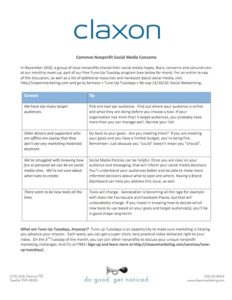
HANDOUT #1: Common Nonprofit Social Media Concerns

HANDOUT #2: Four Social Media Tools for Nonprofits

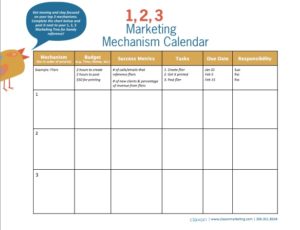
HANDOUT #3: The 123 Marketing Mechanism Calendar

Did you attend the conference?

What did you learn? Share your a-ha moments below!

Wonderful doesn’t cut it

Unique means “the only one of its kind”.  Not just wonderful, but one of a kind.

What makes your organization the only one of its kind?

Many organizations share a ‘why’, i.e. you are probably not alone in believing all children deserve access to quality education or that animals should be treated humanely or that we should protect our planet for future generations.

You would likely find yourself filed with at least a few other orgs under the same mental file folder, e.g. elementary school math, climate change advocacy, microfinance in Latin America, etc.

Your why is critically important. (It’s why the Messaging Roadmap starts at the Belief Proposition.) But it isn’t necessarily unique or compelling.

However, what and how you are going about solving your why should be unique and compelling. (Otherwise you wouldn’t have created an org to do it, right?)

Look at your lists from last week on competition. What makes you different? What sets you apart? What is it about your organization that would make a busy, busy person take the time to learn more?

This will help you answer the question we all ask when deciding whether to engage: “Why you?”

“Because we’re wonderful,” isn’t a compelling enough answer.

This Week’s To-Do

Go ask your donors, volunteers, members, donors, and fans why they decided to engaged with your organization. (To the extent possible, write down what they say verbatim. This will be handy when you write your top-level message.)

Next Week

Your Engagement Proposition (and, no, it doesn’t involve rings or getting down on one knee!)

Nonprofit Messaging Bootcamp

This is week #4 of our Nonprofit Messaging Bootcamp. If you’re just joining the Bootcamp, here’s what you need to do to get started: 1. Download the Messaging Roadmap, 2. Sign up for our free Tune-Up Tuesday videos, and 3. Complete messaging to-do’s outlined for you each week on our blog. Get caught up by reading posts from Week #1, Week #2, and Week #3!

January Tune-Up Tuesday Re-cap: The Nonprofit Messaging Roadmap


In January, we held our monthly Tune-Up Tuesday meet-up at The Hearing, Speech and Deafness Center in Seattle where we reviewed the Messaging Roadmap and discussed how to relate it to participants’ organizations. Below is a re-cap of our lively discussion.

(Note: This month we also presented at AFP Washington’s Martini Mondays where we discussed the Top 5 Nonprofit Messaging No No’s. This re-cap includes some questions and concerns about nonprofit messaging that came out of that presentation as well.)
  

Common Questions and Concerns about Nonprofit Messaging


What is the basic difference between a tagline and an elevator pitch?


A tagline is read not said.

An elevator pitch is said.

What is the difference between how we’d write a mission statement and how we’d write top-level messaging?


Most mission statements (but not all!) speak to the what and the how. Top-level messaging relates to the why and speaks to the hearts of your audience.

Note: There is great value in the process of creating mission and vision statements internally. To develop great messaging, you need to go one step further. Take the work that goes into creating your mission and value and make it compelling.

When we try to do messaging, it gets picked apart and everyone has a word to add.

That’s why we discourage messaging by committee! Messaging is about what your target audiences want/need to hear, not what internal stakeholders want them to know. This is a tricky, and important, distinction to make.

How do we convince our board to see the value of marketing and messaging work in particular?

First of all, don’t use the word Marketing. Marketing and Fundraising are part of an engagement continuum. Marketing is critical to any organization that wants to engage new supporters and retain current ones.

Even within our Fundraising Department, we say different things. How do we get on the same page?

Many organizations have departments that work in silos. If you are in Fundraising you may find that your major gifts team isn’t on the same page as your general fundraising team, for example. Getting people to the point where it’s about the audience perspective is key. Start by writing a job description for your fundraising team (see this post for more on this idea) – including the role of your major gift officers – showing how everyone has a piece in accomplishing your goals. Remember: Your audience doesn’t care about your silos; they care about how they can support what you’re doing.

How do we get our messaging shorter and more impactful?

  • Often we have the tendency to speak to the what. We lead with what we do instead of leading with what we believe. If you are in Microfinance you could lead with “We believe poverty can be eradicated. Microfinance is a powerful tool that can help us do that.”
  • Ask your supporters what resonates with them using surveys or focus groups…or just pick up the phone and do a quick, informal check-in! Asking those further away from the day to day work will often speak to the why of what you do. (Plus, it’s a great cultivation tool!)
  • Be careful not to pack your everything into your messaging. Often, board and staff are nervous about leaving something off. It feels really uncomfortable to not talk about everything.

Our current messaging is just not resonating. What should we do?

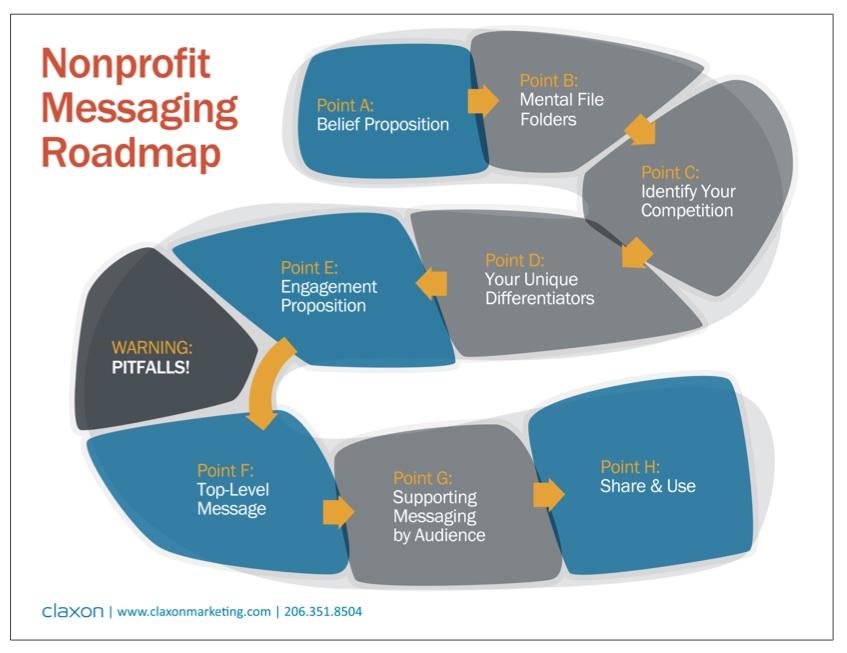
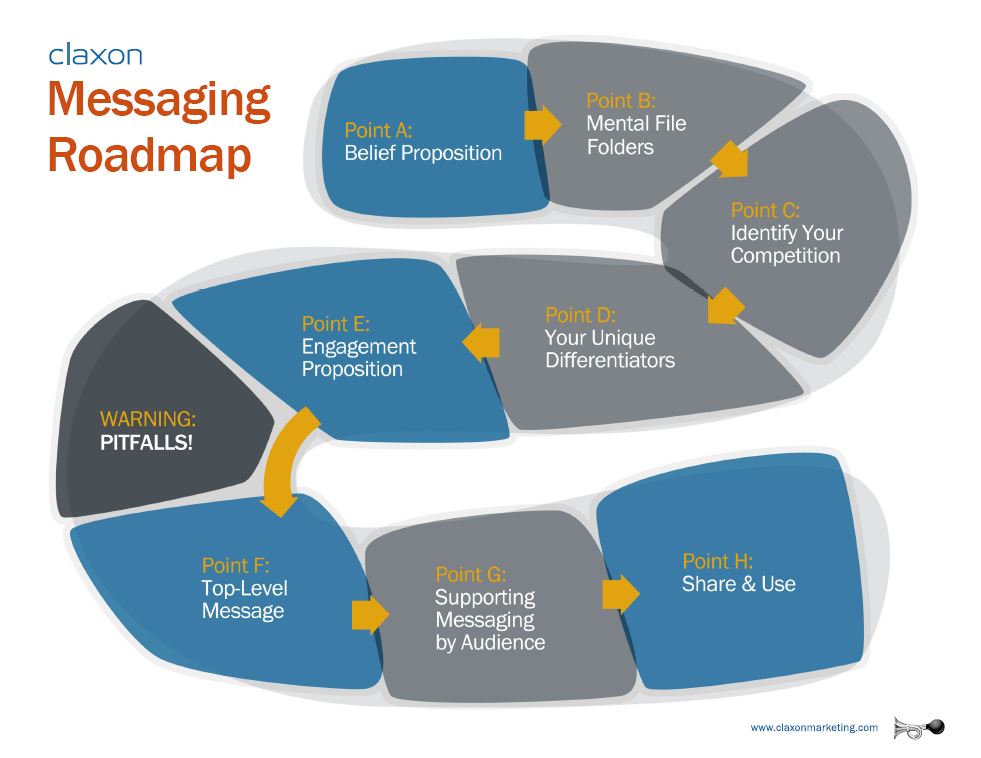
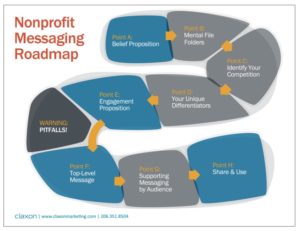
First, start by going back to the why (Point A on the Messaging Roadmap). You need everyone in your organization to come to an agreement on an answer to the following questions: Why do we exist? What would be different in our community if we didn’t exist?

How do you talk without jargon?

Every year, Lake Superior State University publishes its Banished Words list—make sure to avoid these! In the end, speaking to your audience’s heart is the key. Turn statistics into stories. For example, if you’ve been around since 1850, how many generations have you helped?

Handouts

  1. Messaging Roadmap
  2. Messaging Framework

Nonprofit Messaging Resources

  1. Watch AFP Washingon’s Martini Mondays Nonprofit Messaging No No’s.
  2. Subscribe to Nancy Schwartz’s Getting Attention Blog.
  3. Participate in Claxon’s 9-Week Nonprofit Messaging Bootcamp! (Here’s how to get started: 1. Sign-up for Tune-Up Tuesdays Video Series, 2. Read our blog starting with Week #1 of the Bootcamp and 3. Sign-up for next month’s Tune-Up Tuesdays Meet-up in Seattle.)

Competition is not a dirty word!

Bootcamp Week #3: Identifying Your Competition (watch this week’s vid)

Although some will say the hokey pokey is what it’s all about, when it comes to getting people to engage with your organization, standing out is what’s it’s all about.

And you can only stand out if you know what you’re standing out from, right?

There are the obvious sources of competition: other nonprofits doing work similar to yours. However, in the early stages of engagement when you are simply trying to get the attention of people who care about your cause, your biggest source of competition isn’t other organizations–it’s the busy-ness of life.

Think about the factors that demand potential supporters’ attention: commuting, kids, grocery shopping, work, soccer games, fixing the faucet…it’s a long list.  How does what you want them to do fit with what they have to do?

Remember that supporters take notice when you speak to their hearts not their heads, so don’t get caught up in numbers and data at this point. You can get to that when they say “Tell me more!”

This Week’s Messaging To-Do’s

  1. Make a list of your obvious sources of competition and what makes them compelling.
  2. Make a list of less obvious sources of competition, e.g. busyness of life, apathy, fear, etc.

Next Week:

We’ll tackle unique differentiators and what makes your organization compelling…

Nonprofit Messaging Bootcamp

This is week #3 of our Nonprofit Messaging Bootcamp. If you’re just joining the Bootcamp, here’s what you need to do to get started: 1. Download the Messaging Roadmap, 2. Sign up for our free Tune-Up Tuesday videos, and 3. Complete messaging to-do’s outlined for you each week on our blog. Get caught up by reading posts from Week #1 and Week #2!

Mental File Folders

Bootcamp Week #2: If you’re just joining the Bootcamp, here’s what you need to do to get started: 1. Messaging Roadmap, 2. Sign up for our free Tune-Up Tuesday videos, and 3. Complete messaging to-do’s outlined for you each week on our blog. (Go back and do last week’s to get caught up!)
Point B: Mental File Folders (watch the vid)

Last week, you figured out your Belief Proposition. You identified why your organization exists and what would be different in your community if it didn’t exist.

This week, you need to pick your mental file folder. Many organizations fall into the trap of reciting everything they do right out of the gate. When you tell people your everything, they remember nothing. Bummer. That’s why the goal is to whittle it down to the one thing that you do that represents the essence of your organization. This is what fuels word-of-mouth marketing. Why? Because you are making it easy for people to refer others to you. Why? Because they only have to remember one thing about you–and that one thing is the most compelling, authentic thing. So, in the end, it all works out. It just feels scary at first.

(If you don’t believe me on this, listen to Seth Godin. He’s really, super smart.)

If you’re still feeling like you can’t possibly distill what you do down to one thing (or at most two), read this post about Treehouse. If they can do it, you can do it.

This Week’s Messaging To-Do’s

Write down answers to the following two questions:

  1. What would be the “tab” on the mental file folder you want people to associate with your organization?
  2. What do you do? (Not everything–just your main thing.)

Next Week

Identify your competition. (Hint: You have more of it than you might think!)

Need Some In-Person Help? Come to our Tune-Up Tuesday monthly meet-up in Seattle.  Learn more and register here.


Get your messaging booty in shape!

To get your nonprofit’s messaging booty in shape in short order, we are launching a 9-week DIY Nonprofit Messaging Bootcamp. To join in the fun, Messaging Roadmap, sign up for our free Tune-up Tuesday videos, and complete messaging to-do’s outlined for each week on our blog.


Week #1

Point A: Your Belief Proposition

Watch the first episode of Tune-Up Tuesdays to learn why having a clearly articulated ‘Belief Proposition’ is so important to connecting with people who care about your cause. Also, review this previous post about how the United Negro College Fund articulated their Belief Proposition.

This Week’s Messaging To-Do’s


Write down answers to the following questions:

  1. What would be different in your community if your organization didn’t exist?
  2. Why does your organization exist?

Next week

Learn about Mental File Folders.

Need Some In-Person Help?

Sign up for a coaching session.

Inspirational Messaging: InvestED

This week’s bit of messaging inspiration comes to us from InvestED, a Seattle-based nonprofit that understands seemingly small hurdles can be huge barriers to student success. Formerly The Saul and Dayee G. Haas Foundation, InvestED’s message is specific and focused: Get immediate help for students in need.

Because sometimes a pair of sneakers is what it takes to graduate, InvestED encourages secondary school students to stay in school, return to school or get involved in their learning community by providing funding to schools for a range of items including school supplies, appropriate clothing, and activity or course fees.

Is there more to InvestED’s story than this? You bet. But, when it comes to their messaging, they make it easy to understand what they do, how they do it and–most importantly–why they do it. It’s inspirational in its simplicity.

Watch Naomi explain the importance of that pair of sneakers and the impact they made in Naomi’s life.

Do you communicate as effectively as you think?

X

Do you communicate as effectively as you think?

X